Bishkek Food Tour: What It’s Really Like (And What to Expect)
You don’t really “arrive” at a Bishkek food tour. It doesn’t start with a table, or a menu, or some carefully staged tasting lineup. It starts with movement — crossing streets that feel too wide, cutting through parks that don’t quite signal anything yet, and then suddenly… density. Noise stacking on noise. Smells that don’t separate cleanly. People moving like they already know where everything is.
That shift — from open city to compressed market — is the actual core of the experience. Not the food. Not the guide. Not even the tasting stops.
Most tours won’t tell you that upfront. They’re sold as “food experiences,” sometimes even “culinary journeys.” Sounds like you’ll be sitting, tasting, comparing dishes. That’s not really what happens here.
A Bishkek food tour is, at its core, guided access into Osh Bazaar. The food comes with it — but it’s not the structure. The market is.
Most travelers searching for a Bishkek food tour are actually looking for a way to experience Osh Bazaar without getting lost — and that’s exactly what these tours are built around.
What a Bishkek Food Tour Actually Is (And What It Isn’t)
There’s a gap between what these tours look like online and what they feel like in reality. Listings show plates, smiles, curated stops. In practice, it’s more fluid — and sometimes a bit rough around the edges.
The easiest way to understand it is to break it down:
- Market (Osh Bazaar) — the core environment, where most of the time is spent
- Food tastings — short, scattered, often standing or informal
- City context — walking or short transfers, usually at the beginning
Every tour is just a different balance of those three elements.
Some lean heavily into the market — you spend most of your time inside, moving between sections, trying small things along the way. Others dilute it with city walking, history, or even restaurant stops that feel more structured.
That’s where expectations usually break.
If you’re imagining something like a European food tour — multiple seated tastings, clear progression, maybe wine or curated dishes — that’s not the model here. Bishkek doesn’t really work like that.
If a tour description talks more about “culture,” “history,” or “walking experience” than actual food stops — it’s not a food-first tour. It’s a city tour with snacks added in.
The strongest all-round choice if you want a reliable first food experience in Bishkek: market tastings, a substantial local meal, city landmarks and hotel pickup without making Osh Bazaar the entire tour.
How a 4-Hour Bishkek Food Tour Actually Works
On paper, four hours sounds like enough. In reality, it’s tight. You’re fitting a city, a market, and food into a short window — something has to give.
Most tours follow roughly the same flow, even if they’re described differently.
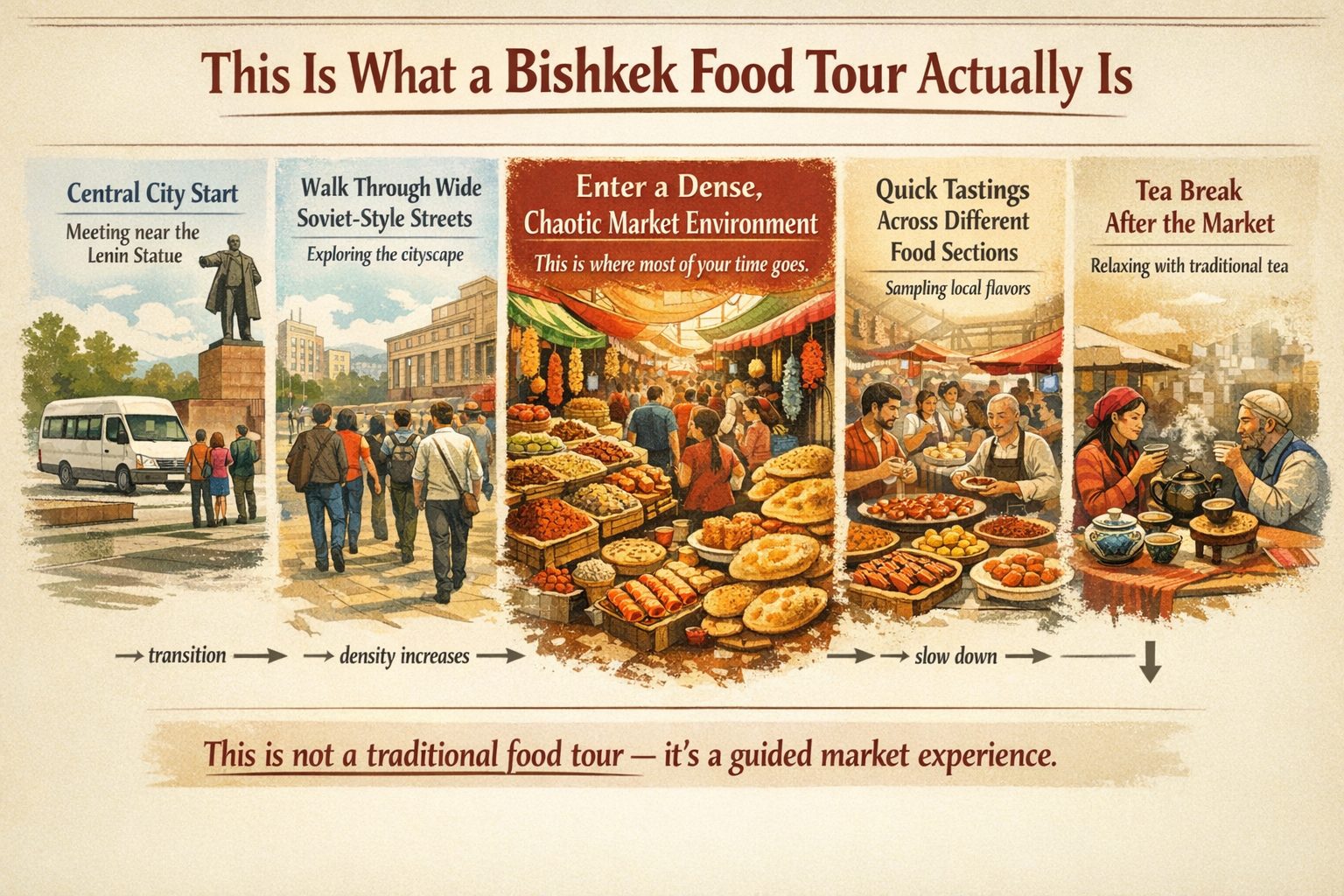
1. Meeting Point and First Movement
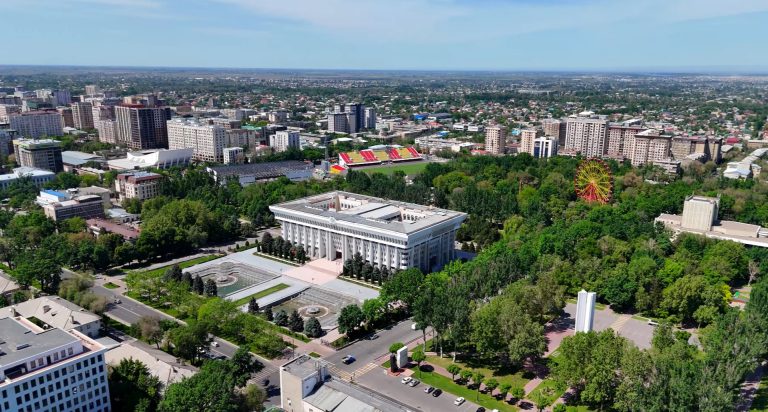
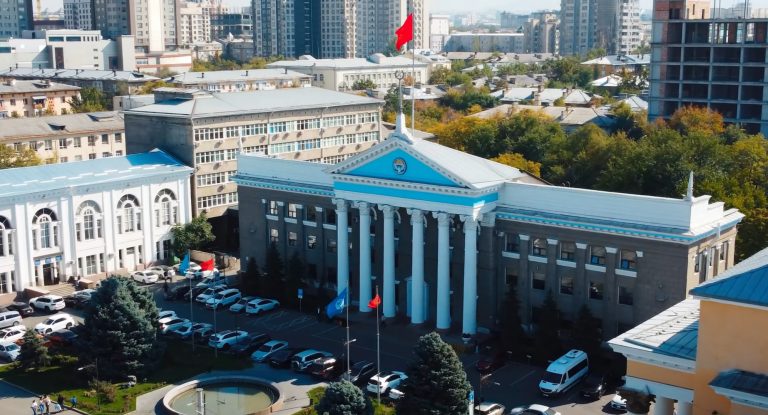
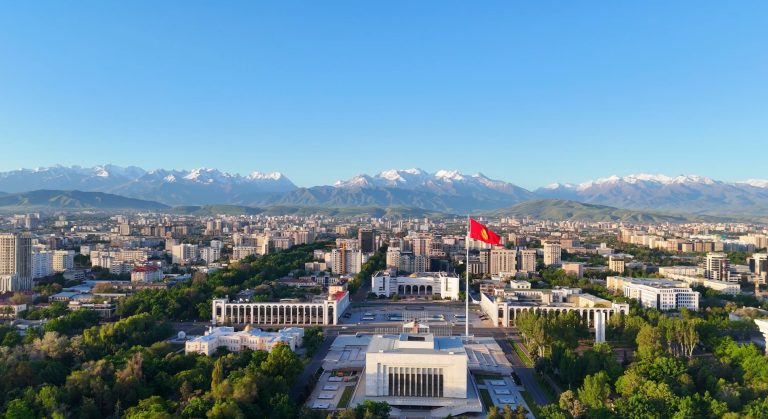
You usually meet somewhere central — often near Ala-Too Square, or get picked up from your hotel if it’s a private tour. From there, the route typically moves through wide Soviet-era boulevards before tightening toward the market area.
The beginning feels slow. Wide streets, trees, not much density. Bishkek doesn’t immediately signal where the “experience” is. That’s part of why the transition later hits harder.
There might be some explanation here — Soviet layout, city structure, a bit of context — but it’s usually brief.
2. Moving Toward the Market
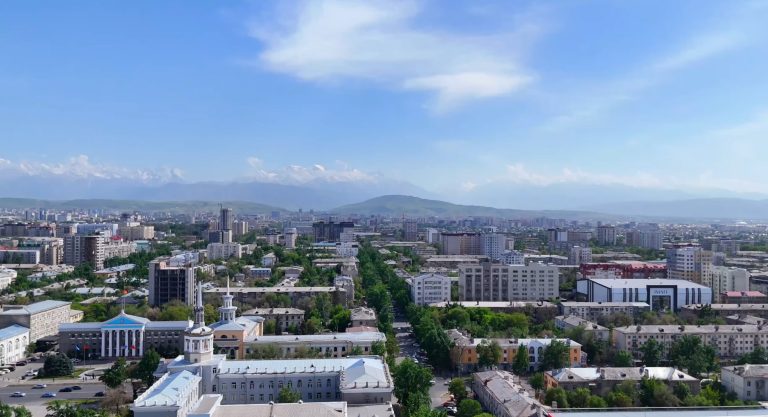
Depending on the route, you may pass through parts of central Bishkek before heading west toward Osh Bazaar — one of the city’s busiest commercial zones.
Then things shift.
You either walk or take a short ride. Traffic thickens, sidewalks get busier, storefronts become less defined. And then, without a clear entrance, you’re inside.
Osh Bazaar doesn’t announce itself. It just starts happening around you.
3. Inside Osh Bazaar (The Core Experience)
This is where most of the tour actually unfolds.
You’re not moving between “attractions.” You’re moving between zones:
- bread sections with stacked lepyoshka
- dry fruit and nut corridors
- spice areas where everything shifts in color
- meat sections — more intense, sometimes skipped for tastings
The guide isn’t just showing you places — they’re filtering. What’s safe to try, what’s worth it, what to ignore.
And this matters more than people expect.
Because without that filter, the market can feel overwhelming fast. Too many choices, no clear logic, no obvious starting point.
4. Food Stops Inside the Market
This is where the “food tour” part technically happens — but not in the way most people expect.
You don’t sit down for a structured tasting. You stop, try something, move. Then repeat.
- fresh bread — still warm, often torn and shared
- dried fruits and nuts — quick tastings while standing
- samsa — one of the few hot, filling items
- sometimes drinks like tea or local fermented options
The rhythm matters more than the individual dishes. It’s not about depth on one item — it’s about moving through different layers of the market without getting lost in it.
Some tours add one heavier stop — lagman or a meat dish — but not always. And even when they do, it’s usually quick.
If you expect a full meal, you’ll feel underfed. If you treat it as a tasting path through a functioning market, it starts to make sense.
5. Final Stop (Tea or Café)
Most tours end outside the chaos.
After the market, guides usually take you to a calmer place — a чайхана or small café. This is where things slow down a bit. You sit, have tea, maybe a dessert or one last dish.
It’s less about food at this point and more about decompression. You’ve already seen the main system — this just gives it a soft landing.
And then it’s over. Four hours go fast.
Types of Bishkek Food Tours (And Why They Feel Completely Different)
On platforms like Viator or GetYourGuide, most tours look similar. Same duration. Same keywords. Same promises.
In reality, they’re not the same product at all.
The difference comes down to what the tour prioritizes — and what it quietly reduces.
1. Bazaar-Focused Tours (Closest to the Real Experience)
These tours are built around Osh Bazaar. Everything else is secondary.
- 70%+ of the time inside the market
- multiple short tastings across different zones
- minimal city walking
You don’t get a polished experience. You get access — and that’s the value.
The guide acts more like a filter than a storyteller. Less talking, more navigating.
What works
- feels authentic and grounded
- best exposure to real local food flow
- more dynamic and unpredictable
What to watch
- can feel chaotic if you expect structure
- not always filling as a meal
- less historical context
2. Hybrid Tours (Most Common Format)
This is what most people end up booking — a balance between market, food, and city.
- Osh Bazaar + 1–2 additional stops
- some walking through central Bishkek
- a mix of tastings and short explanations
It’s designed to be accessible. Nothing too intense, nothing too confusing.
But that balance comes with trade-offs.
What works
- easy to follow, no overwhelm
- good introduction to the city
- more comfortable pacing
What to watch
- less depth inside the market
- fewer tastings than expected
- can feel diluted
3. Restaurant-Based Tours (Not Really Market Tours)
These are often marketed as premium or “full food experiences.”
- multiple seated stops
- more dishes, more volume
- limited or no time in Osh Bazaar
On paper, they look stronger — more food, more comfort. But they shift away from what makes Bishkek interesting in the first place.
What works
- you actually eat full portions
- comfortable and predictable
- better for slower travel pace
What to watch
- misses the market completely
- feels generic compared to the city
- not what most people expect from Bishkek
Quick Comparison: Which Tour Type Fits You
| Tour Type | Main Focus | Food Amount | Market Time | Best For |
|---|---|---|---|---|
| Bazaar-focused | Osh Bazaar | Medium | High | First-time visitors who want real experience |
| Hybrid | Mix of city + food | Medium | Medium | Balanced introduction to Bishkek |
| Restaurant-based | Food / dining | High | Low | Comfort-focused travelers |
Most people don’t choose between tours — they choose between these formats without realizing it.
And that’s why expectations often don’t match the experience.
Real Bishkek Food Tours (What You Actually Get)
Once you start comparing actual tours, something becomes obvious fast — many of them are built on the same structure, just described differently.
Same duration. Same keywords. Slightly different promises.
What really changes is how much of each element you get: market, food, or city.
Below is a breakdown of real tours you’ll see on platforms like Viator and GetYourGuide — stripped down to what they actually deliver.
1. Classic 4-Hour Private Food Tour
This is the most common version — often positioned as a “complete experience.”
- duration: ~4–5 hours
- format: private or small group
- price: mid-range
At first glance, it looks like a full food-focused experience. In practice, it’s more mixed.
You usually get:
- a short city introduction
- time inside Osh Bazaar
- 2–4 tasting stops
- one more structured food stop at the end
What works
- balanced and easy to follow
- good first-day orientation
- includes both market and food
What to watch
- less food than expected
- market time is limited
- can feel more like a city tour
This is the safest option — but not the deepest one.
2. Osh Bazaar-Focused Food Tour
Same duration, same structure — but the emphasis shifts almost entirely to the market.
- most of the time inside Osh Bazaar
- minimal city walking
- tastings spread across different sections
This is where the experience starts to feel more raw — less curated, more reactive.
Instead of moving between “stops,” you move through layers of the market itself.
What works
- strongest sense of place
- more authentic flow
- better use of time
What to watch
- less structure
- fewer explanations
- still not a full meal
If you’re choosing based on experience rather than comfort — this is usually the better pick.
Prefer to keep the focus on Osh Bazaar?
This shorter food experience is more closely aligned with the market-first version described above. The route centres on Osh Bazaar, local products, traditional flavours and the parts of the market that are difficult to understand on a first independent visit.
It is a better fit if you care more about navigating the bazaar and trying food in context than seeing Bishkek’s main squares and monuments.
The trade-off: The experience is shorter and less established than the main private tour. Expect an informal market visit rather than a polished sequence of seated tastings.
The clearest market-first option: a private two-hour walk through Osh Bazaar with local snacks and guidance. It is shorter and less polished than the balanced tour, and the current booking is non-refundable.
3. Short 3-Hour Walking Food Tour
This version looks similar but cuts time — and that changes everything.
- shorter duration (around 3 hours)
- mostly walking
- limited number of stops
The problem isn’t the format — it’s the compression.
You can’t fully explore the market and have meaningful food stops in that time. Something gets reduced.
What works
- lower price
- easy introduction
- less tiring
What to watch
- very surface-level
- rushed experience
- limited food variety
This works if you just want a quick overview — not if you want depth.
4. “Eat Like a Local” / Cultural Walking Tours
These are often marketed with strong storytelling — culture, lifestyle, daily life.
- mix of walking + food
- focus on explanation
- market included, but not dominant
They feel more guided, more structured. But the focus shifts away from food.
What works
- good context and storytelling
- comfortable pace
- less overwhelming
What to watch
- food becomes secondary
- fewer tastings
- less time in Osh Bazaar
If your goal is to understand the city — this works. If your goal is food — not really.
5. City Tour + Bazaar + Snacks
This one is easy to misread.
It’s often presented as a food tour, but the structure is completely different.
- multiple city stops (squares, parks, monuments)
- Osh Bazaar at the end
- very limited food sampling
The market becomes just one stop among many.
What works
- solid city overview
- good for first-time visitors
- structured and predictable
What to watch
- barely a food tour
- very limited tastings
- market feels rushed
This is where expectations break the most.
6. Premium Food Experience (Restaurant-Based)
These are positioned as high-end — more dishes, more comfort, higher price.
- multiple seated stops
- larger portions
- minimal or no market time
It’s a different product entirely — closer to a dining tour than a market experience.
What works
- you actually eat full meals
- more relaxed pace
- predictable experience
What to watch
- misses Osh Bazaar
- feels disconnected from the city
- higher price without unique value
If you came to Bishkek for the market — this won’t deliver it.
This is not a market tour. Choose it when conversation, a home-cooked Kyrgyz meal and a hands-on family experience matter more than walking through Osh Bazaar.
7. Low-Cost Local Market Tours
These are usually run by independent guides or smaller operators.
- lower price
- simple structure
- heavy focus on Osh Bazaar
They can feel more direct — less polished, but sometimes more real.
What works
- strong market focus
- good value for money
- less scripted
What to watch
- quality varies a lot
- less organization
- limited support or structure
Sometimes these end up being the best experiences — sometimes not. It depends entirely on the guide.
What Most Listings Don’t Tell You
Across all these tours, a few patterns repeat — and they’re rarely mentioned clearly.
- “Private” doesn’t always mean fully private — small groups are sometimes combined
- Number of tastings is rarely specified — and often lower than expected
- Market depth varies a lot — some tours stay on the surface
- Time disappears quickly — four hours is tighter than it sounds
Once you see these patterns, the listings start to make more sense.
And you stop choosing based on titles — and start choosing based on structure.
What You Actually Eat on a Bishkek Food Tour
This is where expectations and reality drift the most.
A lot of people imagine a sequence of dishes — something structured, maybe even filling enough to replace a meal.
That’s not how it usually works.
Food here is scattered. Light. Sometimes improvised. You’re not sitting down to eat — you’re moving through a system where food happens along the way.
Typical Tastings You’ll Get
- Lepyoshka (bread) — often the first thing you try, fresh and warm
- Dried fruits and nuts — quick tastings inside the bazaar
- Samsa — one of the few filling items, baked and portable
- Local sweets — halva or simple sugar-based snacks
- Tea — usually at the end
Some tours add one more substantial dish — lagman, plov, or a meat-based plate — but that’s not guaranteed.
What You Probably Won’t Get
- a full multi-course meal
- clear progression between dishes
- long seated dining experiences
- premium or “refined” presentations
Even on higher-priced tours, the format doesn’t completely change — it just becomes more comfortable, not necessarily more substantial.
Eat lightly before the tour — but don’t expect it to fully replace a proper meal. Think of it as layered tasting, not dining.
Pricing Reality: What You’re Actually Paying For
Prices for Bishkek food tours can vary a lot — and not always for obvious reasons.
At first glance, it looks like you’re paying for food. In reality, that’s only part of it.
Typical Price Range
- Budget tours: €25–40
- Mid-range tours: €50–80
- Premium tours: €90–200+
The difference isn’t just in what you eat.
What Drives the Price
- Private vs group — private tours increase cost significantly
- Guide quality — language, experience, pacing
- Comfort level — transport, café stops, structure
- Number of stops — but this is often unclear
Here’s the part that surprises most people:
More expensive doesn’t always mean more food.
A €60 tour might include multiple tastings inside the market, while a €100 tour might shift focus toward explanation, comfort, or city context instead.
| Price Level | What You Usually Get | Main Trade-Off |
|---|---|---|
| Budget (€25–40) | simple market experience, fewer stops | less structure, variable quality |
| Mid-range (€50–80) | balanced tour with market + tastings | limited depth in each part |
| Premium (€90+) | more comfort, sometimes restaurant stops | less focus on Osh Bazaar |
Based on current listings, most 4-hour tours in Bishkek include between 3 and 5 tasting stops. This typically covers bread, snacks inside Osh Bazaar, and one additional dish or tea stop.
Private tours in the €60–80 range usually include:
- market tastings (2–3 stops)
- one hot dish or café stop
- basic transport or walking
Once you understand that, pricing starts to make more sense — you’re choosing a format, not just a food quantity.
Why 4 Hours Is Both Enough — And Not Enough
Most tours cluster around the same duration: four hours.
It sounds reasonable. But when you break it down, it gets tight fast.
- 30–45 min — meeting + movement
- 2–2.5 hours — Osh Bazaar
- 30–60 min — final stop or café
There’s not much room for depth.
If the tour adds more city walking, something else shrinks — usually time inside the market. If it adds a longer meal, the movement through the bazaar becomes more limited.
That’s why different tours feel so different, even with the same duration.
They’re making trade-offs — just not always visible in the description.
What Makes a Tour Feel “Good” (And What Breaks It)
By this point, the pattern is clear — it’s not about the number of dishes or the price.
It’s about how the time is used.
What Actually Works
- enough time inside Osh Bazaar to move beyond the main paths
- multiple small tastings instead of one big stop
- guide acting as a filter, not just a narrator
- clear flow from movement → market → food
What Usually Breaks the Experience
- too much city walking before reaching the market
- only 2–3 tasting stops
- rushed movement through Osh Bazaar
- over-explanation without real interaction
When a tour gets this balance right, it feels natural — like you’re moving through something that already exists.
When it doesn’t, it feels staged.
How to Choose the Right Bishkek Food Tour
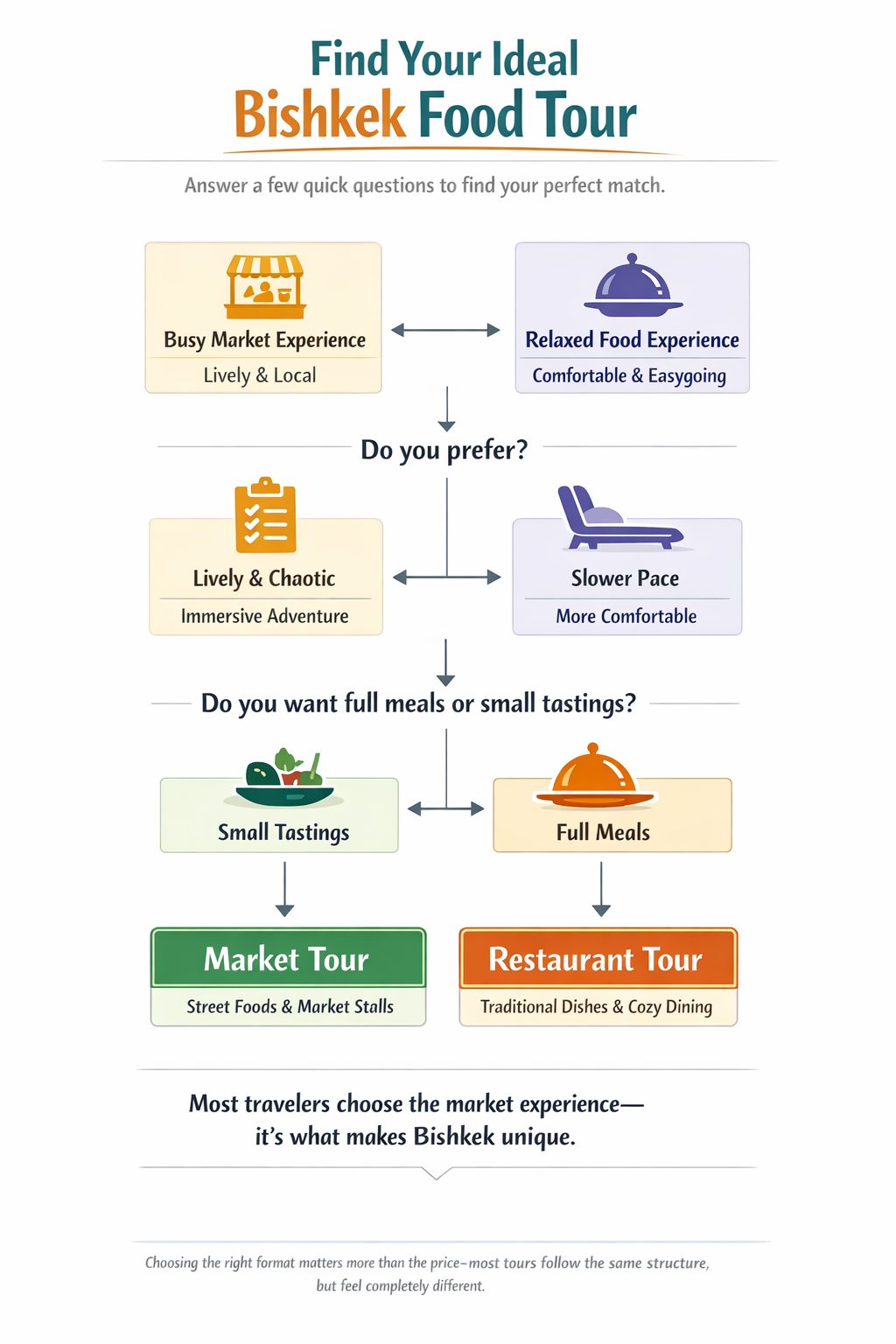
By now, the pattern is clear — you’re not choosing between “better” or “worse” tours.
You’re choosing between different structures.
And once you see that, the decision becomes much easier.
1. Start With the Core Question
What do you actually want more of?
- Osh Bazaar experience → go for market-focused tours
- Balanced introduction → choose hybrid tours
- Comfort and full meals → restaurant-based tours
Most people think they want “food.” What they actually want is access — and that usually means the market.
2. Check How Much Time Is Spent in Osh Bazaar
This is the single most important factor — and it’s rarely stated clearly.
Look for signals:
- is the market described as the main highlight?
- are there multiple tastings inside it?
- or is it just one stop among others?
If Osh Bazaar is not the core — the experience changes completely.
If the itinerary lists more than 2–3 city stops before the market, expect less time where it actually matters.
3. Look Beyond “Private” and “Premium” Labels
These labels don’t always mean what they suggest.
- Private — sometimes still small shared groups
- Premium — often just more comfortable, not more immersive
Focus on structure, not wording.
4. Count the Stops (If You Can)
Good tours usually include:
- 4–5 tasting moments minimum
- a mix of quick bites and one more substantial stop
If the description is vague — it usually means fewer stops.
5. Check the Flow, Not Just the Highlights
A strong tour has a clear progression:
- easy start → movement → market → tastings → finish
If it feels scattered in the description, it will feel scattered in reality.
Real Limitations to Be Aware Of
- not all food is explained — some tastings happen quickly
- language barriers can still exist even on guided tours
- hygiene standards vary inside the market
- vegetarian options are limited
Best Choice for Most Travelers
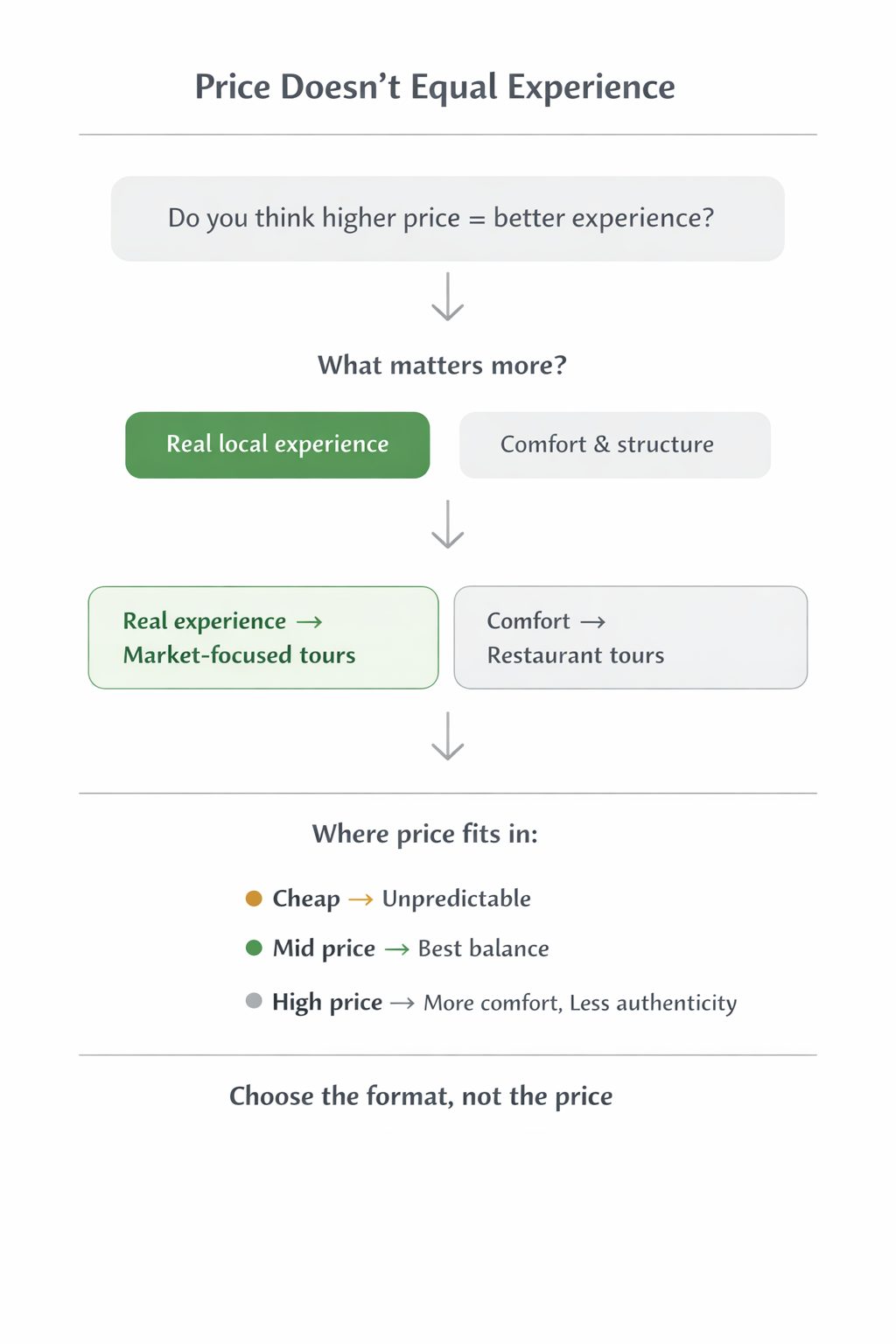
The safest all-round booking on this page: strong review history, hotel pickup, market time, several food stops and a broader Bishkek introduction. Choose the dedicated bazaar tour instead if market depth matters more than balance.
When a Different Tour Might Be Better
Not everyone is looking for the same thing — and that’s where other formats make sense.
If You Prefer a Slower, More Structured Experience
Go for hybrid or restaurant-based tours.
- more sitting, less movement
- clearer explanations
- less intensity inside the market
You’ll lose some of the raw experience — but gain comfort.
Prefer more sitting and a clearer food sequence?
This three-hour small-group experience is closer to a cultural meal and walking tour than an intensive market visit. It combines traditional dishes in a yurt-style restaurant with a short central-city walk, another food stop, dessert and tea.
Choose it if you want local food and conversation without spending most of the experience moving through the crowded sections of Osh Bazaar.
The trade-off: You gain comfort and a clearer structure, but lose much of the market atmosphere that defines the more distinctive Bishkek food tours.
A three-hour food-first alternative built around three local food locations, dessert and tea, with a short central Bishkek walk. It is more structured and comfortable, but it does not deliver the Osh Bazaar experience.
If You’re Short on Time
Shorter tours can still work — just adjust expectations.
They won’t go deep, but they can give you a quick sense of how the city and market function.
A small-group hands-on class where you make lagman from scratch and eat the finished meal. It is a cooking experience, not a Bishkek food tour, but it is a strong short alternative for food-focused travelers.
If You’re Traveling Solo and Want Flexibility
Lower-cost or local tours can be a good option.
Less polished, but sometimes more direct. Just be ready for variability.
Choose market-focused tours if you want:
- real exposure to Osh Bazaar
- dynamic, unscripted experience
- strong sense of place
Choose alternative formats if you prefer:
- comfort and slower pacing
- clear structure and explanations
- less intensity and movement
Once you match the format to your expectations, the experience starts to make sense — and stops feeling confusing.
FAQ: Bishkek Food Tours Explained
Is a Bishkek food tour worth it?
Yes — but not for the reason most people expect. You’re not just paying for food. You’re paying for access to Osh Bazaar in a way that actually makes sense. Without a guide, the market can feel overwhelming and hard to navigate.
Do these tours replace a full meal?
Usually no. You’ll try multiple things, but portions are small and spread out. Some tours include one more filling dish, but overall it’s better to think of it as tasting rather than dining.
Is Osh Bazaar safe to visit?
Yes, generally it’s safe — especially during the day. The main challenge isn’t safety, it’s navigation. The market is dense and unstructured, which is why guided tours can be helpful for first-time visitors.
What’s the best time for a food tour in Bishkek?
Late morning to early afternoon works best. The market is fully active, food is fresh, and the pace feels natural. Early mornings can be quieter, while late afternoons start to slow down.
Should I choose a private or group tour?
Private tours offer more flexibility and pacing, but the core experience stays similar. If the structure is weak, a private format won’t fix it — so focus on the itinerary first.
Can I explore Osh Bazaar without a tour?
Yes — but the experience will be very different. Without context, it can feel chaotic and hard to read. A tour doesn’t just show you places, it helps you understand how the market actually works.
Final: What This Experience Really Is
A Bishkek food tour isn’t really about food.
That sounds strange at first — but once you’ve seen how these tours work, it starts to click.
The food is there, of course. You’ll taste things, try local flavors, maybe find something unexpected. But that’s not the structure holding the experience together.
The structure is Osh Bazaar.
Everything else — the tastings, the movement, the pacing — builds around it.
And that’s why tours here feel different from what many travelers expect. They’re less about sitting and more about navigating. Less about dishes and more about systems.
If you approach it that way, the experience works.
If you expect a structured, food-first tour — it might feel incomplete.
This experience works best for a very specific type of traveler — and less so for others.
So, Should You Take One?
- Best for: first-time visitors who want help navigating Osh Bazaar
- Good for: travelers interested in local food culture, not just dishes
- Not ideal for: those expecting a structured, restaurant-style food tour
- Skip if: you prefer slow dining and full meals over movement
Once expectations match the format, the experience becomes much clearer.
What to Do Next
If you’re planning to explore Bishkek beyond the food tour, it helps to understand how the city connects together.
- how walking routes link the main areas
- how the Soviet grid shapes movement
- how markets fit into the overall structure
That’s where the rest of the city starts to open up.
Because the food tour isn’t really the destination — it’s the entry point.