Kyrgyzstan Travel Costs: 2026 Budget Guide
Quick Answer: Is Kyrgyzstan Expensive to Travel?
Kyrgyzstan is still an affordable country to travel in, especially if you use guesthouses, marshrutkas, shared taxis and local cafes. A realistic budget starts around $35–$50 per day for backpackers and around $85–$130 per day for independent mid-range travelers.
Kyrgyzstan Travel Cost Calculator
Quick estimate tool — adjust travel style, transport and activities to see a realistic Kyrgyzstan trip budget.Kyrgyzstan Travel Cost (2026)
Set your style, transport, permits, activities — get daily + total + a copyable budget summary.
Trip basics
Baseline sets the vibe. Transport + permits + activities add the real-world cost.
Permits & admin
Tip: if you’re going into border areas, sort permits early and carry paper.
Transport
Activities
Results
Estimated total (per person)
$0
—
Estimated daily (per person)
$0
—
Estimate only. Prices vary by season, route, and how hard you go on 4x4s.
The important catch is that Kyrgyzstan is cheap for everyday travel, but not always cheap for remote adventure travel. Food, city transport and simple guesthouses are good value. Private drivers, 4×4 routes, horse trekking, border-zone permits and remote lakes can raise the total cost quickly.
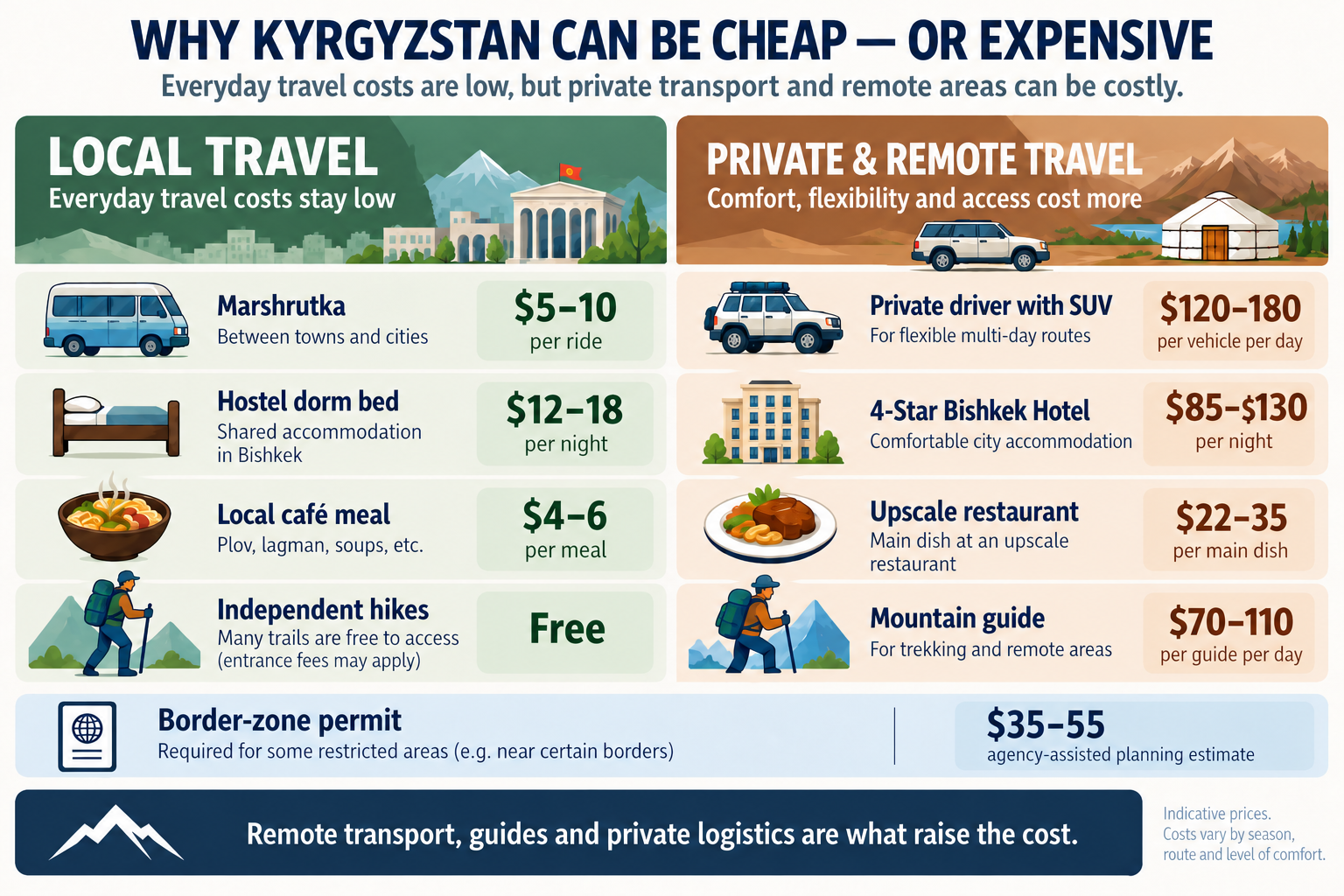
Budgeting here means navigating two parallel travel economies. The local side includes marshrutkas, bazaars, family guesthouses and simple city apartments. It remains inexpensive by international standards. The adventure side includes 4×4 transport, remote yurt camps, guides, horses and difficult mountain logistics, where prices are closer to international tourism rates.
This difference matters more than your hotel category. A traveler staying in comfortable rooms but following public transport routes may spend less than a backpacker arranging private access to Kel-Suu, Song-Kul or a remote trailhead.
Kyrgyzstan Travel Budget Per Day
| Travel Style | Daily Budget | What It Usually Includes |
|---|---|---|
| Backpacker | $35–$50 | Hostels, guesthouses, marshrutkas, shared taxis, local canteens and simple hikes. |
| Independent Mid-Range Traveler | $85–$130 | Private rooms, better meals, some private transfers, day trips and yurt stays. |
| Adventure / 4×4 Traveler | $150–$250+ | Remote lakes, private driver or self-drive SUV, border permits, horse trekking and guides. |
| Premium Explorer | $250–$450+ | High-end hotels, upgraded yurt camps, private guides, custom logistics and premium vehicles. |
These are planning ranges rather than fixed package prices. A city day in Bishkek may cost far less, while a day involving a private 4×4, a mountain guide or a remote yurt camp may exceed the average.
How Much Does a Kyrgyzstan Trip Cost?
For a short independent trip, Kyrgyzstan can still be very affordable. The final price depends less on food or hotels and more on how many remote places you include.
| Trip Length | Budget Traveler | Mid-Range Traveler | Adventure / Private Transport |
|---|---|---|---|
| 7 days | $250–$400 | $600–$900 | $1,000–$1,700+ |
| 10 days | $370–$500 | $850–$1,400 | $1,500–$2,500+ |
| 14 days | $550–$750 | $1,200–$2,000 | $2,200–$3,500+ |
International flights are not included. The adventure column assumes several days of private transport, guided activities or remote accommodation rather than a private vehicle every day.
Does Kyrgyzstan Cost More in Summer?
There is no single high-season surcharge for Kyrgyzstan. July and August are busy on Issyk-Kul, while the same summer window offers the widest choice of high-altitude yurt camps and mountain itineraries. A lower room rate outside peak season is not necessarily a cheaper trip if the road, camp or activity you wanted is unavailable.
| Travel Period | What Changes | Budget Implication |
|---|---|---|
| July–August | Strong demand at popular lake resorts; seasonal mountain camps operating. | Compare accommodation and transport in advance, especially around Issyk-Kul and Song-Kul. |
| June and September | Some mountain camps operate, but opening dates and pass conditions vary. | Confirm road access and overnight accommodation before choosing dates for a remote route. |
| October–May | Many high-altitude camps are closed, although some lower-altitude properties operate year-round. | A cheaper hotel cannot compensate for an inaccessible planned destination; build a suitable seasonal itinerary. |
As a practical example, Ak-Sai Travel lists its Son-Kul camp for June–September, while its Oimo-Tash camp near Issyk-Kul operates year-round. These are individual operators’ schedules, not fixed dates for every camp. For weather and route planning, see our best time to visit Kyrgyzstan guide.
Solo vs Couple vs Group: How Sharing a Driver Changes the Cost
Private transport is usually priced by vehicle rather than by passenger. The difference matters most on multi-day routes where a single traveler would otherwise cover the full car and driver bill.
For an illustration, RideKG advertises a Delica/UAZ 4×4 with a local driver for $150 per vehicle per day, with up to 10 hours and 250 km included. If the vehicle rate stays the same and everyone can travel together, the split looks like this:
| Travelers Sharing | Vehicle Cost Per Day | Cost Per Person |
|---|---|---|
| 1 | $150 | $150 |
| 2 | $150 | $75 |
| 4 | $150 | $37.50 |
This is a worked example, not a guaranteed four-person quote: confirm permitted seating, luggage space and the final vehicle price. Overtime, extra kilometres and the driver’s overnight expenses may increase the bill. Food, park entries and per-person activities do not automatically become cheaper in a group. For route-specific quotes, read our private driver cost guide.
When an Organized Tour Can Be Better Value
Public transport is normally the cheapest choice between major towns. Once the route includes mountain roads, several remote stops or an overnight yurt stay, the comparison becomes less straightforward.
| Travel Method | Usually Best For | Main Cost Issue |
|---|---|---|
| Marshrutkas and shared taxis | Solo travelers moving between Bishkek, Karakol, Kochkor and Osh | Cheap, but schedules and final connections can be inconvenient. |
| Self-drive car | Experienced drivers who want a flexible road trip | Rental, fuel, deposit, insurance restrictions and possible road damage. |
| Private driver | Couples, families and groups sharing the daily cost | More expensive for one person, but practical for flexible multi-stop routes. |
| Small-group or organized trip | Solo travelers visiting remote places | Fixed itinerary, but transport and some accommodation are shared. |
For example, a Song-Kul tour can be easier to price than arranging separate transport, a yurt and activities. The same logic applies to some Issyk-Kul routes and horse riding trips. Compare what is included rather than looking only at the headline price.
A useful remote-trip price comparison: A two-day small-group trip to Song-Kul bundles the long-distance transport, yurt accommodation and horse-riding activity into one price. For a solo traveler, this can be easier to budget than arranging a private vehicle and each service separately.
Hidden Costs of Traveling in Kyrgyzstan
The advertised daily price of a vehicle or mountain trip is not always the final amount you will pay. In Kyrgyzstan, the biggest surprises often come from rental contract restrictions, extra driving days and services that were not included in a remote overnight stay.
| Potential Extra Cost | What to Check Before Paying |
|---|---|
| Rental deposit and insurance excess | Ask how much is held, when it is refunded, what the insurance excludes and how much you could owe after damage. |
| Mileage and prohibited roads | Confirm the total mileage allowance and get written approval for the exact mountain roads on your route. |
| Driver overtime and overnight stays | Check daily hours, kilometre limits, fuel, waiting time, and whether the driver’s room and meals cost extra. |
| Yurt meals and facilities | Check whether the rate is per person or per whole yurt, and whether meals, heating, hot water and showers are included. |
| Last-mile transfers and permits | Budget for the connection from the main road to a remote lake or trailhead, plus any required border-zone permit assistance. |
| Travel insurance | Verify cover for your planned trekking altitude, activities, emergency treatment and possible medical evacuation. |
For example, Kyrgyz Nomad Rentals’ published terms specify a $400–$700 security deposit, a $500 accident deductible, a 300 km daily mileage allowance and $0.35 for each excess kilometre. Certain roads, including Tosor Pass and Altyn-Arashan, are excluded. Those figures describe one rental company, not every 4×4 rental in Kyrgyzstan. A refundable deposit is money you need available, not a normal trip expense.
Request an itemized written quote for the complete route, not just a vehicle’s daily rate. Keeping an additional 10–15% of your estimated spending as a personal contingency is a sensible planning choice, not an observed average surcharge. It does not replace suitable insurance.
Visa, Permits, and Administrative Fees
The paperwork side of a Kyrgyzstan trip is usually manageable, but the permitted length of stay now depends more carefully on nationality. Under rules introduced at the end of 2025, citizens included in one official group may stay visa-free for a total of up to 30 days within each 60-day period. Other nationalities have different limits, including 60, 90 or 180-day arrangements.
Do not assume that an old travel guide describing a general 60-day visa-free stay is still correct. Check the current rule for your passport before booking a long trek. Registration requirements are also separate from visa-free entry limits.
| Requirement | Typical Planning Cost | Key Considerations for 2026 |
|---|---|---|
| Visa-Free Entry | $0 | The allowed stay depends on nationality. Many travelers now fall under a 30-days-within-60 rule, while other passports have different limits. |
| E-Visa | Varies | An e-visa is not an automatic tourist extension. Eligibility, permitted stay and price depend on the visa category and nationality. |
| Border Zone Permit | $35–$55 | A typical agency-assisted planning range. Processing charges and included services vary. |
| Registration | Often included or low cost | Requirements depend on nationality, length of stay and accommodation type. Hotels may handle registration where required. |
| National Park Fees | Usually a few dollars | Visitor, vehicle, shuttle and camping charges differ by destination and may change during the season. |
Expert Tip: Start border-permit arrangements at least two to three weeks before visiting Kel-Suu Lake, Inylchek or other controlled border areas. Carry a printed copy as well as a digital version because mobile service is unreliable and checkpoints may request the physical document.
Accommodation: From Urban Hostels to Boutique Yurts
Kyrgyzstan still has inexpensive hostels and family guesthouses, but the accommodation market is becoming more varied. In addition to basic rooms, travelers can now choose renovated guesthouses, modern city hotels, upgraded yurt camps and a small number of glamping-style properties.
Urban Centers: Bishkek & Osh
Bishkek has the widest selection and normally the highest prices. Osh is generally cheaper, although rates rise when demand is high. Short-term apartments can be useful for longer stays, but cleaning charges and minimum-night rules sometimes make a guesthouse better value for a short visit.
| Accommodation Type | Bishkek (Avg/Night) | Osh (Avg/Night) |
|---|---|---|
| Hostel Dorm Bed | $12–$18 | $10–$14 |
| Mid-Range Guesthouse | $35–$55 | $26–$40 |
| 4-Star Business Hotel | $85–$130 | $70–$100 |
These are useful booking ranges rather than official national averages. Weekend demand, location, air conditioning and whether breakfast is included can make a noticeable difference.
The Rural “Yurt” Economy
Yurt prices are particularly easy to misread because a listing may charge for one bed, one guest sharing a yurt, or the entire yurt. Meal packages and occupancy make a substantial difference. Compare the price for your actual group, not just the largest number printed on a booking page.
- Shared yurt at Song-Kul: A Meiman listing review dated October 11, 2026 reports a rate of 1,500 KGS per person at Yurtcamp Rahat, including breakfast.
- Private yurt for two: The same review lists a two-person yurt at Yurtcamp Rahat for 3,000 KGS per whole yurt, with breakfast. This is not 3,000 KGS per person.
- Organized camp at Song-Kul: Ak-Sai Travel currently lists $65 for double occupancy with breakfast and $100 for single occupancy with breakfast. Confirm the price basis and final amount for your party before booking.
- Higher-comfort accommodation: At Ak-Sai’s Karkyra camp, the published VIP-yurt rate for double occupancy with full board is $95. Confirm whether the quoted amount applies per guest or per accommodation unit.
These are published property examples, not countrywide averages. Before booking, ask about meals, heating, showers, electricity, cancellation rules and the exact cost of reaching the camp. For high-altitude locations, also confirm seasonal opening dates and road access.
Food & Dining: The “No Service Charge” Era
One of the clearest changes for visitors in 2026 is the end of separate mandatory restaurant service charges. Since January 1, restaurants and cafes may not add a separate percentage for service, table setting or staff work. Those costs must be included in the published menu price.
This makes bills easier to understand, although it does not mean restaurant prices remained unchanged. Businesses can adjust menu prices to cover operating and staffing costs. Check whether an optional tip is already suggested on the payment screen, but it should not appear as a compulsory percentage added after ordering.
| Item | Local Café (Stolovaya) | Mid-Range Restaurant | Upscale Dining (Bishkek) |
|---|---|---|---|
| Main Dish (Plov/Laghman) | $4–$6 | $9–$14 | $22–$35 |
| Pot of Tea | $1.50 | $3 | $5 |
| Local Beer (0.5L) | $1.20 | $2.50 | $4.50 |
| Fresh Nan Bread | $0.30 | $1 | $2 |
| Coffee (Cappuccino) | $2 | $3.50 | $5 |
Expert Tip: Look for business-lunch menus in Bishkek between roughly noon and 3 PM. A soup, main course and drink may cost around $6–$9 even in restaurants where the evening menu is considerably more expensive.
Transportation: The 4×4 Self-Drive & Logistics Guide
Transportation is where a low-cost trip can become expensive. Main routes between Bishkek, Karakol, Osh and Kochkor are affordable by public transport. Reaching Kel-Suu, Song-Kul, remote trailheads or high mountain passes may require a 4×4, an experienced driver or an organized transfer.
Do not assume that every mountain destination requires a Land Cruiser. A larger vehicle only makes sense where road conditions, river crossings, ground clearance or seasonal damage justify it.
4×4 Rental Costs
If you plan to drive routes such as Song-Kul or Tosor Pass, ask the rental company about the exact road exclusions before paying. Some contracts prohibit specific mountain roads even when the vehicle itself is capable of driving them.
| Vehicle Type | Low Season (Daily) | Peak Season (Daily) | Typical Deposit |
|---|---|---|---|
| Compact 4×4 (Lada Niva) | $55–$65 | $75–$90 | $400–$500 |
| Standard SUV (RAV4/Duster) | $65–$80 | $90–$110 | $600–$800 |
| Premium 4×4 (Land Cruiser) | $100–$120 | $140–$180 | $800–$1,200 |
Important 2026 Conditions: Mileage limits are not identical across rental companies. Some provide generous daily mileage, while others charge for excess distance. Airport delivery, additional drivers, border crossings, camping equipment and permission for difficult roads may also cost extra. Read the exclusions rather than comparing only the daily rate.
Motorcycle Rental Costs in Kyrgyzstan
Renting an adventure motorcycle in Bishkek is another way to explore Kyrgyzstan independently, particularly for experienced riders planning a road trip. It is not necessarily a budget alternative to a car: motorcycle hire is priced per bike, while two or more travelers can split the cost of a single rental vehicle.
| Motorcycle | Approximate Daily Rental | Listed Minimum Age |
|---|---|---|
| Suzuki Djebel 200 | €55 | 21 |
| Honda CRF250L | €80 | 21 |
| Honda Africa Twin / BMW R1150GS | €100 | 22 |
| Rieju 500 ADV / CFMoto 450 MT | €120 | 22 |
| BMW F650 GS Dakar | €160 | 25 |
These are illustrative advertised rates from motorcycle rental listings in Bishkek, not fixed quotes for your travel dates. Promotional prices, availability, minimum rental periods and included services vary by supplier and booking date. The listed motorcycles require a category A motorcycle licence; confirm whether an International Driving Permit or licence translation is needed. Before paying, compare refundable deposits, insurance excesses, helmets and protective gear, included mileage, breakdown support and any restrictions on mountain roads. Some listings include a helmet and unlimited mileage, but do not assume that every motorcycle does.
Compare Motorcycle Rental Prices
Affiliate link. We may earn a commission if you book. Check the destination, travel dates and final rental terms after opening the booking page.
Fuel Prices & Logistics
Fuel prices have been unusually volatile in 2026, so an exact figure can become outdated quickly. Check current pump prices shortly before collecting a rental car and leave extra room in the budget for a long route.
- Marshrutka (Intercity): Often $5–$10 for common routes. Cheap, but departure times and luggage space are not always predictable.
- Shared Taxi: Often $10–$20 per seat, depending on distance and demand. Usually faster than a marshrutka.
- Private Driver with SUV: Commonly $120–$180 per day, depending on distance, vehicle, overnight costs and whether fuel is included.
A low daily driver quote is not automatically the cheapest final offer. Confirm whether the price includes fuel, waiting time, the driver’s accommodation and meals, airport pickup and difficult-road supplements. For arrival-day planning, compare the available options for getting from Bishkek Airport to the city centre.
Useful as a complete-price comparison: transport, accommodation, meals and several activities are bundled together, so compare the total rather than only the vehicle day rate.
Public Transport in Bishkek
From July 1, 2026, a standard ride on municipal buses and electric buses costs 17 KGS with cashless payment. Cash payment on designated services and travel on small buses generally costs 20 KGS. Some express, semi-express and night services use different tariffs.
Cashless payment is the simplest option on municipal transport. For taxis, app-based services such as Yandex Go provide an upfront fare, although prices rise during rush hour, bad weather and periods of high demand.
Cash, Cards and ATMs in Kyrgyzstan
The Kyrgyz som (KGS) is the currency to use for everyday payments. Cards and ATMs are convenient in Bishkek and other main towns, but do not build a remote mountain itinerary around finding a working cash machine at the next stop. Family guesthouses, drivers, yurt camps and small rural shops may require cash or a locally supported transfer.
According to the UK Foreign Office, Visa cards are widely accepted, while Mastercard acceptance can be less consistent. Some ATMs impose withdrawal limits, often around 10,000 KGS per transaction, although the limit varies by bank and machine. Check that your own card works before leaving a major town; QR payments are common but may not work with an overseas account.
How Much Cash Should You Carry?
Calculate cash for the next part of your route, not for the entire holiday: add unpaid accommodation, meals, transport, entrance or permit charges, and a modest emergency allowance. If you have already prepaid a guided tour and lodging, your cash requirement may be much smaller. Keep some small som notes and avoid carrying all your money in one place.
ATM costs can come from the machine operator, your home bank and currency conversion. If an ATM or card terminal offers to charge you in your home currency, review the exchange rate and any markup before accepting; paying in KGS avoids that particular dynamic currency conversion offer, although your own bank’s fees can still apply. Clean, relatively new USD or EUR notes are easier to exchange than damaged bills.
Activities, Trekking & National Park Fees
Kyrgyzstan remains inexpensive for independent hiking compared with many established mountain destinations. The larger cost is usually not the entrance fee itself, but transport to the trailhead, equipment, permits and professional support. Travelers comparing guided routes can also review the main trekking tours in Kyrgyzstan.
Park and canyon fees can change during the season. Carry small amounts of cash even where cashless payment is sometimes available.
National Park Entrance Fees 2026
- Ala-Archa National Park: Since June 8, 2026, the adult entrance fee is 250 KGS. Children aged 7–14 pay 180 KGS, while children under seven enter free. Vehicle-access restrictions apply, so check the current shuttle or transfer arrangement before departure.
- Skazka (Fairytale) Canyon: The entrance fee is normally around 50 KGS per person. Bring small cash.
- Karakol Valley / Altyn-Arashan: Local ecological or checkpoint fees may be collected. The amount can depend on the entrance and route.
- Sary-Chelek Biosphere Reserve: Visitor, vehicle and camping charges may apply. Confirm the current arrangement in Arkyt or with the reserve administration.
Trekking Equipment Rental Prices
Renting equipment in Bishkek or Karakol can be practical if trekking is only one part of your trip. Reserve specialist items in advance during July and August, and inspect tents, zippers and sleeping bags before leaving the shop.
| Item | Daily Rate (USD) | Typical Deposit (USD) |
|---|---|---|
| Quality Tent (2–3 person) | $10–$15 | $150 |
| Sleeping Bag (-10°C/14°F) | $5–$7 | $40 |
| Camping Stove | $4–$6 | $50 |
| Trekking Poles (Pair) | $3–$5 | $30 |
| Sleeping Mat | $3 | $25 |
Deposits and replacement charges differ between rental shops. Confirm whether payment must be made in cash and whether fuel canisters are included with a stove.
Guiding & Porter Services
A guide is not necessary for every marked valley walk. It becomes more valuable on unmarked routes, high passes, glacier terrain and itineraries affected by sudden weather or river conditions.
- Professional Mountain Guide: $70–$110 per day, depending on group size, language and technical difficulty.
- Porter (up to around 15 kg/33 lb): $35–$50 per day. Confirm whether food and accommodation are included.
- Horse for Luggage: $25–$35 per day, plus the horseman’s fee of roughly $30–$40 per day. Groups can share the horseman cost.
Sample 10-Day Itineraries & Budget Breakdowns
The following examples show how three very different 10-day trips can affect the total budget. They cover accommodation, food, ground transport and basic activities. International flights to Manas Airport are not included.
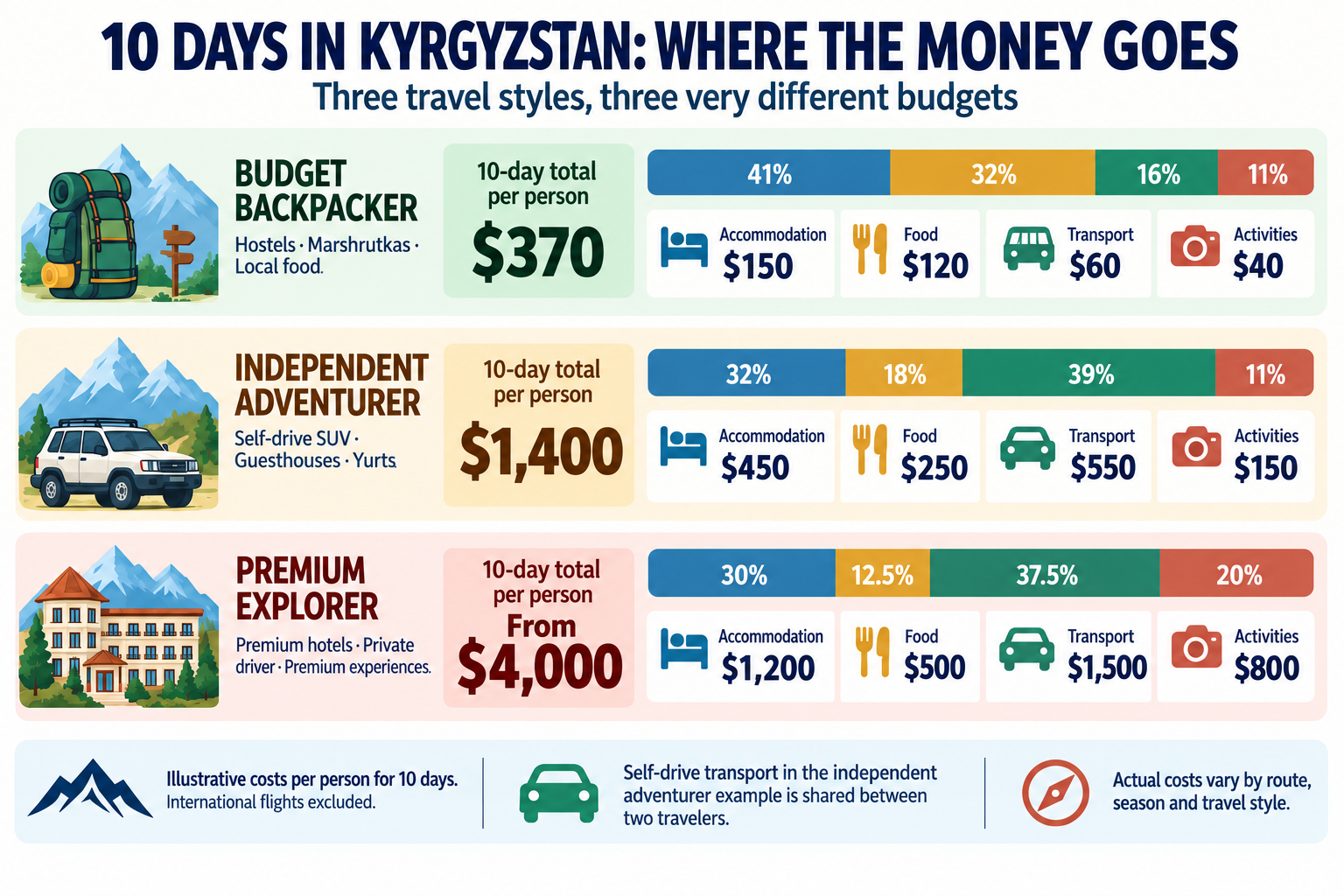
Scenario A: The Budget Backpacker (The “CBT” Route)
Focus: Public transport, family guesthouses, local food and independent hiking on accessible routes.
- Accommodation: Dorm beds in Bishkek and simple family stays in Karakol or Kochkor — around $150 total.
- Food: Canteens, bazaars and simple cafes — around $120 total.
- Transport: Marshrutkas and occasional shared taxis — around $60 total.
- Activities: Independent walks, Issyk-Kul beaches and several small entrance fees — around $40 total.
- Total 10-Day Budget: Approximately $370–$420 per person.
Scenario B: The Independent Adventurer (The “Self-Drive” Route)
Focus: A rented 4×4, comfortable guesthouses and freedom to reach places poorly served by public transport.
- Accommodation: Mid-range hotels and several nights in a yurt camp — around $450 total.
- Food: Restaurant meals in cities and full board at yurt camps — around $250 total.
- Transport: Ten days of SUV rental plus fuel — approximately $1,100 total, or around $550 each when shared by two people.
- Activities: Horse riding, a cultural demonstration and entrance fees — around $150 total.
- Total 10-Day Budget: Approximately $1,350–$1,500 per person.
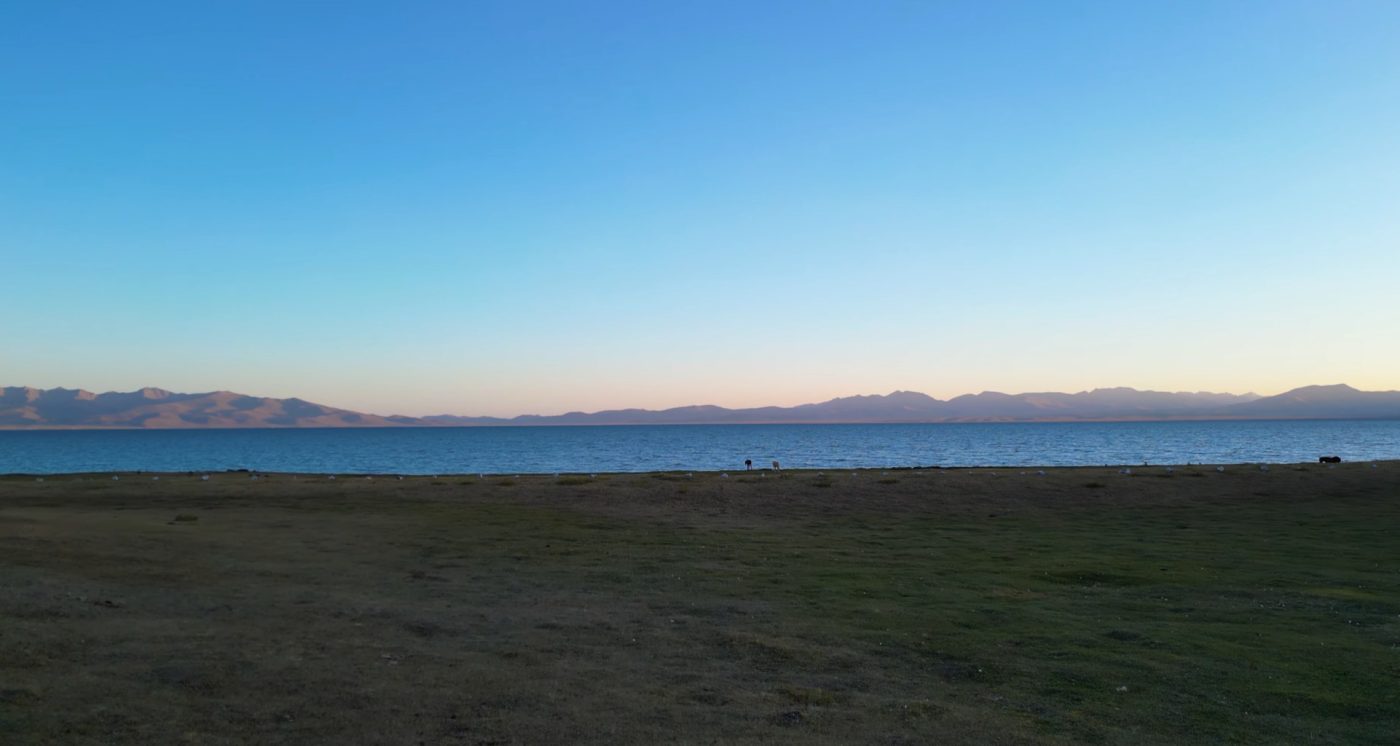
A useful real-world benchmark against the independent budgets above because transport, accommodation and much of the trip logistics are bundled into one small-group itinerary.
Scenario C: The Premium Explorer
Focus: High-standard accommodation, private transport, personalized guided experiences and maximum flexibility.
- Accommodation: Four-star Bishkek hotels and upgraded yurts — around $1,200 total.
- Food: Higher-end restaurants and selected private meals — around $500 total.
- Transport: A private driver in a high-standard SUV — around $1,500 total.
- Activities: Private cultural experiences, guided excursions and premium outdoor activities — allow around $800.
- Total 10-Day Budget: Approximately $4,000+ per person.
This premium estimate has the widest margin of error because private transport, accommodation standards and customized experiences can vary substantially in price.
Advertised as a private ten-day journey with 4x4 transport and meals. Confirm group arrangement, accommodation standards and the full list of inclusions before comparing its quote with the $4,000 premium example.
Money-Saving Tips for Kyrgyzstan 2026
Kyrgyzstan remains manageable on a moderate budget, but the best savings come from choosing the right transport model rather than cutting every meal or accommodation cost.
1. Master the “Marshrutka” Network
A private transfer between major cities can cost many times more than a marshrutka seat. Public transport works particularly well between Bishkek, Karakol, Kochkor and Osh. Use 2GIS to locate stations, but confirm departure points locally because routes and bus stations can change.
For remote destinations, calculate the final connection before committing to public transport. Saving money on the main route does not help much if the last 50 kilometers require an expensive private vehicle.
2. Bring “Crisp” Cash
Exchange offices may reject torn, heavily folded or marked USD and EUR notes, or offer a poorer rate. Compare exchange rates in central Bishkek rather than changing a large amount at the airport, and keep small som notes for rural expenses. See the Cash, Cards and ATMs section above for withdrawals and fees.
3. Travel in a Group of Four
Splitting a private vehicle among three or four travelers can cut the per-person transport bill substantially. Use the cost-sharing table above for an example, and confirm seating and luggage space before booking.
4. Eat the “Dish of the Day”
Local canteens and lunch menus normally offer better value than international dishes in tourist-oriented restaurants. Ask what was prepared that day rather than choosing only from a translated menu.
Plov, shorpo, laghman, manti and other local staples commonly provide a filling meal for around $3–$6 in an ordinary cafe. Business lunches are another good option in Bishkek and Osh.
5. Use Local Navigation Apps
A local SIM normally costs around $5–$10 depending on the provider and data package. Download 2GIS for offline maps and Yandex Go for app-based taxi pricing.
Save offline maps before leaving Bishkek or Karakol. Mobile coverage is weak or absent on many mountain roads, and a navigation app cannot replace a downloaded route, paper backup or local advice.
Bottom line: Kyrgyzstan in 2026 is still good value for travelers who enjoy mountains and independent travel. Everyday costs remain reasonable. The budget rises when the route requires private transport, difficult-road vehicles, guides, horses or remote accommodation.
Plan those expensive days first. Once transport to the remote places is covered, food, city accommodation and public transport are unlikely to be the part of the trip that breaks the budget.