How to Check Kyrgyzstan Tour Reviews Before Booking
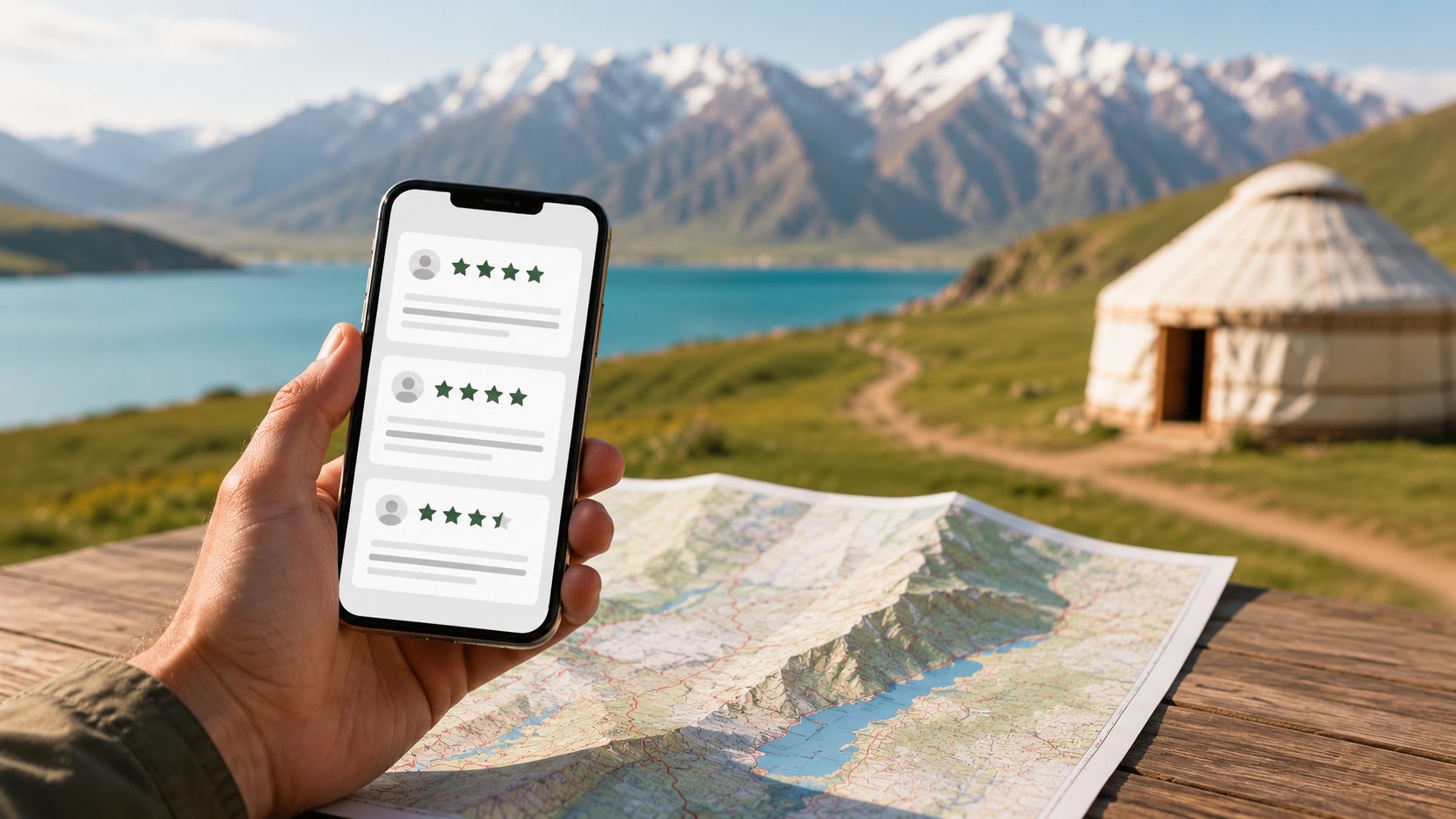
Tour reviews can save you from a weak guide, a badly organized itinerary, or a long day in the wrong vehicle. They can also mislead you.
This is especially true in Kyrgyzstan. A tour here is not always a simple museum ticket or a short city walk. Many trips involve mountain roads, changing weather, long drives, remote guesthouses, yurt camps, horse riding, and places where phone signal disappears for hours. A five-star rating helps, but it does not tell the whole story.
The most useful reviews are not always the most excited ones. They are the reviews that explain what actually happened: where the traveler went, how the guide communicated, what the vehicle was like, how long the drive took, where they slept, what was included, and how the company handled problems.
If you are still deciding what kind of trip to book, start with a broader look at the country in our Kyrgyzstan travel guide or browse the main things to do in Kyrgyzstan. Once you know the route you want, the next step is learning how to read reviews properly.
Start With the Review Details, Not the Star Rating
The first mistake is simple: trusting the average rating too quickly.
A tour with a 4.8 rating and dozens of detailed reviews may be safer to judge than a perfect 5.0 profile where every comment says only “amazing guide” or “best experience ever.” Positive reviews are useful, but only when they contain real information.
A strong review usually tells you at least a few of these things:
- which route or destination the traveler visited;
- how long the drive took;
- whether the guide spoke the promised language;
- what kind of vehicle was used;
- whether meals, tickets, pickup, or accommodation were included;
- how the company handled weather, delays, or changes;
- whether the trip matched the description.
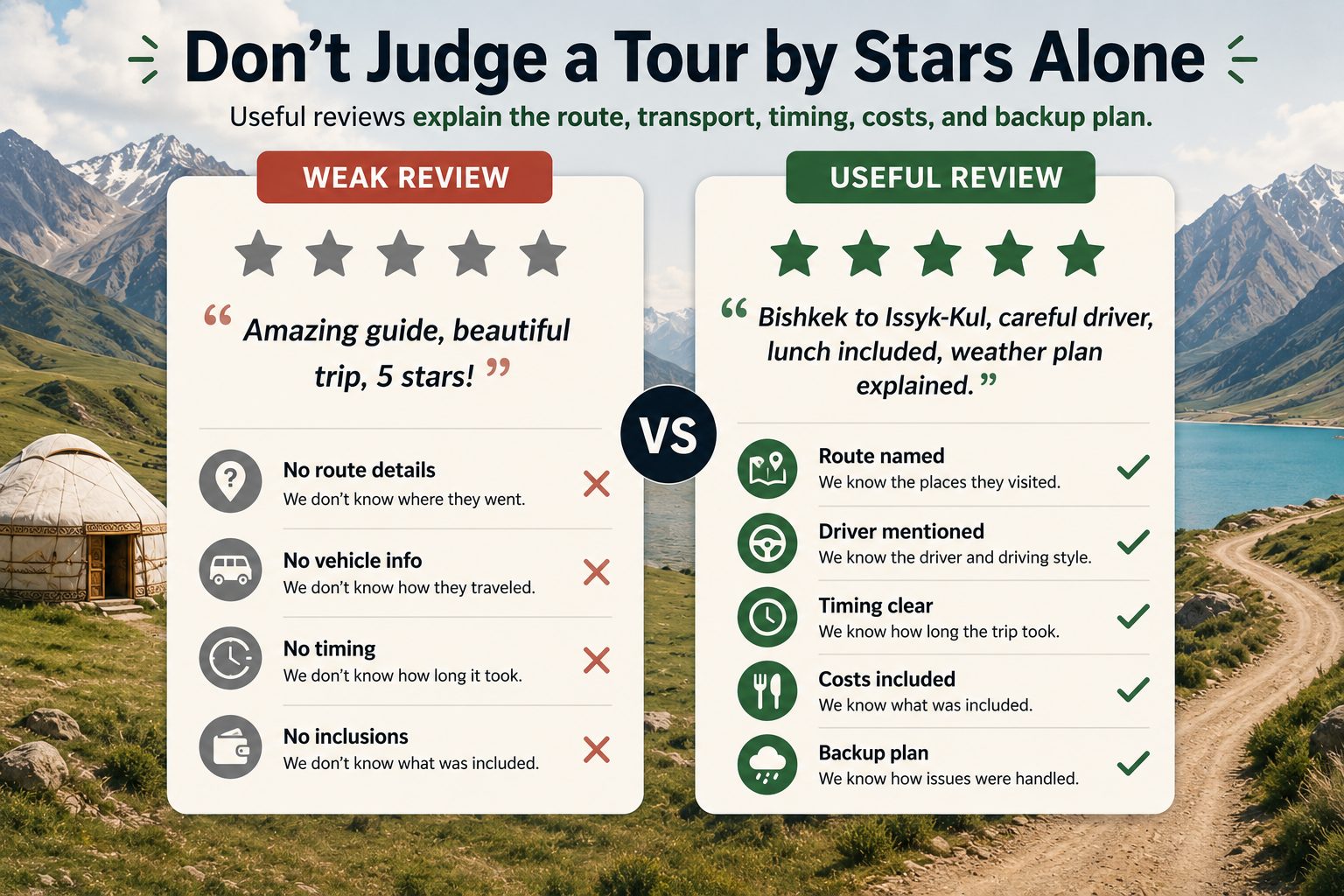
Compare these two examples:
Weak review: “Amazing trip, wonderful guide, beautiful country, highly recommended.”
Useful review: “We left Bishkek at 8 a.m., stopped at Burana Tower, drove to Issyk-Kul, had lunch included, and our driver was careful on rough sections of the road. The guide explained the schedule clearly and adjusted the timing when the weather changed.”
The second review gives you something to work with. It tells you about timing, route, inclusions, driving, communication, and flexibility. That is the kind of review you want when comparing tours.
Check Whether the Review Mentions the Actual Route
Route details matter a lot in Kyrgyzstan because different tours have very different risk levels and comfort levels.
A short Bishkek city tour is not the same kind of product as a multi-day trip to Kel-Suu or a horse riding route near Song-Kul. For a city tour, you mostly care about the guide’s knowledge, timing, walking pace, and communication. For a mountain tour, you also care about the vehicle, road conditions, backup plans, weather judgment, and accommodation.
Good reviews often mention specific places, such as:
- Ala Archa;
- Issyk-Kul;
- Kol-Tor Lake;
- Altyn Arashan;
- Ala-Kul Lake;
- Kel-Suu Lake;
- Tash Rabat;
- Osh Bazaar.
If a review only says “we saw beautiful mountains” but never names the place, it is not useless, but it is weaker. It may still be a real review. It just does not help you judge whether that company is good for the exact trip you want.
This becomes more important for remote routes. A company can be excellent at easy day trips from Bishkek and still be a poor choice for a remote mountain itinerary. The opposite can also be true: a small local operator may not have polished marketing, but may be very strong on one specific region.
Read the Negative Reviews Before the Positive Ones
Before you read twenty glowing comments, filter for the lowest reviews first.
This does not mean you should believe every angry customer. Some travelers arrive with unrealistic expectations. Some complain about normal parts of travel in Kyrgyzstan: long drives, simple toilets, basic food in remote areas, cold nights in the mountains, or itinerary changes caused by weather.
Still, negative reviews are valuable because they show what can go wrong.
Look for repeated complaints about:
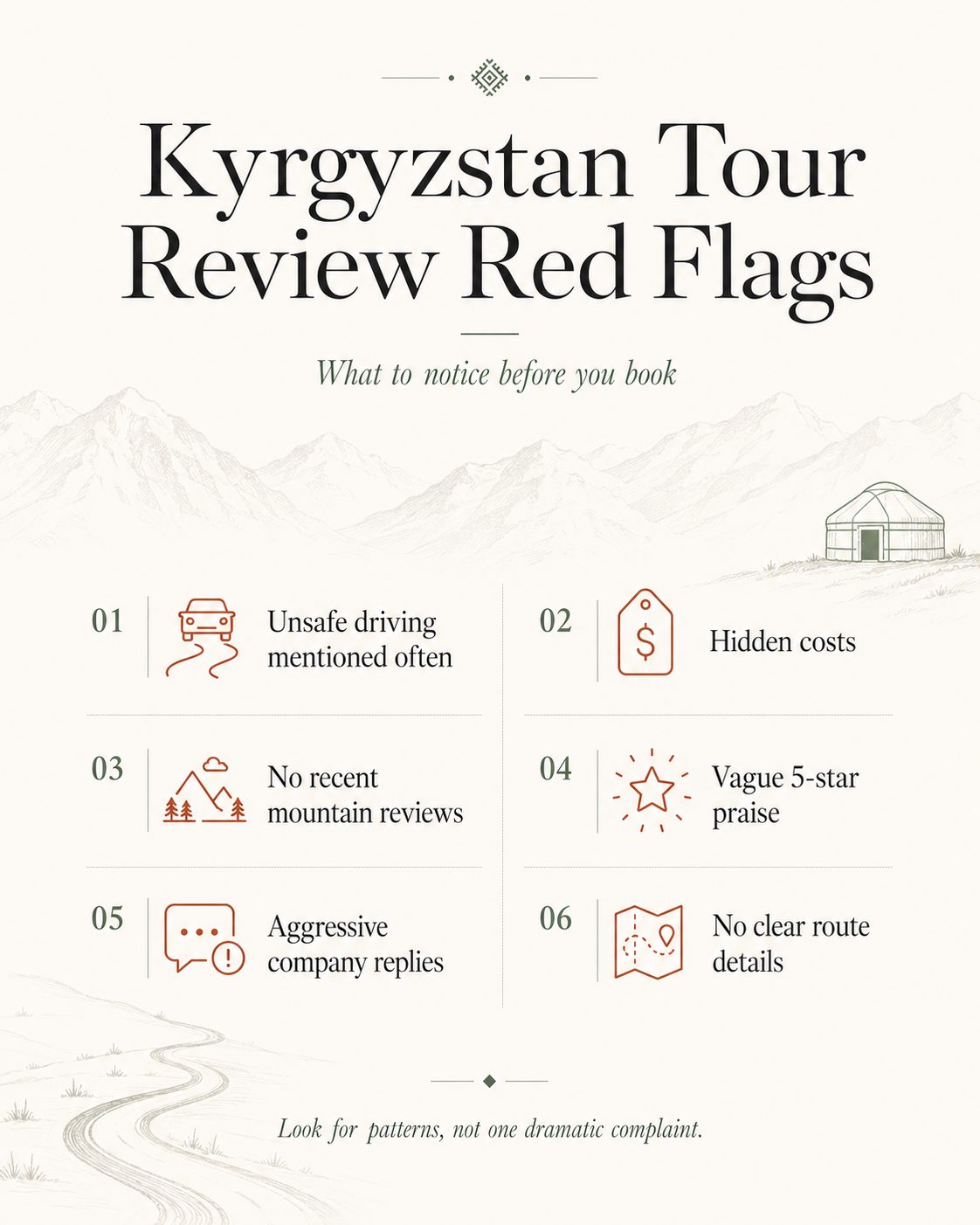
- unsafe driving;
- hidden fees;
- poor communication before the tour;
- a guide who did not speak the promised language;
- a vehicle that was not suitable for the route;
- major itinerary changes without explanation;
- refund or cancellation problems;
- rude behavior from the guide, driver, or office team;
- accommodation that was much worse than described.
Do not panic over one dramatic review. Look for patterns. One bad experience can happen anywhere. Three or four similar complaints about the same issue deserve much more attention.
Unsafe driving is one of the biggest red flags. Many Kyrgyzstan tours involve long road sections, sometimes on mountain roads or in rural areas. If several reviewers mention speeding, aggressive driving, tired drivers, or a vehicle that felt unsafe, take that seriously.
Hidden costs are another strong warning sign. Some small extra expenses can happen in travel, but the main inclusions should be clear before you pay. If reviews repeatedly mention surprise charges for pickup, fuel, meals, entrance tickets, horse rental, permits, or accommodation, ask detailed questions before booking.
Separate Normal Kyrgyzstan Travel Challenges From Bad Service
This is where many travelers misread reviews.
Kyrgyzstan is beautiful, but not every trip is smooth. A long drive is not automatically bad service. A basic yurt toilet is not automatically a scam. A route change because of snow, rain, mud, or rockfall may be the responsible decision.
The real question is whether the operator explained the situation honestly and handled it professionally.
| Review complaint | Could be normal in Kyrgyzstan? | When it becomes a red flag |
|---|---|---|
| “The drive was much longer than expected.” | Yes, many routes involve long road time. | If the company did not explain the driving time before booking. |
| “The yurt camp was basic.” | Yes, many rural stays are simple. | If the listing promised hotel-style comfort. |
| “The route changed because of bad weather.” | Yes, especially in mountain areas. | If there was no backup plan or explanation. |
| “The driver was speeding on mountain roads.” | No, this is not a normal complaint to ignore. | Repeated mentions of unsafe driving are a serious warning. |
| “We had to pay extra during the trip.” | Sometimes small optional costs exist. | If mandatory costs were not disclosed before payment. |
| “The guide spoke little English.” | Only if no English-speaking guide was promised. | If the tour was sold as English-guided. |
This distinction matters for places such as Kel-Suu, Altyn Arashan, Ala-Kul, and other remote routes. Weather, access, and road conditions can change. A good company should not pretend otherwise. It should explain the risk clearly and give you a realistic plan.
For seasonal planning, also check our guide to the best time to visit Kyrgyzstan. A review from July may not tell you much about the same route in October or early spring.
Look at the Reviewer Profile
Do not read reviews in isolation. Look at the reviewer too.
A stronger reviewer profile may have:
- reviews from other trips or countries;
- photos from the tour;
- a personal writing style;
- specific details about the day;
- a mix of positives and small negatives;
- a review date that makes sense for the travel season.
A weaker profile may have only one review, no photo, no other activity, and very generic language. That does not prove anything by itself. Many real travelers leave only one review in their life. Some people create an account only because they had a great guide and wanted to say thanks.
The pattern matters more than one profile.
If almost every review comes from a one-review account, all posted within a short period, all using similar phrases, and none mentioning the actual route, that is a reason to cross-check the company elsewhere.
Use careful judgment here. The goal is not to accuse anyone. The goal is to decide how much weight a review deserves.
Watch for Reviews That Feel Too Perfect
A perfect rating is not automatically suspicious. Some small operators really do excellent work, especially if they run only a few tours and care about every guest.
But a review profile that feels too polished can be less useful than it looks.
Useful review signals
- The review names the route or destination.
- The traveler mentions transport, timing, or accommodation.
- The review includes a real detail that does not sound copied.
- The reviewer explains what was good and what was difficult.
- The company has recent reviews for the same type of tour.
Signals to cross-check
- Every review is short and extremely generic.
- Many reviews repeat the same phrases.
- Most reviewers have no other activity.
- No review mentions the actual itinerary.
- There are no recent reviews for seasonal mountain tours.
Generic praise is common in travel reviews, so do not overreact. But if a tour is expensive or remote, you should expect more than “everything was perfect.” You want details.
For example, if you are booking one of the classic day trips from Bishkek, a short review may be enough. If you are booking a multi-day horse trek, a remote lake trip, or a long mountain route, short emotional reviews are not enough.
Check Recent Reviews for Seasonal and Remote Tours
Freshness matters. Not equally for every tour, but it matters.
For a walking tour in Bishkek, an older review can still be useful. The city, museums, bazaars, and food stops do not change as dramatically from month to month.
For mountain trips, fresh reviews are much more important.
Look for recent reviews when booking:
- trekking routes;
- horse riding tours;
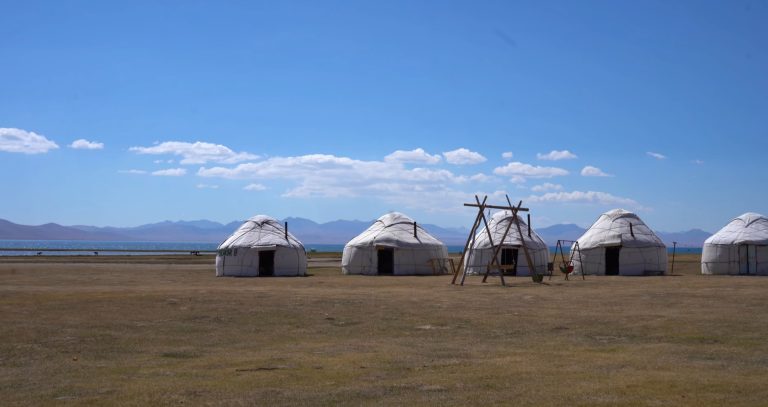
- yurt camp stays;
- remote lake trips;
- multi-day private tours;
- winter or shoulder-season routes;
- trips involving high passes or rough roads.
Why does this matter? Guides change. Vehicles change. Guesthouses change. Yurt camps may operate differently each season. Roads can be repaired, damaged, blocked, or made worse by weather. A company that was excellent three years ago may still be good, but you need recent evidence.
For remote trips, try to find reviews from the same season you plan to travel. A summer review of a mountain lake does not always tell you what the route feels like in May, October, or winter.
Cross-Check Reviews Across More Than One Place
Do not rely only on one review source.
Check several places when possible:
- large tour booking platforms;
- travel review platforms;
- map reviews;
- the company’s own website;
- social media pages;
- recent traveler photos;
- local tourism or community-based tourism listings;
- travel forums and trip reports.
A company website is not a bad source, but it is usually the most controlled source. Most businesses show their best reviews on their own site. That is normal. Just do not stop there.
External reviews are more useful because they are harder for the company to fully control. Map reviews can help you see whether the business has a real presence. Social media can show recent activity, current vehicles, guides, and guest photos. Forums and trip reports can reveal small practical details that formal reviews often miss.
If you are comparing prices at the same time, use our Kyrgyzstan travel costs and budget guide to sense-check whether the tour price seems realistic for the route, inclusions, and season.
Read How the Company Replies to Complaints
A company’s reply to a bad review can be more revealing than the review itself.
Good replies are calm and specific. They explain what happened without attacking the traveler. They may admit a mistake, clarify a misunderstanding, or describe what the company changed afterward.
Weak replies often look different:
- angry tone;
- copy-paste responses;
- blaming the traveler for everything;
- denying every complaint without detail;
- revealing private information;
- insulting or mocking the customer;
- arguing instead of solving.
This matters because travel does not always go perfectly. Weather changes. Roads close. People misunderstand pickup times. A good company does not need to be perfect. It needs to communicate well when something goes wrong.
If a company responds professionally to criticism, that is a positive trust signal. If it attacks every unhappy traveler, think carefully before giving it your money.
Ask These Questions Before You Book
Reviews are only part of the decision. Before paying, ask direct questions. A good operator should be able to answer clearly.
Useful questions include:
- What exactly is included in the price?
- Is hotel pickup included?
- Where is the meeting point?
- What type of vehicle will be used?
- Is the tour private or shared?
- What language will the guide speak?
- How many hours of driving are expected?
- Are meals included?
- Are entrance fees included?
- What accommodation is used on multi-day tours?
- What happens if weather or road conditions change?
- What is the cancellation policy?
- Are horses, yurt stays, permits, or border-zone documents included where needed?
Ask the boring questions. They prevent the biggest disappointments. In Kyrgyzstan, clear answers about driving time, vehicle type, inclusions, accommodation, and weather plans are more useful than another five-star quote.
Pay attention not only to the answer, but to how the answer is written. A strong operator usually gives specific replies. A weak operator often replies with vague reassurance: “Don’t worry, everything is good.” That may be true, but it is not enough for a remote or expensive trip.
Do Extra Checks for Trekking, Horse Riding, and Remote Tours
Trekking and horse riding tours need extra attention. These trips can be wonderful, but they are not the same as a short sightseeing drive.
When reading reviews for trekking or horse riding, look for details about:
- guide experience on the exact route;
- group size;
- route difficulty;
- altitude and walking time;
- horse condition and handling;
- food and drinking water;
- overnight conditions;
- weather changes;
- transport to and from the trailhead;
- what happened when someone got tired or the route changed.
This is especially important for mountain areas and lake routes. Kyrgyzstan has incredible scenery, but remote travel requires judgment. The cheapest option is not always the best option when the route involves horses, high altitude, long drives, or limited access to help.
For more context, read our guides to the mountains of Kyrgyzstan, lakes of Kyrgyzstan, and horse riding tours.
Can You Trust a New Tour Company With Few Reviews?
Sometimes, yes.
Not every good local guide has hundreds of reviews. Some guides work through larger companies. Some are new to online booking. Some run seasonal tours and only get a small number of guests each year. A small review count is not an automatic rejection.
Instead, ask more questions.
Good signs from a newer company include:
- a clear itinerary;
- specific answers to your questions;
- realistic driving times;
- transparent inclusions;
- clear cancellation terms;
- recent real photos;
- local knowledge of the route;
- a backup plan for weather or road problems.
Bad signs include vague answers, pressure to pay quickly, no written itinerary, no clear pickup plan, no explanation of the vehicle, and no clarity about guide language or inclusions.
A new operator with few reviews can still be worth booking if the communication is clear and the plan is realistic. A popular operator with many reviews can still be a bad fit if recent reviews show repeated problems.
Final Checklist Before Booking a Kyrgyzstan Tour
Before you book, run through this quick checklist:
- The reviews mention the actual route you want.
- The reviews are recent enough for the type of tour.
- The negative reviews do not show repeated safety issues.
- The company replies professionally to complaints.
- The price and inclusions are clear.
- The guide language is confirmed.
- The vehicle type is clear for road-based tours.
- The accommodation level matches your expectations.
- There is a plan for bad weather or road changes.
- You understand the cancellation policy before paying.
That is the real value of reading reviews. You are not trying to prove that every review is real or fake. You are trying to reduce uncertainty before you spend money and commit your travel days.
In Kyrgyzstan, the best tour reviews do more than praise the scenery. They show whether the guide, driver, and company can handle the practical side of the trip. That is what you should trust most.
FAQ: Checking Kyrgyzstan Tour Reviews
Are Kyrgyzstan tour reviews reliable?
Many Kyrgyzstan tour reviews are useful, but star ratings alone are not enough. The best reviews are specific, recent, and mention the actual route, guide, transport, accommodation, communication, and what happened when plans changed.
Is a one-review profile always suspicious?
No. Many real travelers only leave one review. It becomes more concerning when many reviews are from one-review profiles, posted close together, written in a similar style, and missing practical route details.
Should I avoid a tour company with a few bad reviews?
Not automatically. One bad review can happen to any company. Look for repeated complaints about the same issue, especially unsafe driving, hidden fees, poor communication, refund problems, or major itinerary changes without explanation.
How recent should Kyrgyzstan tour reviews be?
For Bishkek city tours, older reviews can still help. For mountain tours, horse riding, yurt camps, remote lakes, and multi-day routes, recent seasonal reviews are much more important because roads, guides, vehicles, and accommodation can change.
What is the biggest red flag in Kyrgyzstan tour reviews?
Repeated complaints about unsafe driving are one of the biggest red flags. Other serious warnings include hidden costs, poor communication, guide language problems, aggressive company replies, and refund issues that appear in several reviews.
Can I book a Kyrgyzstan tour with few reviews?
Yes, but ask more questions before paying. Confirm the route, vehicle, guide language, inclusions, accommodation, cancellation policy, and backup plan for bad weather or road problems. Clear communication can make a newer operator easier to judge.