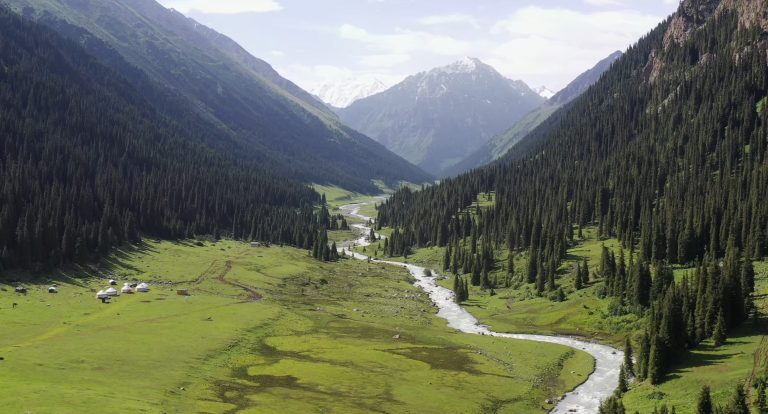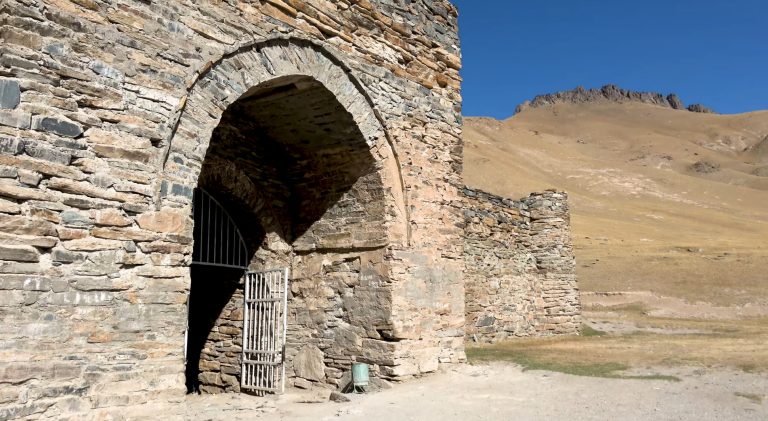
Kel Suu (Kol Suu) Lake: What It’s Really Like to Visit Kyrgyzstan’s Most Remote Lake
You don’t end up at Kel Suu by accident. It’s not somewhere you pass through, not a quick detour, not even something you casually “add” to a Kyrgyzstan itinerary. You go there on purpose — and usually only after you’ve already decided you’re okay with things taking longer than expected.
The road starts normally enough. Out of Naryn, past the last petrol stations, past the last places where things feel predictable. Then it stretches out. Valleys open, then empty. The landscape flattens, then rises again. At some point, you stop seeing anything that looks like infrastructure.
And then, much later than you thought it would take, the terrain tightens. Cliffs begin to close in. The scale changes. The space that felt wide and open suddenly compresses — and somewhere inside that narrow cut, hidden until the final approach, sits Kel Suu.
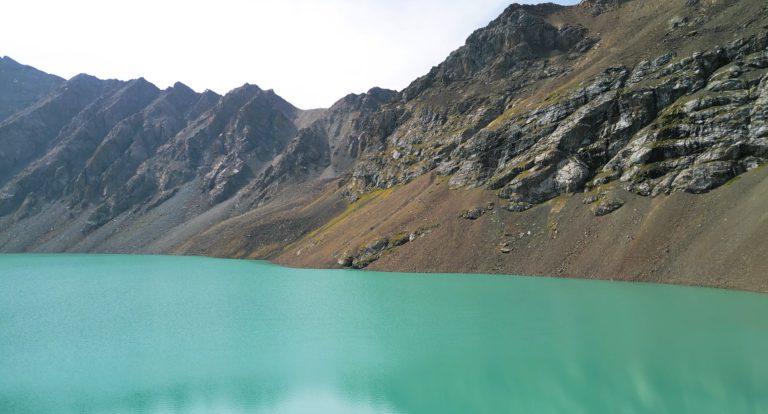
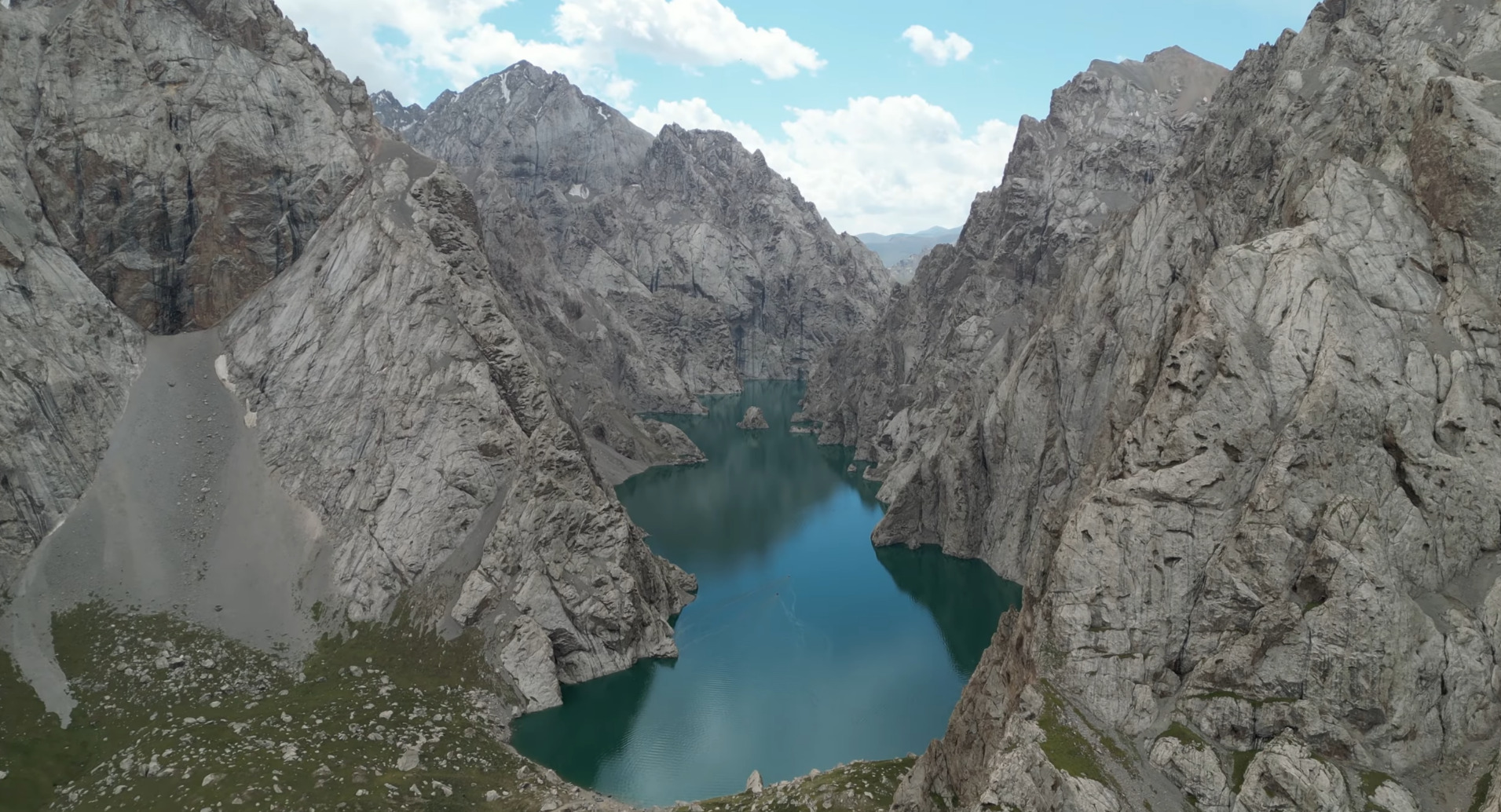
It doesn’t land like a typical viewpoint. There’s no clean reveal, no framed perspective. You arrive slightly off-balance, after hours of movement, and the lake just… appears. Long, narrow, dark against pale rock. Quiet in a way that doesn’t feel designed for visitors.
But the strange part isn’t how it looks.
It’s that it doesn’t always look like that at all.
Should You Even Go to Kel Suu?
- Go → if you’re okay losing 2 full days for one location
- Go → if the journey matters more than the viewpoint
- Skip → if you expect a guaranteed “photo moment”
- Skip → if your itinerary is already tight
Kel Suu at a Glance
| Factor | Reality |
|---|---|
| Location | Remote valley near the China border |
| Altitude | ~3,500 meters |
| Access | 4×4 + horse or hike |
| Time needed | Minimum 2 days |
| Permit | Required |
| Water level | Unpredictable |
| Infrastructure | Very basic |
That table alone already filters people out. And that’s a good thing.
Kel Suu works best when you understand what it actually is — not just visually, but logistically. Because most of the experience isn’t standing at the lake. It’s everything that happens before you reach it.
What Kel Suu Actually Is
Kel Suu — sometimes written as Kel-Suu — sits deep in the Kok-Kiya valley in southeastern Kyrgyzstan, close to the border with China. At around 3,500 meters above sea level, it exists in a landscape that already feels stripped back to essentials: rock, wind, grass, and distance.
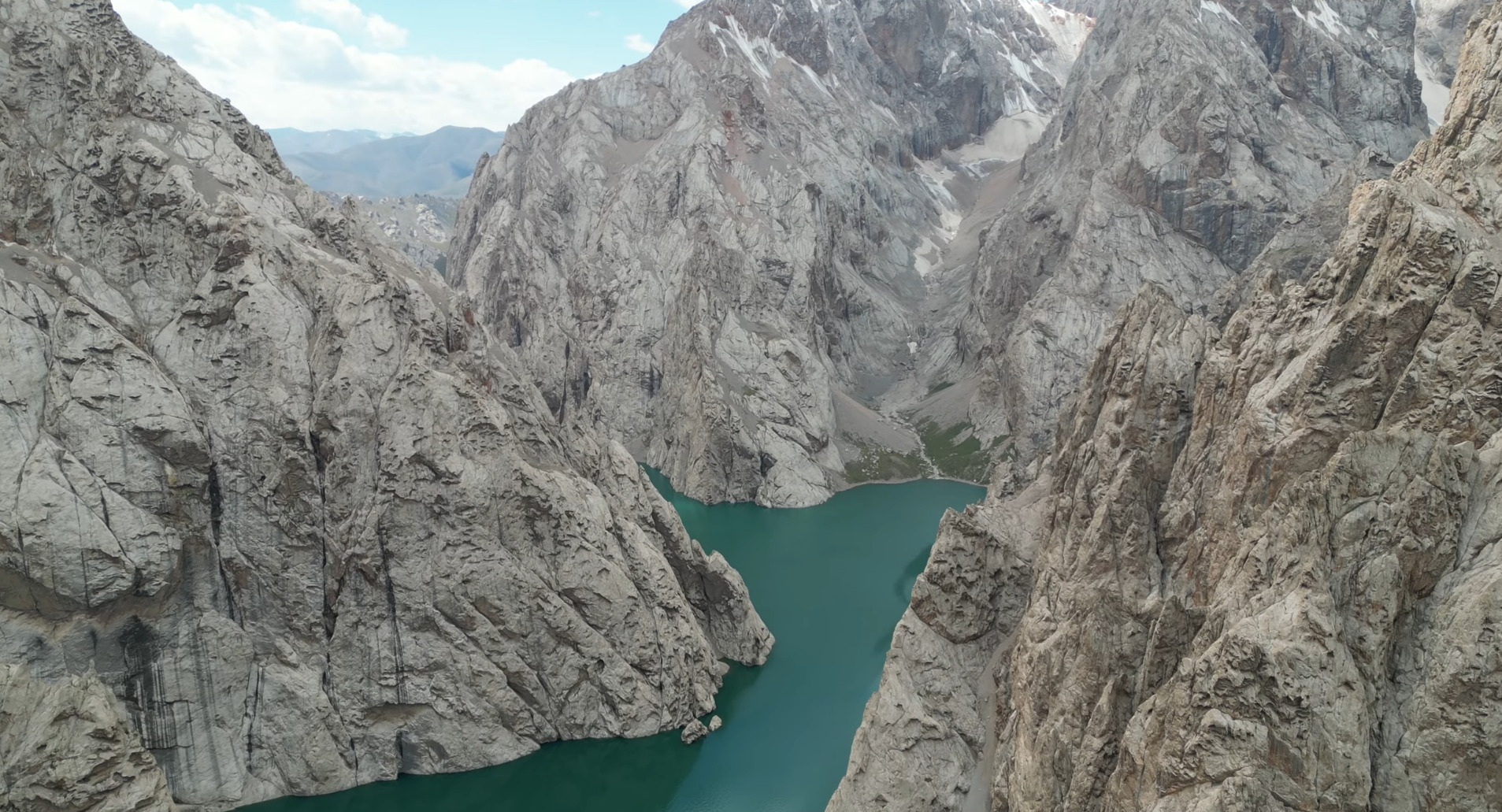
The lake itself is narrow, almost compressed between steep rock walls. In photos, it often looks like a fjord — a long, dark ribbon of water cutting into the land. But unlike a fjord, Kel Suu isn’t stable.
Its shape changes. Its size changes. Sometimes significantly.
And that’s where expectations usually start to drift away from reality.
Why Kel Suu Is Not the Same Lake Every Time
Most alpine lakes behave predictably. Seasonal changes, yes — but within a visible range. Kel Suu doesn’t follow that pattern.
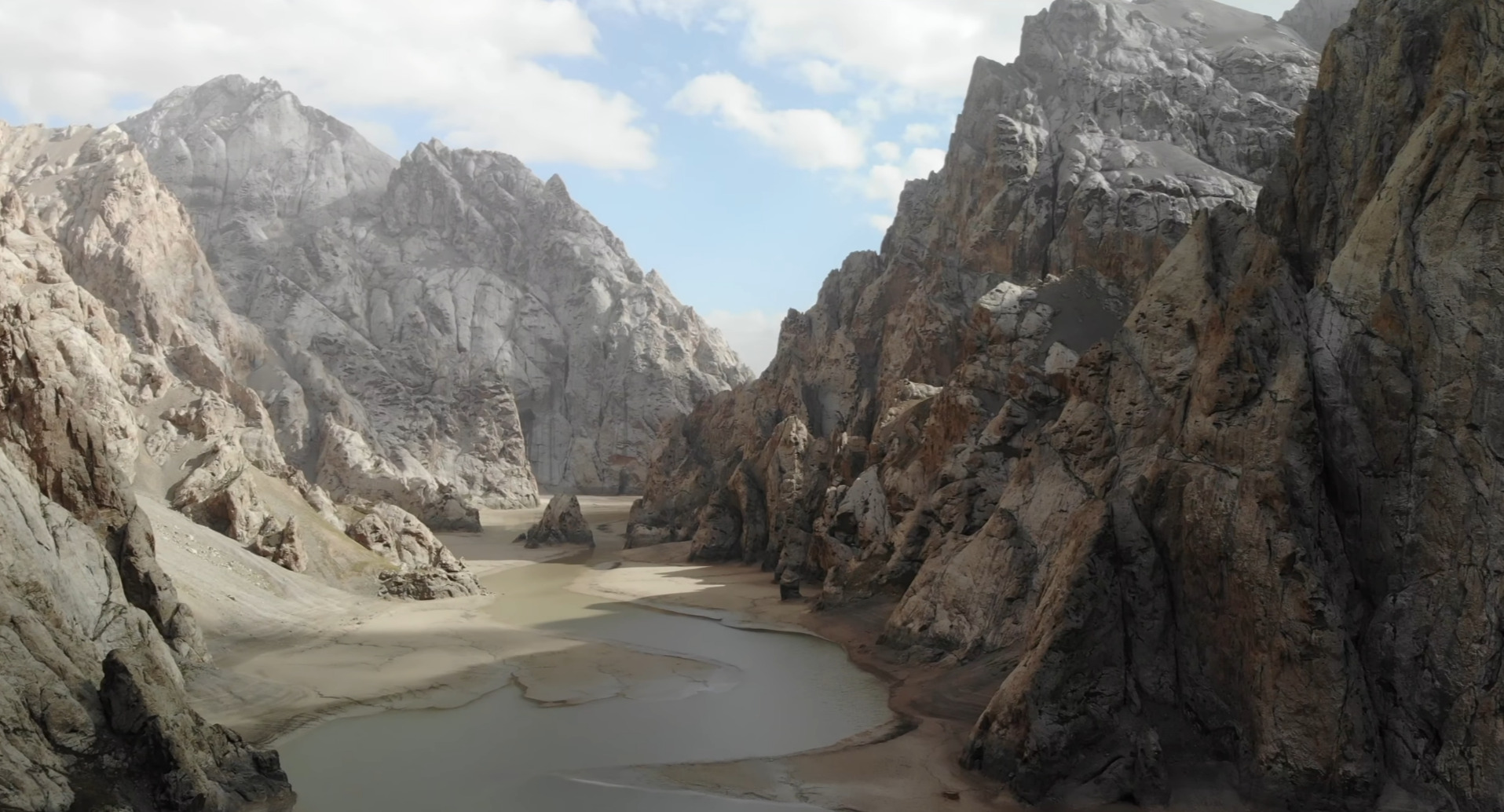
It’s connected to underground drainage systems. Water can disappear through subsurface channels, sometimes lowering the lake level far more than people expect. In some cases, sections of the lakebed become exposed. In others, the narrow canyon-like shape shortens or breaks visually.
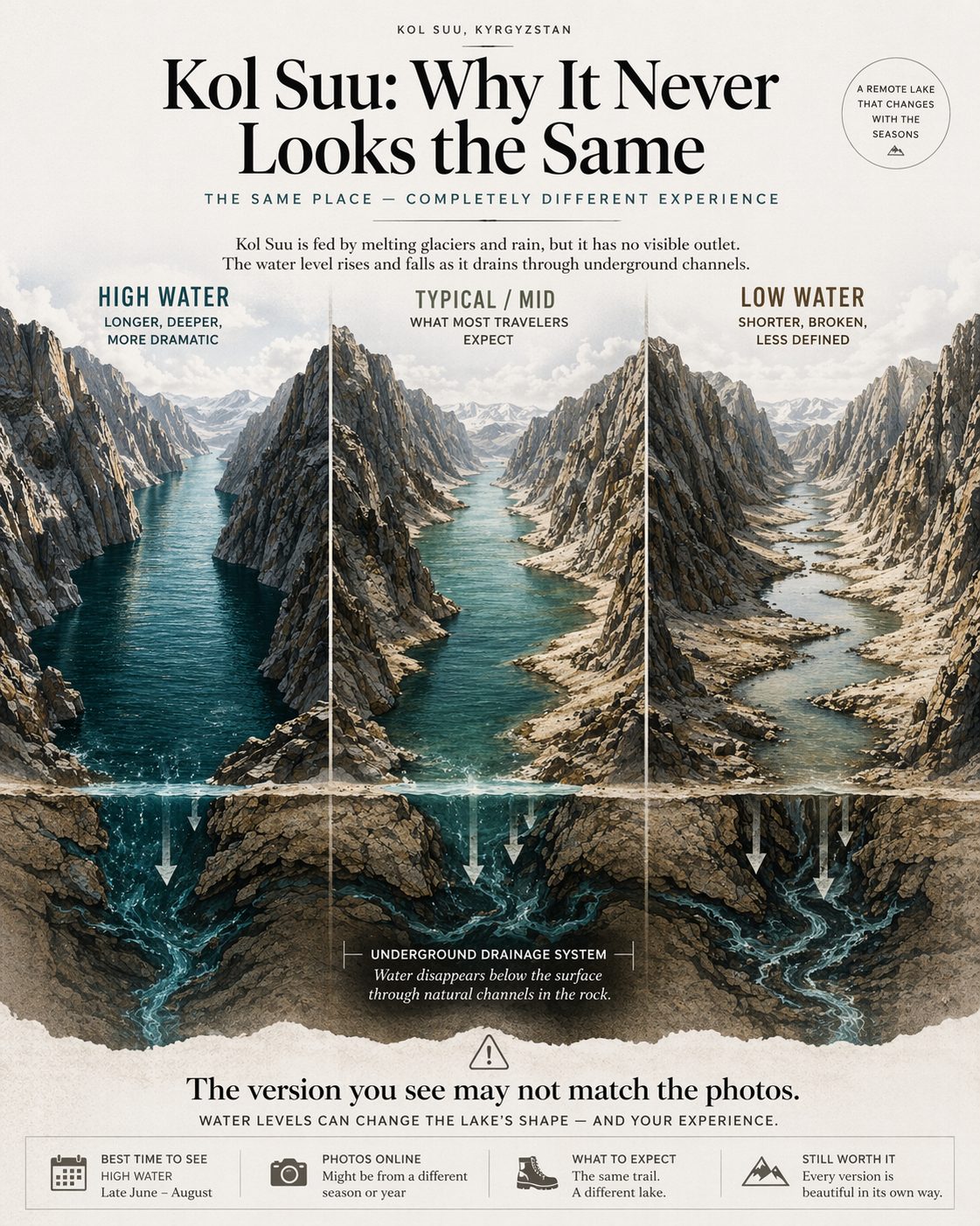
This isn’t a rare event. It’s part of how the place works.
Rough patterns exist, but they’re not reliable enough to plan around:
- Early summer (June) → higher water levels are more common
- Mid-summer (July) → often stable
- Late summer (August) → fluctuations begin to appear
- September → lower levels are more likely
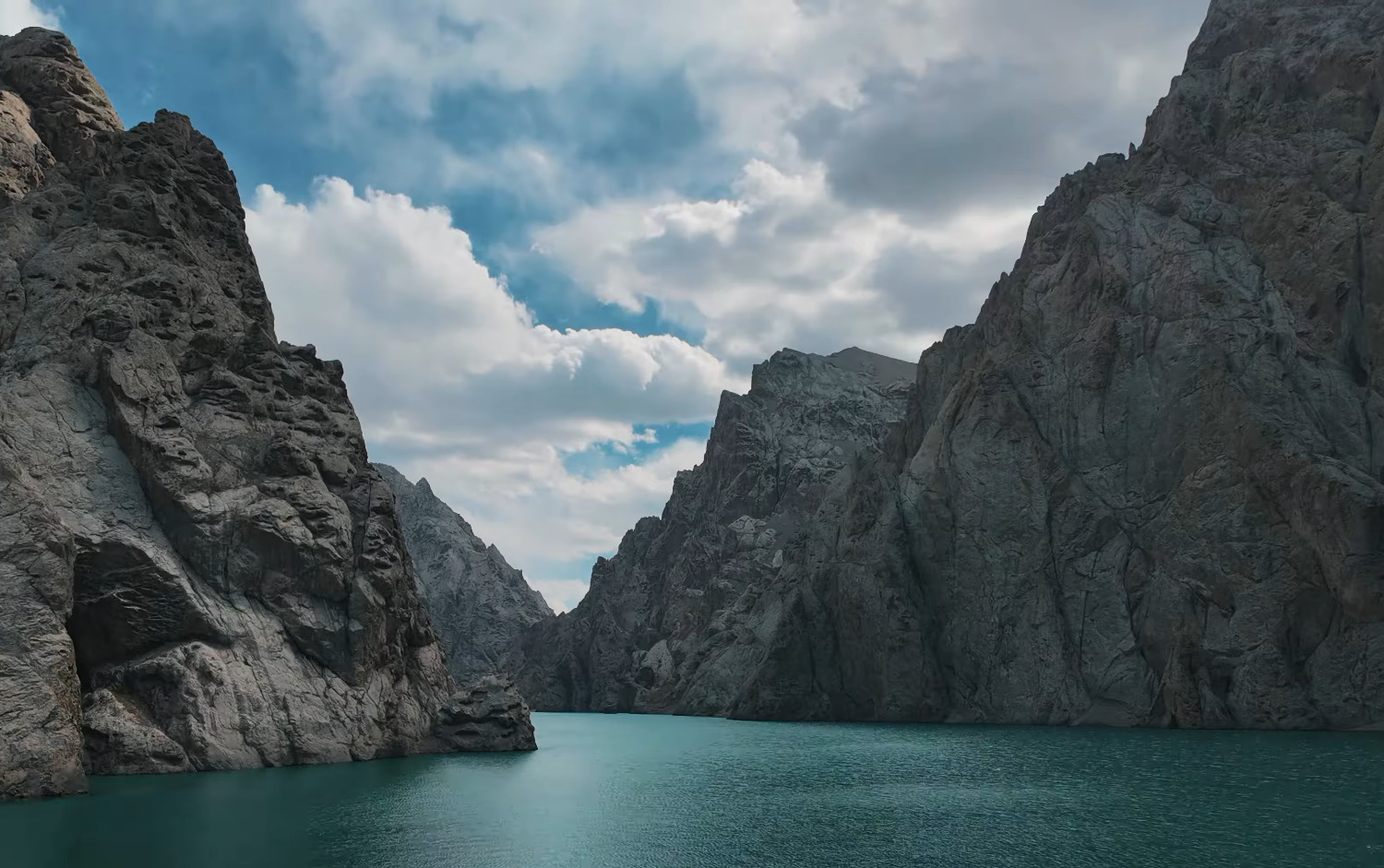
Still, none of that guarantees anything.
If your decision to go is based on seeing a specific photo of Kel Suu, you’re setting yourself up for the wrong experience. The lake is not a fixed landmark — it’s a variable one.
For some people, that unpredictability becomes the reason to go. For others, it’s the exact reason they feel disappointed.
Which is why understanding the journey matters more than understanding the image.
Where Kel Suu Is Located (And Why It Feels Further Than It Looks)
On a map, Kel Suu doesn’t look that far from Naryn. The distance is roughly 150–180 kilometers depending on the route. In most places, that would mean a few hours of driving.
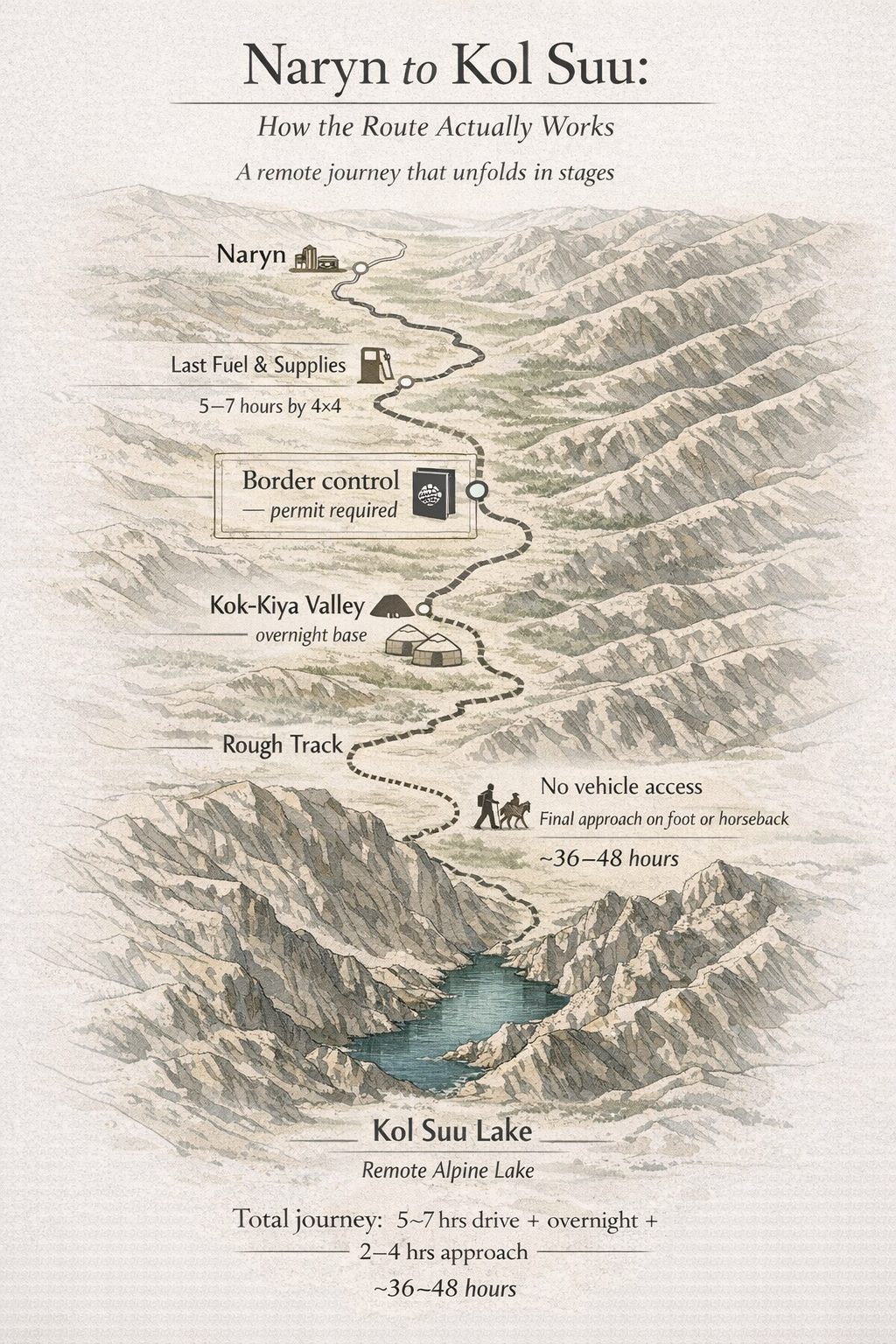
Here, it doesn’t.
The route moves through increasingly remote terrain, where road quality degrades gradually rather than suddenly. Asphalt fades into gravel, gravel into dirt, and eventually into tracks that shift depending on weather and usage.
River crossings are common. After rain, sections can slow down dramatically or become temporarily impassable.
That’s why the journey usually takes 5–7 hours in good conditions — and longer when things aren’t ideal.
By the time you reach the Kok-Kiya valley, you’re already committed. Turning around at that point doesn’t make much sense.
And the lake still isn’t there yet.
What the Journey Actually Feels Like
There’s a moment somewhere after leaving Naryn where things stop feeling like a road trip and start feeling… stretched out. Not dramatic, not even difficult yet — just slower than your brain expects.
You keep thinking you’ll “get there soon.” You won’t. Not yet.
The first part is easy to read. Wide valleys, scattered yurts, herds moving in the distance. Then the road starts to lose shape. Less defined. More improvisation. Drivers don’t follow lanes — they follow ground that looks drivable.
At some point, you cross a river. Then another. Maybe shallow, maybe not. It depends on the week, sometimes the day. No one makes a big deal out of it, but it quietly resets your expectations.
And then the landscape changes again.
It narrows. The openness disappears. The scale shifts from horizontal to vertical — cliffs, ridges, tighter space. You start feeling like you’re entering somewhere, not just passing through.
By the time you reach the Kok-Kiya valley, it doesn’t feel like a destination. It feels like a staging point.
How the Trip to Kel Suu Actually Works (Step by Step)
This is the part that’s usually glossed over. It shouldn’t be.
- Early departure from Naryn
You leave in the morning. Not because it’s scenic — because it takes time. - Long drive into remote terrain
Hours of movement without clear checkpoints. Just gradual isolation. - Border control checkpoint
Permits get checked. This is where access becomes controlled. - Arrival in Kok-Kiya valley
A cluster of yurt camps appears almost unexpectedly. - Overnight stay
You don’t continue the same day. The lake isn’t “right there.” - Final approach (next day)
Horseback or on foot. The last stretch is where things finally focus.
It’s not complicated. But it’s layered. And skipping any of those layers usually means you’re not actually doing the trip — just looking at it from a distance.
People often assume Kel Suu is a single destination. In reality, it’s a sequence. The lake only makes sense after everything that comes before it.
The Last Stretch: Walking or Riding In
The road ends quietly. No sign, no marker that says “this is it.” Just a point where vehicles stop and movement changes.
From here, it’s either on foot or on horseback.
The distance isn’t extreme — somewhere around 6 to 8 kilometers depending on where you start. On paper, that sounds manageable. At 3,500 meters, it feels different.
Walking is steady, but it takes time. Not because the terrain is technical — because your pace adjusts whether you want it to or not. Breathing becomes part of the rhythm. You don’t push. You just keep moving.
Horseback looks easier. And physically, it is. But it comes with its own adjustment. The horses know the route better than you do. They move at their own pace, sometimes closer to the edge than you’d choose, sometimes faster than you expect.
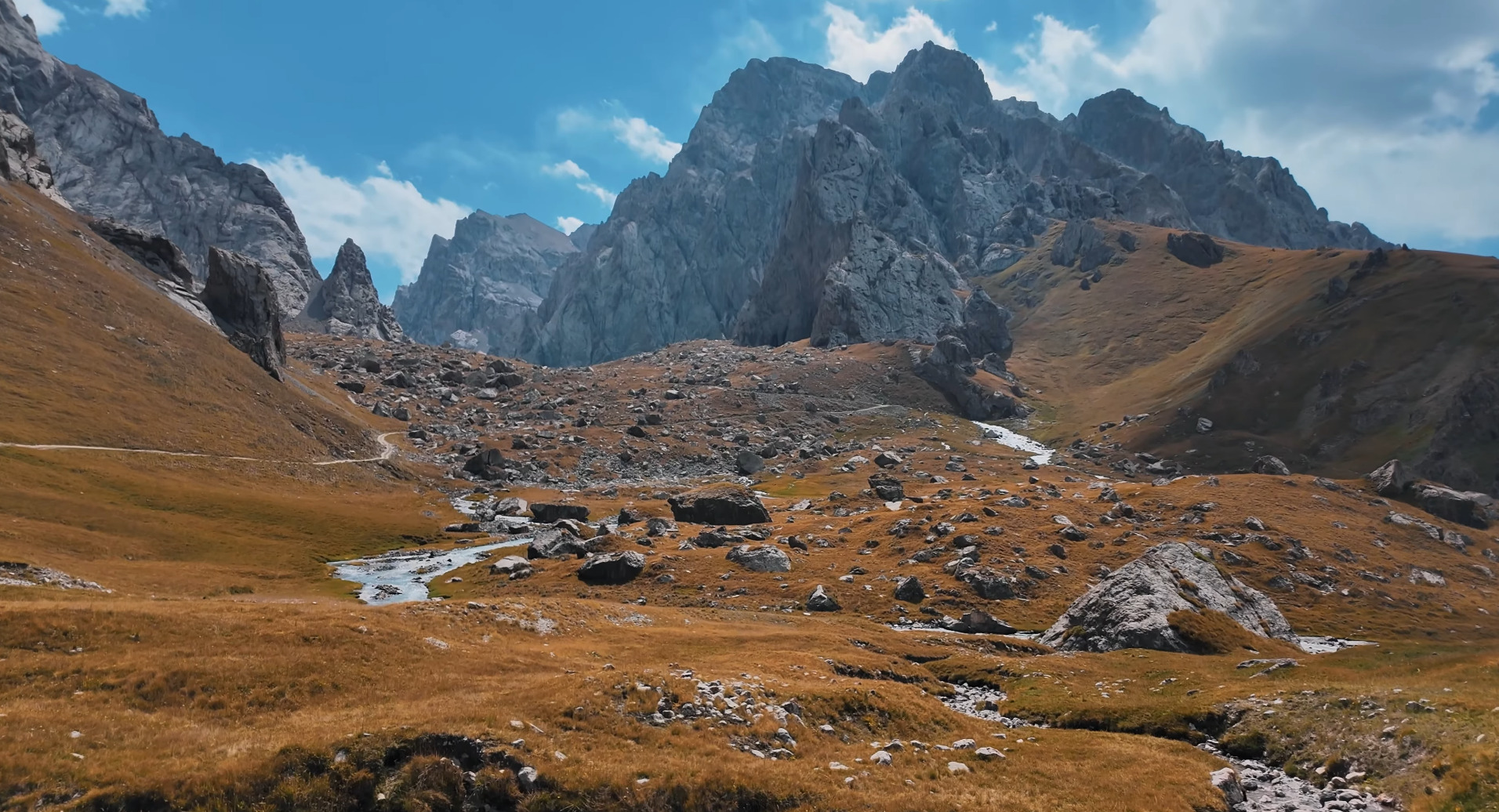
You don’t control much. You follow.
| Option | Time | Effort | What it feels like |
|---|---|---|---|
| Hiking | 3–4 hours | Moderate | Slow, steady, more physical |
| Horseback | 2–3 hours | Low | Less effort, less control |
Either way, the approach isn’t rushed. The lake doesn’t reveal itself immediately. You see pieces first — rock walls, a narrowing path, hints of water if the level is high enough.
Then suddenly, it’s there. No buildup. Just presence.
Do You Need a Permit for Kel Suu?
No permit = trip ends before Kok-Kiya. Not negotiable.
Yes. And this is where plans quietly fall apart if you ignore it.
Kel Suu sits in a controlled border zone near China. Access beyond certain points is restricted, and checkpoints are active. You don’t negotiate your way through them.
The permit is straightforward in theory:
- Issued in advance (usually 1–3 days)
- Requires passport details
- Checked at least once, sometimes more
In practice, it creates a timing constraint. You can’t just decide last minute and go the next morning unless everything is already arranged.
And if you don’t have it, the trip stops early. Not near the lake — much earlier.
That’s the part people don’t expect. The restriction isn’t symbolic. It’s enforced.
If something in your plan depends on “figuring it out on the way,” this is the step that breaks that approach. Kel Suu requires at least a bit of structure.
The cleanest short-format option: private transport, accommodation and the Kel Suu border permit are built into one itinerary.
The Road Itself (And Why It Matters)
The road isn’t just a way to get there. It’s half the experience — and sometimes the part that stays with people longer than the lake itself.
It changes constantly. One hour smooth enough to relax, the next slow and uneven. After rain, everything shifts. Sections that were easy become uncertain. Drivers adjust routes without explaining it — they just know where not to go.
There are no services along the way. No shops. No fuel. Once you leave the main areas near Naryn, what you have with you is what you have.
Signal drops out early. Then completely.
And that’s when the trip starts to feel real. Not because it’s extreme — but because there’s nothing buffering it anymore.
You’re just moving through it.
A six-day private trek that trades speed for a much deeper route through remote valleys, camps and Kok-Kiya.
Where You Stay (And What That Actually Means)
The yurt camps in Kok-Kiya valley don’t announce themselves from far away. You see them late — a few round shapes, low against the landscape, almost blending into it. After hours of nothing, even that feels like a lot.
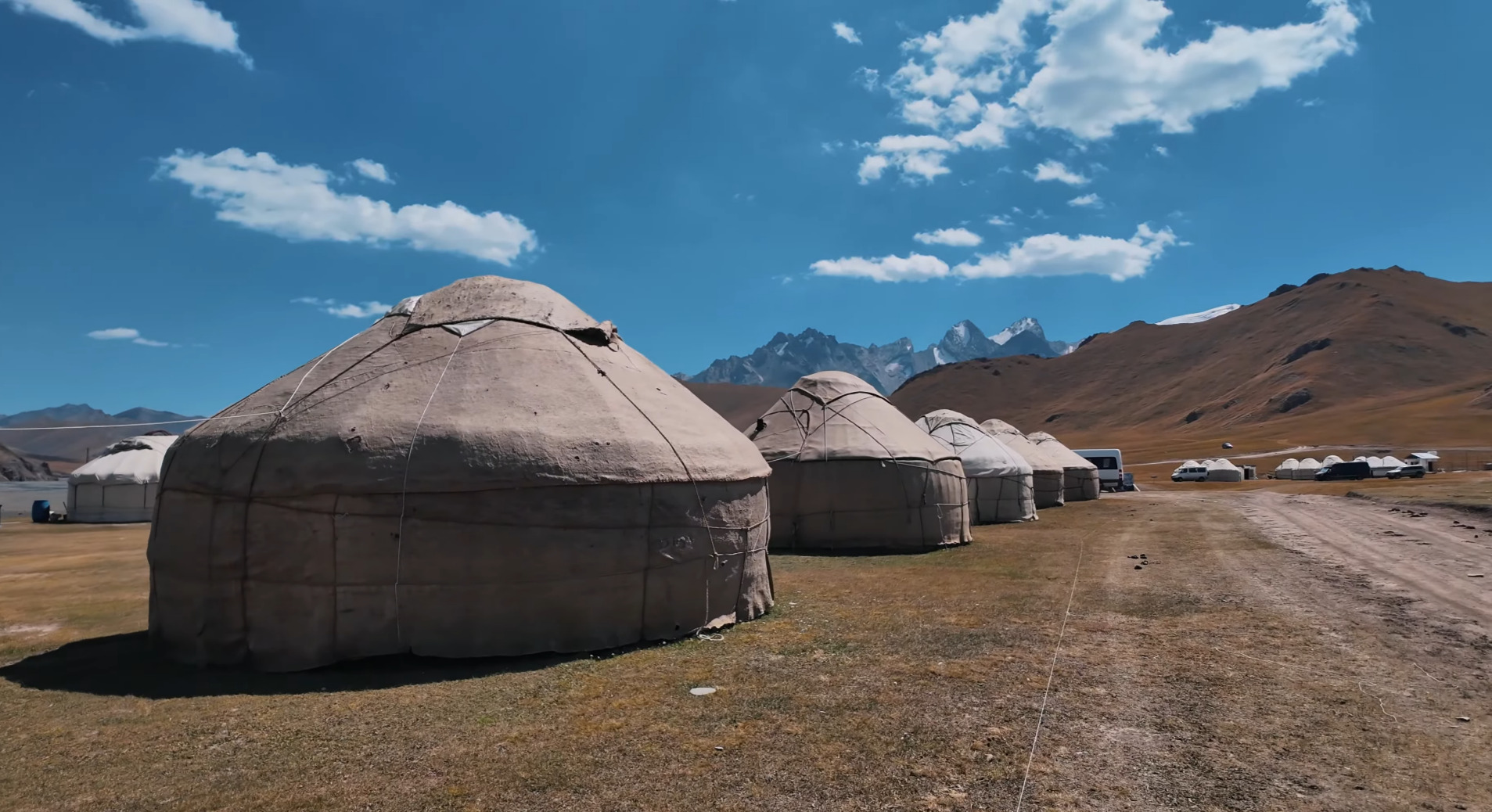
They’re not “accommodation” in the usual sense. More like a pause point. A place where movement stops for a bit before continuing.
Inside, it’s simple. Felt walls, low beds, sometimes carpets layered over each other. It’s warm enough once you’re in, especially if there’s a stove going. Outside — completely different story.
There’s no illusion of comfort here. And that’s kind of the point.
- No proper showers
- Electricity — sometimes, usually in the evening
- Toilets — basic, outside
- Internet — almost never
It’s quiet in a way that doesn’t feel curated. No background noise, no distant traffic, nothing humming somewhere. Just wind, maybe animals, maybe voices from another yurt carried across the valley.
At night, the temperature drops fast.
Temperature, Altitude, and How Your Body Reacts
During the day, it can feel mild. Even warm if the sun is out and the wind stays low. You might walk around in a light layer and think, “this isn’t so bad.”
Then evening comes in.
The air changes quickly at this altitude. Around 3,500 meters, there’s less margin for comfort. Once the sun dips, heat disappears almost immediately.
- Daytime (summer): roughly 10°C to 20°C
- Night: close to 0°C, sometimes lower
You notice it first in your hands, then your face, then everywhere else.
Altitude works differently. It’s not dramatic for most people — no sudden collapse or anything like that. Just a steady shift.
Breathing feels slightly off. Walking feels heavier than it should. Small inclines start to register more than expected.
Nothing extreme. Just enough to slow you down.
Spending even one night in Naryn before coming here makes a difference. Not huge, but noticeable. The body catches up just enough to make the second day easier.
Food and Daily Rhythm in the Camps
Meals are simple and consistent. You don’t choose — you eat what’s prepared.
Usually something warm, filling, and built around what’s available locally:
- Soup
- Rice or noodles
- Bread
- Tea — a lot of tea
It’s not about variety. It’s about timing. You eat when food is ready, not when you feel like it.
The rhythm of the place isn’t structured around visitors. You just step into it for a while.
What It Costs (Roughly — And Why It Varies)
Prices around Kel Suu aren’t fixed in a strict way. They move within a range depending on season, availability, and how things are arranged.
Still, there’s a pattern.
| Item | Typical range |
|---|---|
| 4×4 transport (per day) | $80–150 |
| Yurt stay + meals | $20–40 |
| Horse rental | $15–25 |
| Permit | $10–25 |
It adds up, but not in a hidden way. You can see where the effort goes — distance, fuel, logistics, people involved.
Nothing here is scaled for volume tourism. That’s why pricing feels more direct, less packaged.
| Option | Total cost (approx) | Control |
|---|---|---|
| DIY | $150–300 | High |
| Organized tour | $250–500 | Low |
Small Things That Catch People Off Guard
Not big problems. Just details that don’t show up in planning.
- No shops once you leave Naryn
- No reliable phone signal
- No quick way back if something changes
- Weather shifting faster than expected
- Silence that feels heavier than you thought it would
None of these are deal-breakers on their own. Together, they change how the place feels.
You stop thinking in terms of options. You just follow what’s already set in motion.
Evening in the Valley
By the time the light starts fading, everything slows down without anyone saying it should.
People move less. Conversations get shorter. The temperature drops enough that staying outside stops making sense.
The mountains don’t disappear — they just lose detail. Shapes instead of textures. The kind of light where distance becomes harder to judge.
Inside the yurt, it’s warmer. Not by much, but enough.
And that’s usually when it hits you — you’re not close to anything. Not in the way people usually mean it.
Tomorrow, you go to the lake.
And somehow, it still doesn’t feel like the main event.
The Final Approach to the Lake
The last part doesn’t announce itself clearly. There’s no obvious “you’re close now” moment. Just a gradual tightening of space — the valley narrowing, the path pulling closer to rock.
You’re already a few hours in by this point. Walking or riding, it doesn’t really matter. The rhythm is set. Slow, steady, not rushed.
Then something shifts.
The ground levels out slightly. The path bends. And instead of opening up, the landscape closes in even more — walls rising on both sides, closer than before.
You don’t see the lake immediately. That’s the part that throws people off.
You expect a reveal. A viewpoint. Something framed.
There isn’t one.
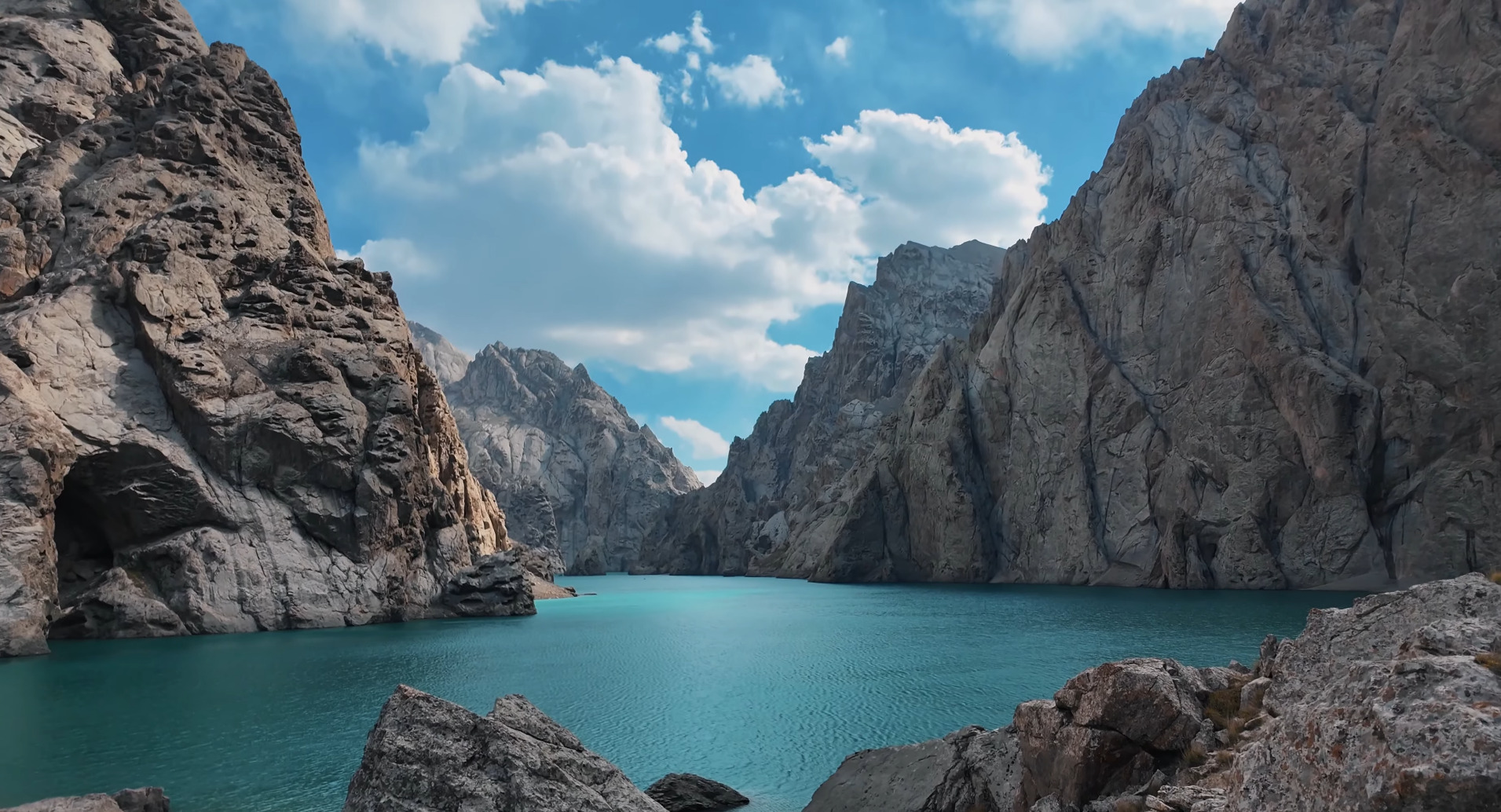
You take a few more steps, maybe turn slightly without thinking about it — and then the water is just there. Quiet, dark, sitting low between the rock.
No buildup. No moment designed for you to react.
It feels like you arrived mid-scene.
What Kel Suu Actually Feels Like When You’re There
Photos flatten it. They stretch the lake, clean up the lines, make everything feel more defined than it is.
In reality, it’s narrower. More contained. Almost compressed between the cliffs.
The scale is harder to read. The water looks still, but not in a calm way — more like it’s holding its place.
Sound doesn’t travel far here. Voices drop off quickly. Even small movements feel slightly muted.
You don’t move around much. Not because you can’t — because there isn’t much reason to. The space isn’t wide. It doesn’t invite exploration in the usual sense.
You arrive, you take it in, and then… you just stand there for a while.
Trying to understand what exactly you’re looking at.
When the Lake Doesn’t Match the Photos
This is where expectations break, quietly.
If the water level is lower, the shape changes. Sections that look like continuous water in photos can become interrupted. Edges appear where you didn’t expect them. The depth of the canyon feels shorter.
Nothing is “wrong.” It’s just not the version people usually imagine.
Some travelers feel disappointed in that moment. Not dramatically — just slightly off, like something didn’t line up.
Others adjust quickly. They stop comparing and just look at what’s there.
That shift makes a difference.
The people who enjoy Kel Suu the most are usually the ones who stop trying to match it to an image. Once you drop that, the place settles into its own logic.
Why Many Travelers Misjudge Kel Suu
- It looks closer on the map than it actually is
- The road takes longer than expected
- The lake doesn’t always match photos
- The altitude makes the final approach feel heavier
- The experience is more about the journey than the lake itself
None of these are hidden facts. They’re just easy to overlook when everything is reduced to a single image.
Kel Suu isn’t misleading — it’s just incomplete if you only see it one way.
How Long People Actually Stay at the Lake
Less time than you’d think.
Most people spend anywhere from 30 minutes to an hour near the water. Sometimes a bit longer, depending on conditions and pace.
Not because there’s nothing to do — but because the space doesn’t demand time in the same way other places do.
You arrive, you take it in, maybe walk a little along the edge if the terrain allows it… and then the experience starts to plateau.
And that’s fine.
The trip doesn’t hinge on how long you stay there. It never really did.
Is Kel Suu Actually Worth It?
Short answer
Kel Suu is worth it — but only if you accept that the lake is not the main event.
It depends on what you’re expecting — but not in a vague way. More like… what kind of trip you’re okay with once things stop being easy.
If you’re picturing a clean, high-impact viewpoint that rewards you quickly, Kel Suu will probably feel off. Too much time to get there, not enough structure once you arrive.
If you’re drawn to places where the process matters as much as the destination, it starts to make more sense.
Because the lake itself isn’t the full experience. It’s one part of a longer sequence that only works when you take all of it together.
It makes sense if you:
- are comfortable with long, slow travel days
- don’t need things to be predictable
- are interested in remote landscapes, not just viewpoints
- can adjust expectations in real time
It probably doesn’t if you:
- want quick access and clear structure
- expect the lake to look exactly like photos
- prefer comfort and stable conditions
- are short on time and trying to fit multiple highlights
There’s no right answer here. Just alignment — or the lack of it.
Common Planning Mistakes
Most issues with Kel Suu don’t come from the place itself. They come from how people plan around it.
- Underestimating travel time
The distance looks manageable. The road changes that. - Skipping the permit step
It seems like a formality. It isn’t. - Assuming it’s a one-day trip
Technically possible in extreme cases, but it strips the experience down too much. - Expecting consistent conditions
The lake doesn’t behave that way. - Packing for mild weather
Altitude changes everything, especially at night.
None of these are complicated to avoid. They just require paying attention early enough.
How Kel Suu Fits Into a Kyrgyzstan Trip
Kel Suu rarely works as a standalone decision. It fits into a broader route — or it doesn’t.
Most travelers reach it through Naryn, which acts as a natural staging point for the region. From there, the route extends outward rather than connecting easily to other highlights.
That’s important.
Kel Suu doesn’t sit on a convenient loop. Visiting it usually means committing to a direction, then retracing part of it.
Building a wider Naryn Region itinerary? Compare the Kel Suu tour options if you want permits, 4×4 transport and accommodation arranged in one route. Combining Kel Suu with Song Kul can reduce some of the backtracking and bundle the long 4×4 transfers, remote accommodation and lake activities into one trip.
A compact way to link two remote high-altitude lakes without planning separate trips.
For some itineraries, that’s worth it. For others, it pulls too much time away from places that are easier to combine.
You feel that trade-off more clearly once you’re already on the road.
Things That Surprise Most Travelers
- The lake may not look like the photos
- The journey takes longer than expected
- The final stretch feels harder than it should
- There is almost no infrastructure near the lake
- The road becomes part of the experience, not just access
Individually, none of these are dramatic.
Together, they shift how the trip feels.
How Much Time You Should Realistically Plan
The minimum is two days. That’s the baseline.
- Day 1: Naryn → Kok-Kiya valley (arrival, overnight)
- Day 2: Early start → lake → return → drive back or stay again
Some people extend it to three days, either to slow the pace or to avoid doing everything back-to-back.
Trying to compress it further usually removes the parts that make the trip feel complete.
Adds Naryn and a dedicated Kel Suu excursion, giving the route more breathing room than the four-day option.
What You Actually Need to Bring
Not a long list — but the right things.
- Warm layers (even in summer)
- Water and snacks (no shops after Naryn)
- Basic medication (nothing available locally)
- Power bank (limited electricity)
- Passport (for permit checks)
It’s not about over-preparing. Just covering the gaps that the environment doesn’t fill for you.
So… Is It About the Lake?
Not really.
The lake is the point you move toward, but it’s not the thing that carries the experience.
What stays with people tends to be everything around it — the long approach, the quiet in the valley, the shift in pace once you leave normal infrastructure behind.
The lake just anchors it.
Without the rest, it wouldn’t hold the same weight.
Practical Summary
| Topic | What to know |
|---|---|
| Time required | Minimum 2 days |
| Starting point | Naryn |
| Transport | 4×4 vehicle + horse or hiking |
| Permit | Required in advance |
| Accommodation | Yurt camps only |
| Best season | June to September |
| Difficulty | Moderate (due to altitude and access) |
If you reduce everything down to essentials, that’s what Kel Suu looks like. No extra layers, no shortcuts built into it.
FAQ
Can you visit Kel Suu without a tour?
Yes, but it’s not straightforward. You still need to arrange transport, permits, and access to a yurt camp. Most independent attempts end up relying on local drivers and camp coordination anyway.
How difficult is the hike to Kel Suu?
The distance itself is manageable, but altitude changes the effort. What looks like a moderate walk on paper feels slower and more demanding in practice.
Is Kel Suu always full of water?
No. Water levels change depending on underground drainage and seasonal conditions. The lake may look very different from photos.
Do you always need a border permit?
Yes. Kel Suu lies in a controlled border zone, and permits are checked at checkpoints before reaching the valley.
How long should you stay?
Two days is the minimum. Adding an extra day makes the trip more relaxed and avoids rushing the return.
Where This Fits Into a Larger Route
Kel Suu doesn’t connect easily to everything else. That’s part of why it feels the way it does.
Most routes build outward from Naryn — not through it. You go in, spend the time needed, then come back the same way before continuing somewhere else.
That makes Kel Suu less flexible than other places in Kyrgyzstan. But it also keeps it from becoming too easy to pass through.
It holds its distance.
What Stays With You
It’s not the kind of place that gives you a single, clear takeaway.
You don’t leave thinking “that was the best view” or “that was the highlight.” It’s less defined than that.
What stays is the sequence. The long road, the quiet in the valley, the way the lake appears without trying to impress you — and disappears just as easily when you leave.
There’s no neat conclusion to it.
And maybe that’s why it works.
Kel Suu doesn’t try to be anything beyond what it is. It doesn’t adapt itself to expectations. It just sits there — sometimes full, sometimes not — and lets you decide what to do with that.
And once you’ve been there, it’s hard to reduce it back down to a photo again.
Kel Suu Planning Snapshot (Save This)
| Minimum time | 2 days |
| Best base | Naryn |
| Permit needed | Yes |
| Best months | June–September |
| Access type | 4×4 + horse/hike |