Best Day Trips from Bishkek
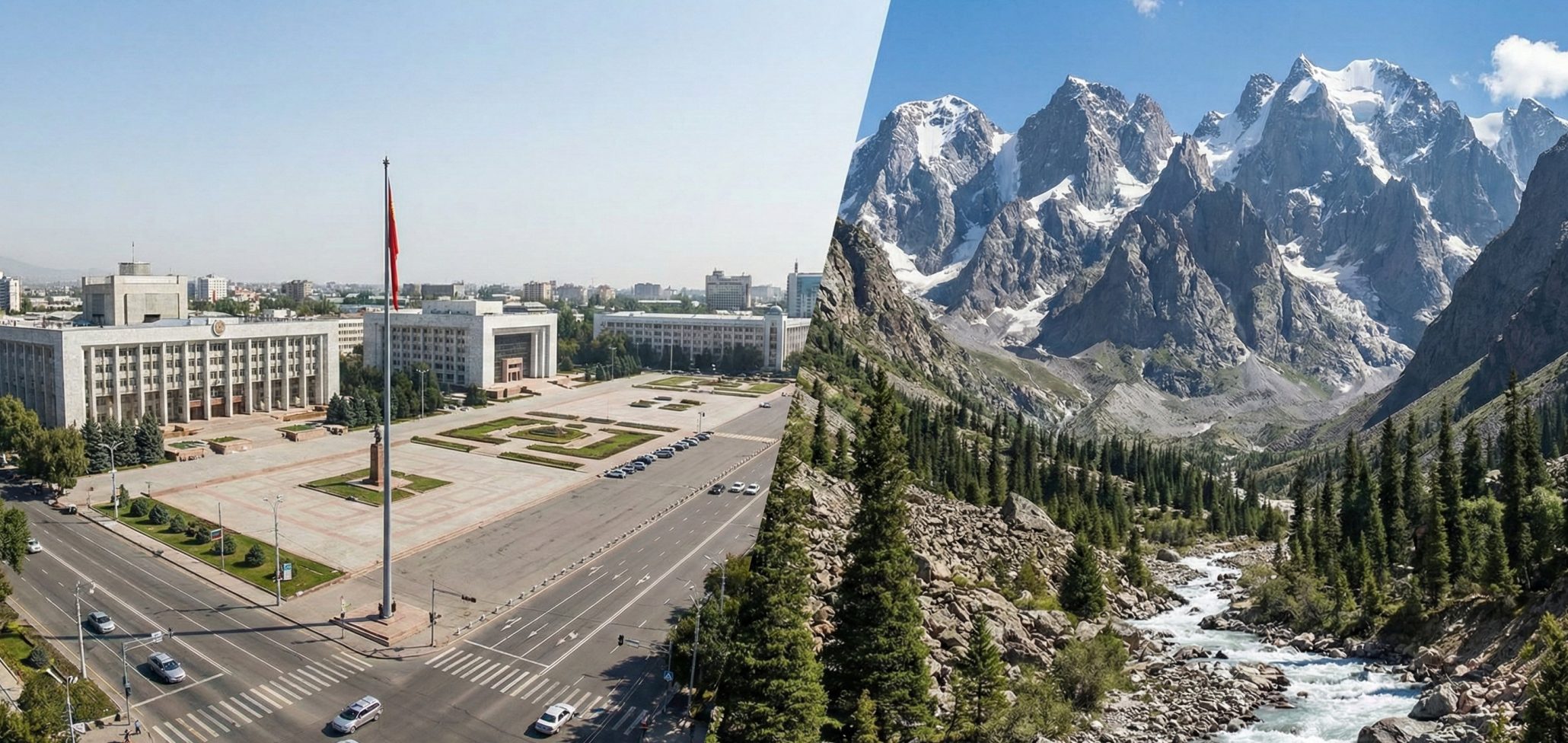
Bishkek is where most journeys across Kyrgyzstan kick off. The city feels orderly, almost restrained. Grid streets. Big squares. Soviet geometry everywhere. You can figure it out fast.
But no one flies here for the boulevards.
The real pull sits beyond the ring roads. Within an hour — sometimes less — the whole atmosphere tilts. Concrete blocks fade into pastureland. Dry plains wrinkle into red rock corridors. And those snow-covered peaks… they just hover there, even in July, like they’re showing off.
If your schedule is tight, day trips from Bishkek are the cleanest way to taste the country’s alpine terrain, Silk Road leftovers, and raw steppe landscapes without dragging your suitcase from guesthouse to guesthouse every night.
This isn’t a dreamy brochure rundown. It’s logistics. Driving time. Road quality. What the terrain really feels like under your boots. What you can realistically see in one day before the light drops and you’re racing back through mountain curves.
Best Day Trips from Bishkek: Quick Comparison
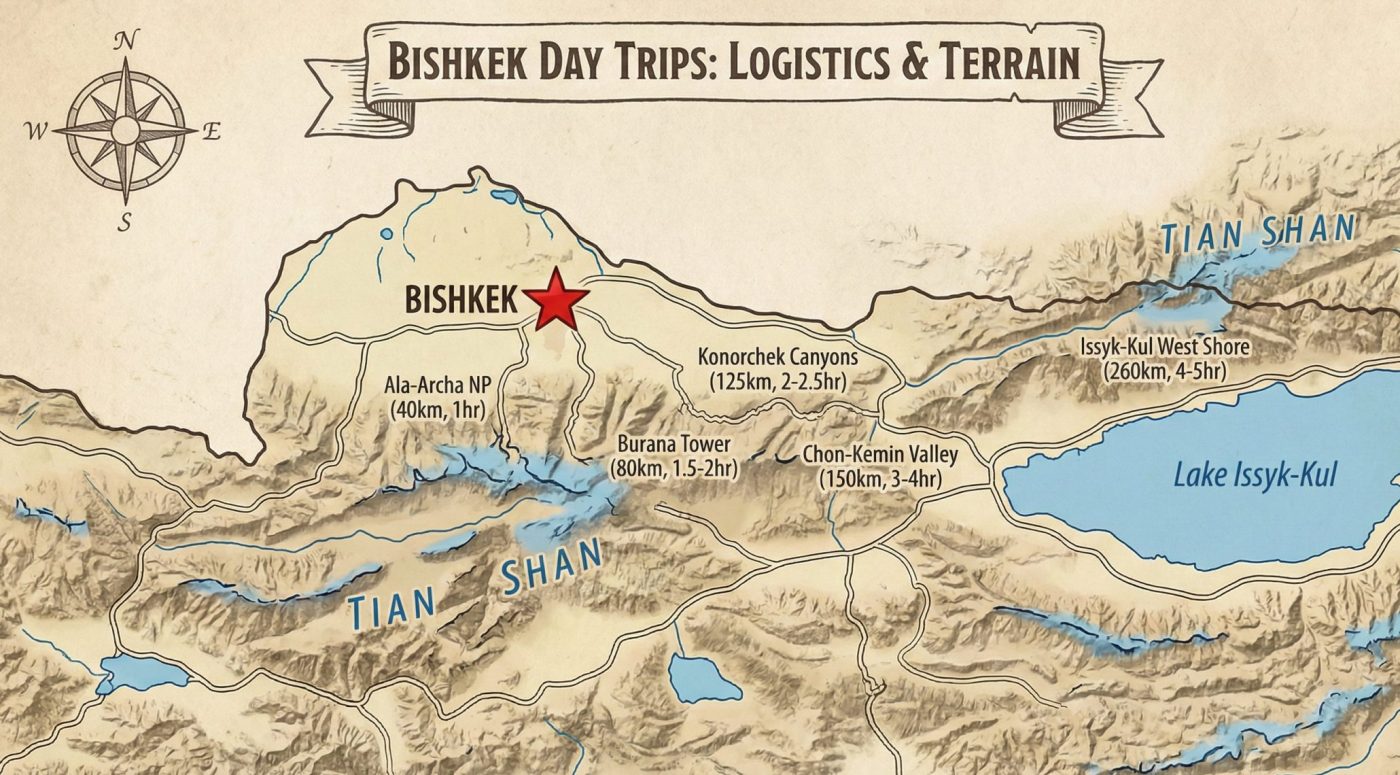
If you only have one free day in Bishkek, choose by total day length first. Kyrgyzstan looks compact on a map, but mountain roads, village traffic, weather and photo stops can turn a short-looking route into a long day.
| Trip | Total Day | Best For | Main Trade-Off |
|---|---|---|---|
| Ala-Archa National Park | 5–7 hours | Mountains, hiking, first-time visitors | Busy weekends; higher trails are steeper than they look |
| Burana Tower + Konorchek Canyon | 8–9 hours | Silk Road history + red-rock scenery | Exposed canyon walk with little shade |
| Issyk-Kul Lake | 10–12 hours | Iconic lake views | Very long road day |
| Chon-Kemin Valley | 8–12 hours | Horses, countryside, rural scenery | Longer drive than Ala-Archa |
| Bishkek walking / food tour | 3–5 hours | Arrival day, bad weather, no-drive option | You stay in the city |
The strongest all-round choice if you want mountain scenery and the main Bishkek sights in one organized day without committing to a long road trip.
Ala-Archa National Park — Best Easy Nature Day Trip
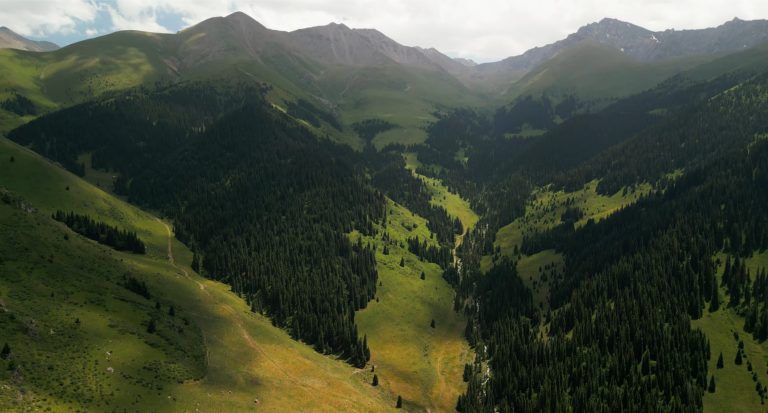
The easiest classic day trip from Bishkek is Ala-Archa National Park. It gives you the biggest mountain payoff for the least road time and works well for first-time visitors, short stays and travelers who want flexible walking rather than a full trekking day.
Ala-Archa is the obvious first move. Forty kilometers south, and suddenly you’re in high-altitude wilderness. No complicated planning. No overnight bags. Just granite walls and cold air.
What You’ll Actually See
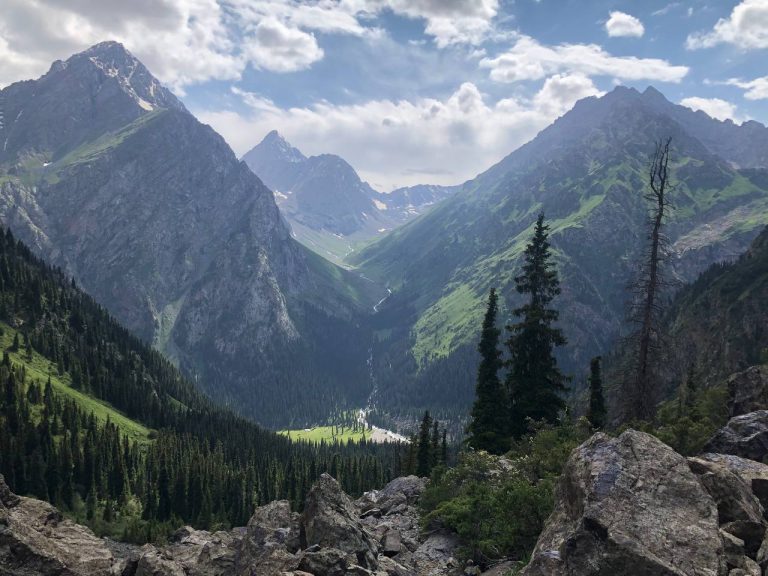
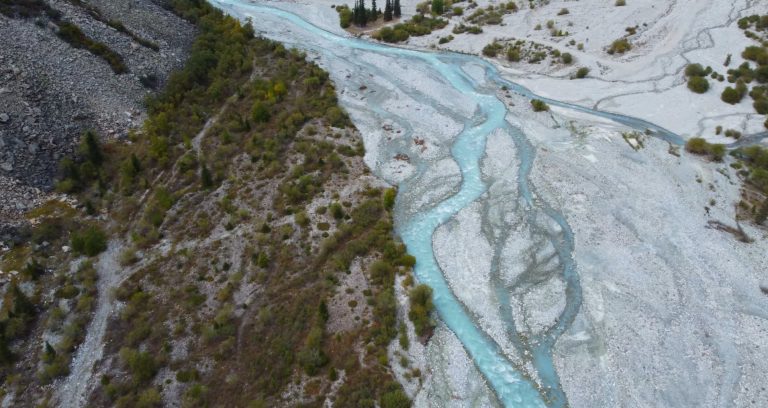
- Fast-flowing glacial rivers
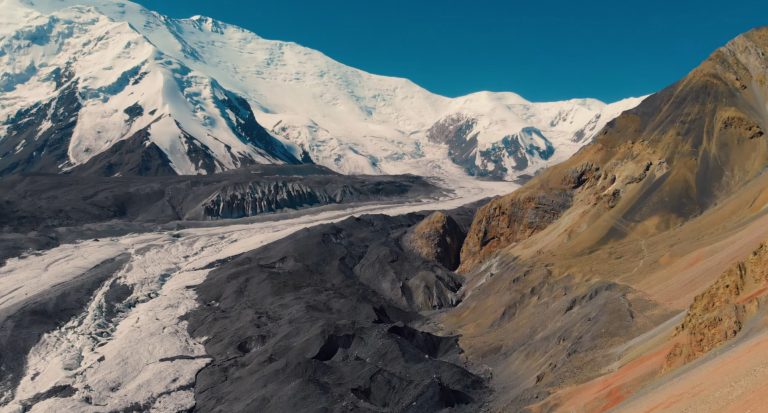
- Jagged granite summits
- Broad alpine meadows
- Snow patches lingering into early summer
The lower valley trail is forgiving. Mostly gradual. You can walk for an hour, maybe two, and still feel swallowed by the Tian Shan mountains. The scale hits you. Wide sky. Pine forest. That sharp mineral smell in the air.
Go higher and it gets steeper. Switchbacks. Loose rock. Thinner air. People underestimate that part.
Trail Options
- Valley walk (easy, mostly flat)
- Waterfall hike (moderate incline)
- Panoramic viewpoints (demanding, exposed sections)
The waterfall route is popular for a reason. It’s short enough to manage but steep enough to feel like you earned something. If you push to the viewpoints, expect a real climb. This is not a city park stroll.
When It Works Best
- Short stays in Bishkek
- Arrival or departure day
- Travelers skipping multi-day trekking routes
Weekends get busy. Families grilling meat. Kids running wild. It’s lively, sometimes chaotic. If you want quieter trails and cleaner photos, leave early.
Independent vs Coordinated Transport
You can hire a taxi from Bishkek. Easy enough. The tricky part is the return. Drivers may not wait. Mobile signal fades in parts of the valley. Negotiating pickup times can turn awkward if your hike stretches longer than planned.
Small-group departures run daily in peak season. Fixed schedule. Guaranteed ride back. Less stress. Some people prefer the independence. For a short stay, a guaranteed return ride can be more useful than maximum flexibility.
A good-value choice if you want several hours in the national park without paying for a private city-and-mountains itinerary.
Burana Tower + Konorchek Canyon — Best History + Canyon Day
This is the strongest mixed day trip from Bishkek if you want two very different landscapes in one route: Silk Road history at Burana Tower, then a dry red-rock hike in Konorchek Canyon. For route details, see the Burana Tower and Konorchek Canyon guide.
Burana Tower
Burana Tower sits alone in the steppe, a quiet reminder that this region once pulsed with Silk Road trade. The minaret dates back to somewhere between the 9th and 11th centuries and marked the ancient city of Balasagun.
Now it’s just wind. Grass. And that tower.
What Makes It Worth Visiting
- Climbable brick minaret with sweeping steppe views
- Balbal stone statues scattered nearby
- Open archaeological field
- Big horizon photography
The climb inside the minaret is tight. Dark steps. You feel the age in the bricks. At the top, the landscape stretches flat and endless. Hard to imagine caravans once passing through here, but they did.
On its own, Burana fills maybe an hour. Two if you linger, read plaques, wander the petroglyphs. Most travelers pair it with something else — otherwise the drive can feel disproportionate.
Best Combined With
- Konorchek Canyons
- Western shore of Issyk-Kul (long, full day)
- Village lunch stops along the highway
Summer heat can be brutal. There’s almost no shade. The steppe sun hits differently — dry, relentless. Bring water. More than you think.
If you’re curious about Silk Road history but don’t want a multi-day cultural itinerary, this is the simplest historical site near Bishkek. Compact. Photogenic. Direct.
Konorchek Canyon
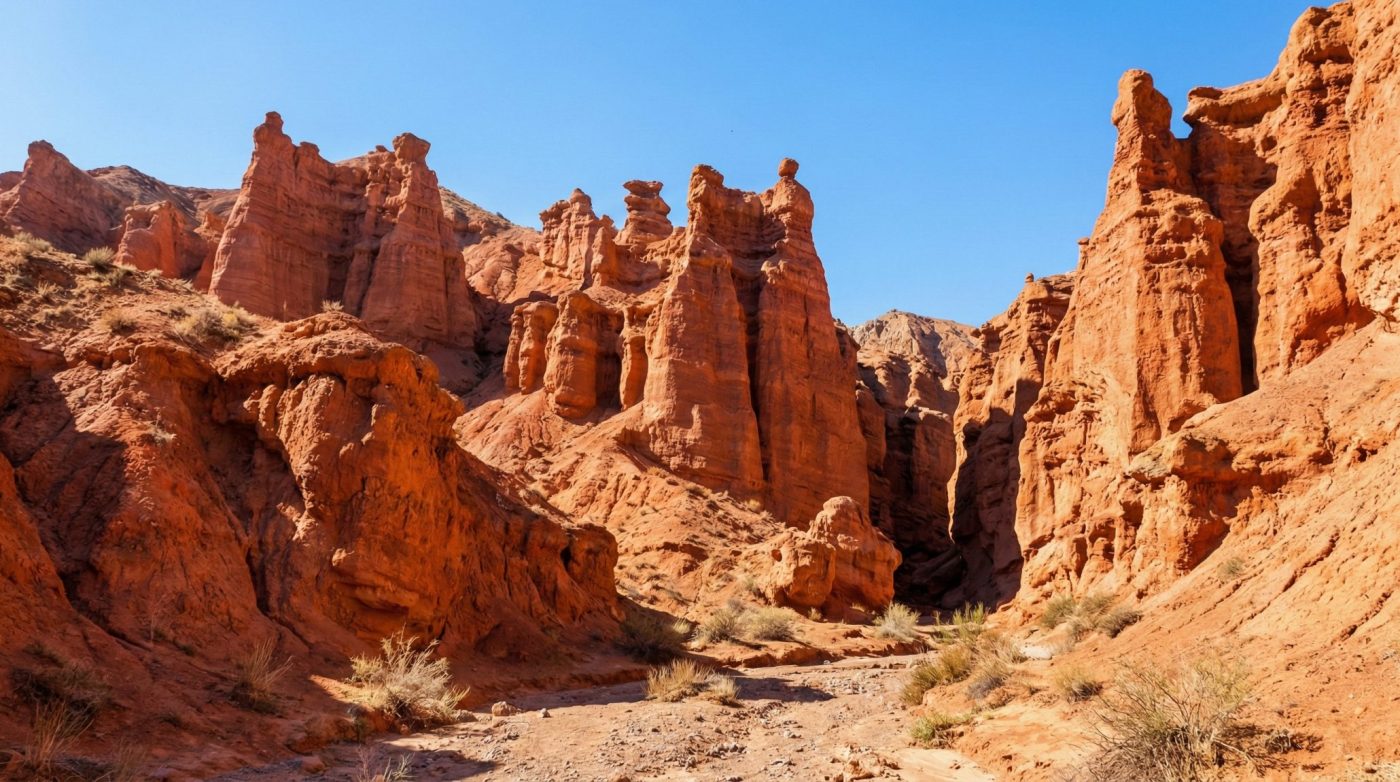
Konorchek Canyons usually get stitched together with Burana Tower, and that pairing just makes sense. You start with bricks and history, then end up inside a furnace of red stone. The canyon sits inside Boom Gorge, and the shift in scenery hits fast. One minute it’s steppe and road dust, the next it’s jagged sandstone walls glowing like they’re lit from inside. It doesn’t look anything like Ala-Archa’s alpine drama. No glaciers. No pine air. Just raw, baked rock.
What the Landscape Is Like
- Red sandstone rock towers
- Dry, desert-like terrain
- Natural columns and narrow passages
- Open skies with very little shade
The landscape feels very different from the alpine image many travelers associate with Kyrgyzstan: wide sky, cracked earth, red sandstone and almost no infrastructure.
Access and Walking Level
To reach the main formations, you walk. Around 3–4 km one way, sometimes a little more depending on how curious you get. The path isn’t technical in a mountaineering sense, but it’s uneven, rocky, and completely exposed. There is almost no shade, so summer sun exposure matters.
- Comfortable walking shoes required
- No facilities inside the canyon
- Bring water, especially in summer
- Limited phone signal
In peak summer, the heat can feel brutal — sharper than in Bishkek, heavier somehow. The rocks hold warmth and throw it back at you. Early departures help, especially in midsummer when the canyon heats up quickly.
How It Fits Into a Day
On its own, Konorchek can feel short. Beautiful, yes. But short. That’s why combining it with Burana Tower works so well. Together, you get a full 8–9 hour stretch that doesn’t drag. History in the morning, Martian canyon in the afternoon. It balances out.
Technically, you can organize private transport and do it independently. The roadside entrance is easy to miss though, and timing the return pickup can turn into a small logistical headache. A lot of travelers just book arranged departures because it removes the guesswork. You show up, you walk, you leave. Simple.
A more focused day than the Issyk-Kul combination: enough time for Burana and the canyon without turning the trip into a 10–12 hour road marathon.
Issyk-Kul Lake — Best Big Day Trip if You Accept the Drive
Issyk-Kul is massive. The scale is the first thing you notice. One of the largest alpine lakes on the planet, sitting at 1,600 meters above sea level, wrapped in snow-capped ranges on both sides. It looks calm from a distance, almost polite. Then you get closer and realize it behaves like a sea.
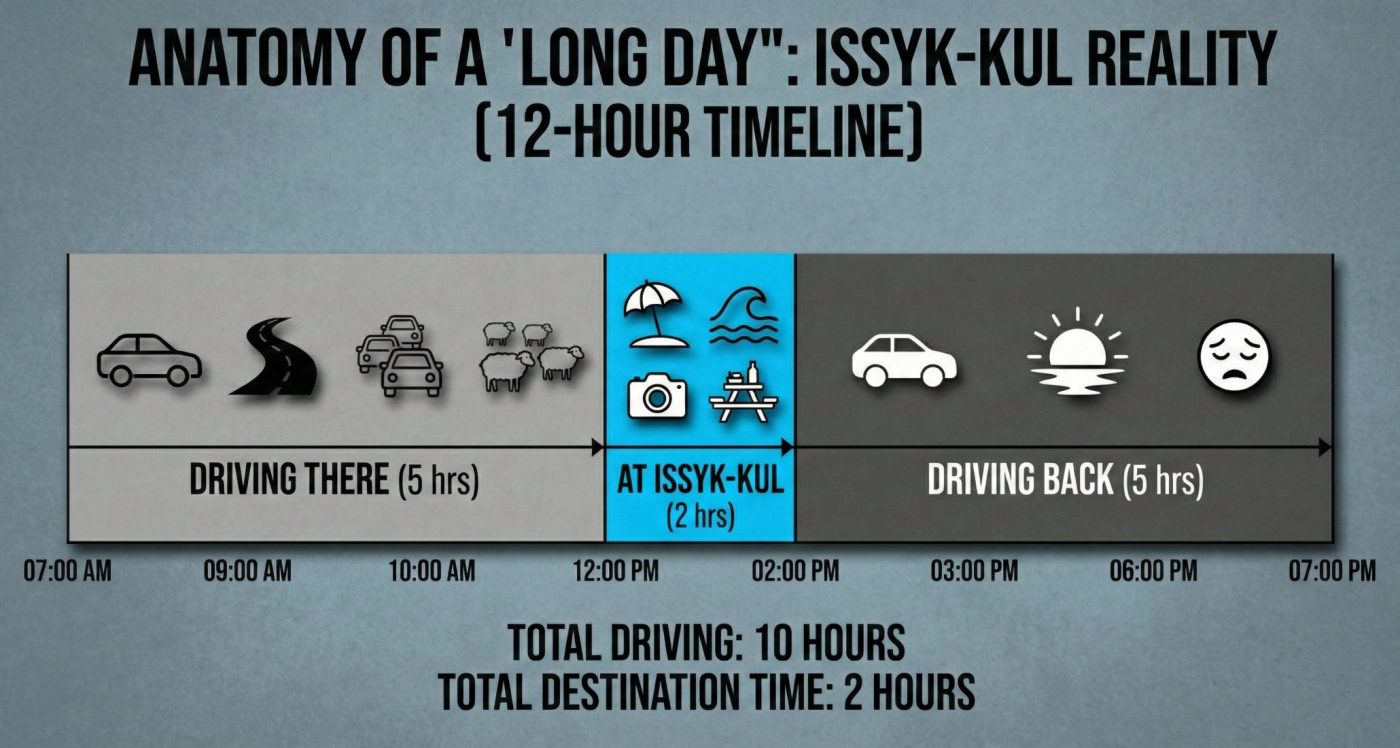
From Bishkek, Cholpon-Ata and the north-shore resort area typically take around 4 hours or more each way once traffic and stops are included. So yes, it is possible as a day trip, but you are committing to the drive as much as the destination.
What You Can Realistically See in One Day
- Western shoreline views
- Beach walks near Cholpon-Ata
- Rukh Ordo cultural complex
- Mountain-lake panoramas along the highway
You will not circle the entire lake in one day. Most single-day visits stick to one reachable section — usually the western or northwestern side. You stop, walk along the shore, maybe dip your hands in the water, take those wide mountain-and-water shots photographers love.
Road Conditions and Timing
- Modern highway sections mixed with slower village zones
- Occasional livestock crossings
- Variable traffic during summer
The highway is decent in long stretches, but village traffic, livestock and summer congestion can slow the day. Summer traffic can thicken near resort towns. Leaving before 8:00 AM isn’t just a suggestion — it changes the entire feel of the day. Evening returns often happen after sunset. Long shadows. Tired silence in the car.
Who This Day Trip Is For
- Travelers with only one free day outside Bishkek
- Visitors who want to see Kyrgyzstan’s iconic lake
- Photographers interested in wide mountain-water compositions
Who Should Consider Staying Overnight
- Slow travelers
- Families with young children
- Anyone uncomfortable with long road days
If you don’t have a rental car, coordinating transport makes a big difference. Managing a 9–10 hour round-trip drive alone is exhausting. For short-stay visitors, that practical detail — not the scenery — is usually what decides it.
If Issyk-Kul is the day trip that interests you most, compare this fast format with a slower Issyk-Kul tour from Bishkek. An overnight route usually makes more sense if you want Cholpon-Ata, the north shore, swimming time, or a less rushed lake experience.
The packed option: Burana, canyon scenery and Issyk-Kul in one day. Excellent for variety, but expect a long day with limited time at each stop.
A better fit if the lake is the priority: private transport, more Issyk-Kul time and fewer compromises than the all-in-one route, although it is still a very long day.
Chon-Kemin Valley — Best Horse-Riding Day Trip
For a deeper look at the valley itself, see the Chon-Kemin Valley guide.
Chon-Kemin feels different. Softer. Quieter. No dramatic cliffs trying to dominate your camera roll. Just open meadows, scattered villages, and slopes that rise gently instead of exploding upward. It’s pastoral, almost nostalgic. You hear animals before you see them.
Main Activities
- Horseback riding
- Short scenic hikes
- Village guesthouse lunches
- Light cultural experiences
The valley isn’t vertical like Ala-Archa. It isn’t dry and sculpted like Konorchek. It sits somewhere in between — green, spacious, relaxed. It feels slower and more rural than the sharper mountain scenery around Ala-Archa.
Horseback Riding Considerations
If riding is the main reason for the trip, compare more options in the Kyrgyzstan horse-riding tours guide.
- Beginner-friendly options available
- Basic riding instructions provided locally
- Weather-dependent scheduling
Most riding options are accessible even for beginners. Local guides give quick, practical instructions — nothing fancy, just enough to keep you balanced. Weather can shift plans though. Rain changes everything out there. Trails get slick, horses get moody. It happens.
For travelers who want mountains without altitude strain, Chon-Kemin Valley is comfortable. No lung-burning climbs. No desert heat blasting your face. Just rolling terrain and rural roads that can be uneven in places, especially outside peak maintenance periods. Travel time depends on season, traffic, and a bit of luck. That’s part of it.
A full-day private route combining Burana Tower, Chon-Kemin scenery, horseback riding and a traditional Kyrgyz lunch.
No-Drive Alternatives in Bishkek
If you do not want another long road day, a Bishkek walking tour or food tour is the better fallback. These are especially useful on arrival days, in poor mountain weather, or when you want an easier first look at the city.
- Walking tour: Soviet architecture, Ala-Too Square, city orientation and local context.
- Food tour: markets, Kyrgyz dishes and an easy introduction to local food culture.
If food is the main focus, read the Kyrgyzstan food guide before you start ordering in markets, cafes and local restaurants. You can also compare dedicated options in the Bishkek food tour guide and Bishkek city tour guide.
Not really a day trip, but a strong fallback when you want an easy half-day of Kyrgyz food, markets and city sights without a long drive.
How to Choose a Bishkek Day Trip
The practical choice usually comes down to two things: how many hours you are willing to spend on the road and how much walking you want once you arrive.
| Destination | Road Commitment | Walking Effort | Best Fit |
|---|---|---|---|
| Ala-Archa | Low | Easy to demanding | Best overall mountain escape |
| Burana Tower | Low–moderate | Very light | History with minimal walking |
| Burana + Konorchek | Moderate | Moderate | Best landscape contrast |
| Issyk-Kul | High | Very light | Iconic lake, limited time in Kyrgyzstan |
| Chon-Kemin | Moderate | Flexible | Rural scenery and horse riding |
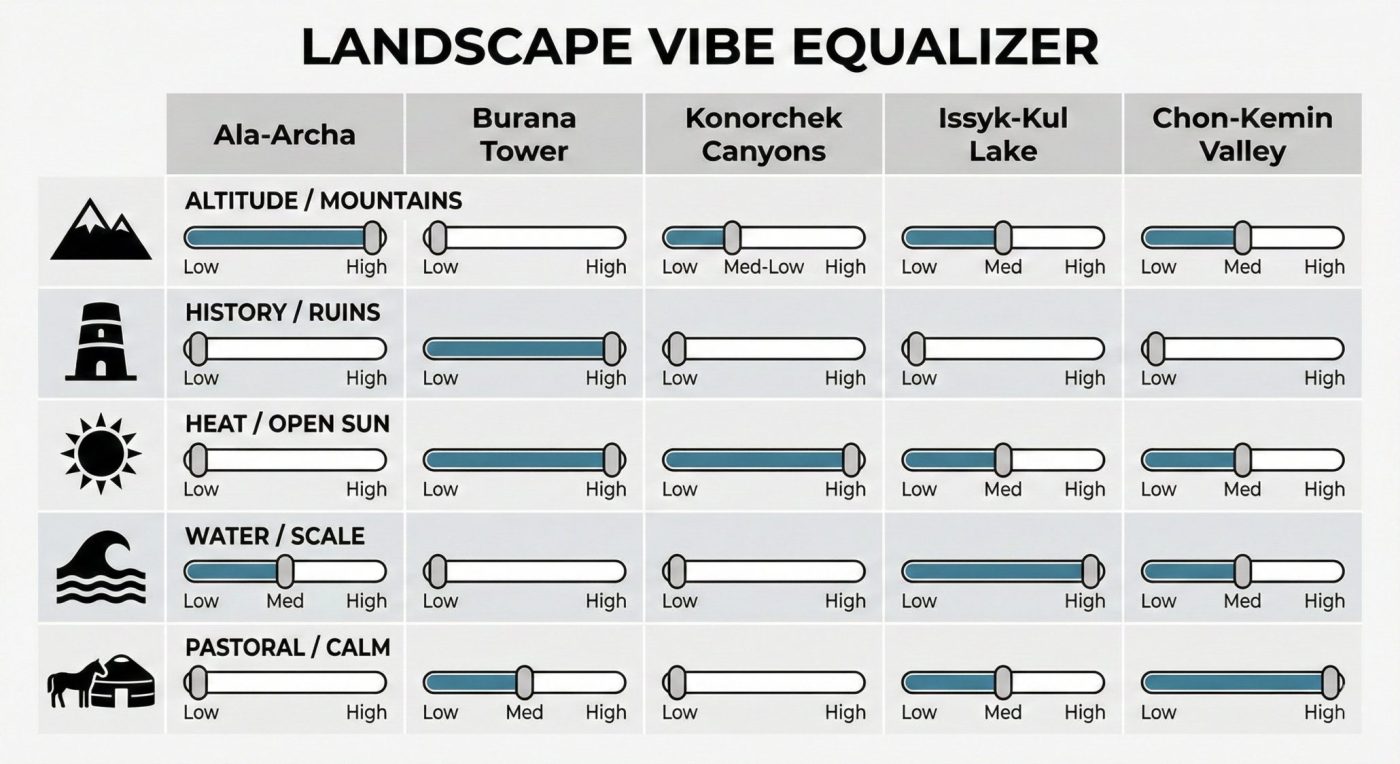
If you want the biggest mountain payoff with the least road time, choose Ala-Archa. Choose Burana + Konorchek for the strongest history-and-landscape combination. Choose Issyk-Kul only if seeing the lake matters more than avoiding a long drive. Choose Chon-Kemin if horses and rural scenery are the priority.
Seasonal Considerations
Mountain weather changes quickly. A clear morning in Bishkek can turn into a cold afternoon in Ala-Archa, while steppe and canyon routes may be hot and exposed.
Spring (April–May)
- Snow may linger on higher alpine trails
- Rivers run strong with meltwater
- Valleys explode into green
Lower Ala-Archa works well. Burana is simple any time the road is clear. Konorchek can feel exposed if the wind picks up — and it often does.
Summer (June–August)
- Peak visitor flow
- Heat in steppe and canyon zones
- Sharp mountain visibility
Start early. Konorchek under midday sun is brutal, all reflected heat and dry air. Issyk-Kul is refreshing by comparison, especially if you dip your feet in. Ala-Archa stays cooler because of altitude, which feels like cheating in the best way.
Autumn (September–October)
- Fewer travelers
- Stable early-season weather
- Gold and amber tones in valleys
Early autumn is often the sweet spot. Crisp air. Clear skies. Less traffic on the road. Everything feels sharper, quieter.
Winter (November–March)
- Snow restricts higher routes
- Road conditions vary widely
- Mountain scenery turns stark and dramatic
Ala-Archa’s lower valley still delivers serious alpine atmosphere, just colder. Burana remains accessible most of the time. Konorchek depends heavily on road surface and recent snowfall — sometimes fine, sometimes not worth the gamble.
What Travelers Underestimate
The biggest mistake is treating distance in Kyrgyzstan as a simple kilometer calculation. Mountain roads, village speed limits, livestock, weather and photo stops all add time. Once a route involves more than about three hours of driving each way, the road becomes a major part of the day.
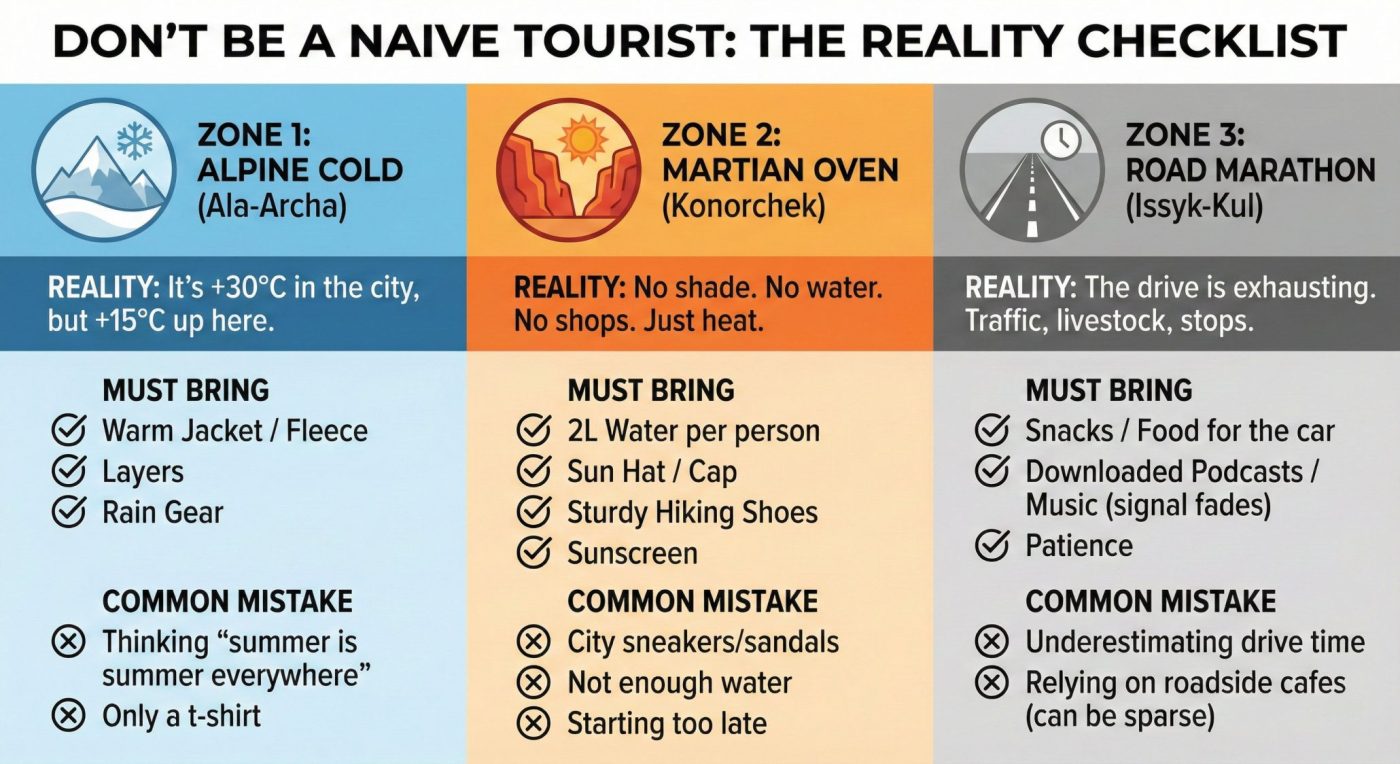
- Weather: Bishkek can be warm while Ala-Archa is cold, windy or wet.
- Sun exposure: Konorchek and Burana have very little shade.
- Food and water: services thin out quickly outside the city and main lake towns.
- Daylight: late starts make long combinations feel rushed.
Choose one anchor destination rather than stacking every possible stop. Ala-Archa works well as a flexible mountain day. Burana combines naturally with Konorchek. Issyk-Kul is already a major road commitment on its own.
Independent vs Organized Day Trips
Independent travel gives you more control over timing, stops and pace. Organized departures are more useful when return transport is uncertain, the day is long, or you do not want to manage rural road logistics.
| Factor | Independent | Organized Tour |
|---|---|---|
| Flexibility | High | Fixed or semi-fixed schedule |
| Driving / navigation | You manage it | Handled for you |
| Return transport | Must be arranged | Included |
| Best for | Longer stays, confident drivers | Short stays, long day trips, first-time visitors |
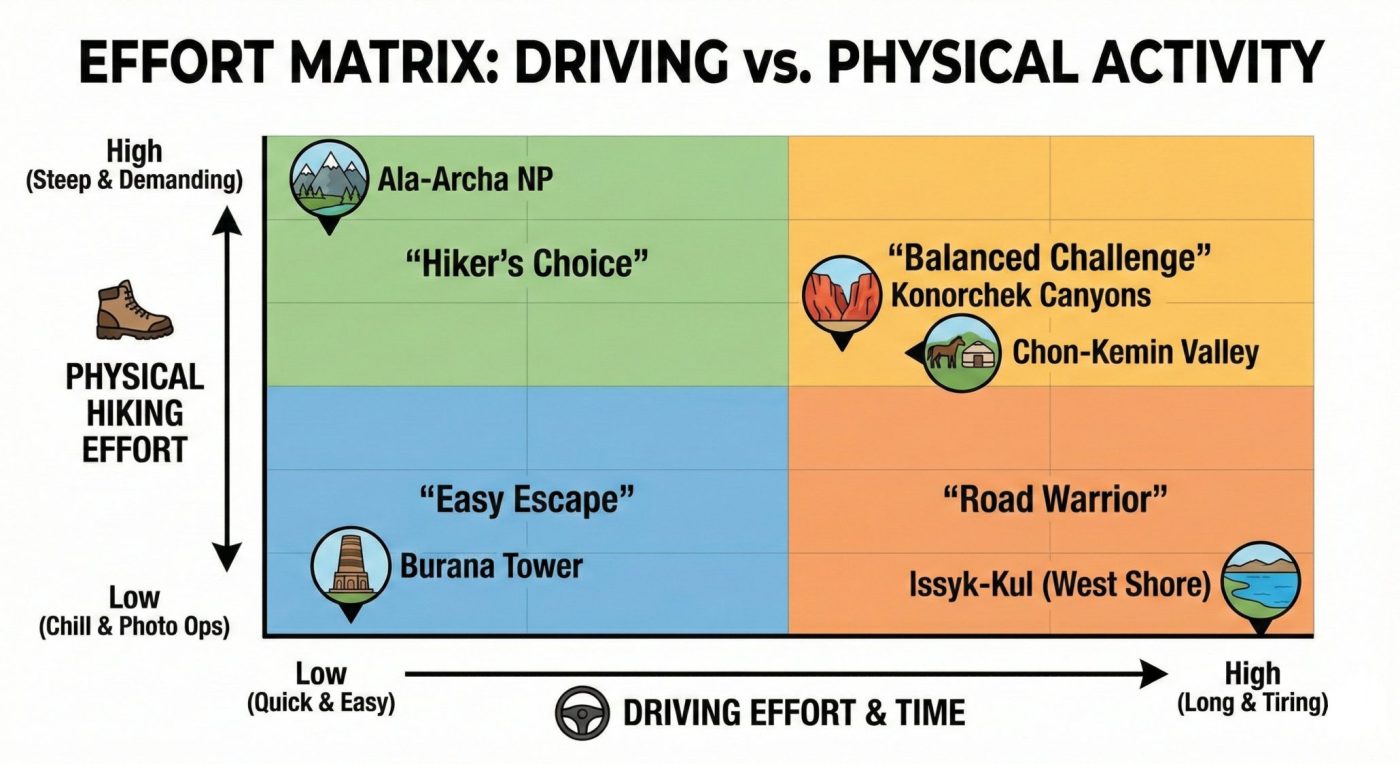
Ala-Archa and Burana are the easiest to arrange independently. Konorchek becomes more convenient with coordinated transport because the access point and return timing matter. Issyk-Kul and Chon-Kemin are possible independently, but an organized departure removes a lot of driving and timing friction.
FAQ About Day Trips from Bishkek
What is the best day trip from Bishkek?
Ala-Archa is the best all-round choice for most first-time visitors because it delivers mountain scenery with the least road time. Burana + Konorchek is better if you want history and canyon scenery in the same day.
Can you visit Issyk-Kul as a day trip from Bishkek?
Yes, but it is a long day. A fast day trip works if seeing the lake matters more than minimizing road time, while an overnight trip is better if you want more time on the shore.
Can you visit Ala-Archa without a tour?
Yes. Ala-Archa is one of the easier day trips to arrange independently by taxi or private car. The main practical issue is making sure you have reliable return transport from the park.
Which Bishkek day trip has the least driving?
Ala-Archa has the least driving among the classic out-of-city day trips. If you want no long drive at all, choose a Bishkek walking tour or food tour instead.
Final Thoughts on Day Trips from Bishkek
No single route defines this country. Ala-Archa’s alpine sharpness, the open steppe around Burana, Konorchek’s carved red rock, the vast blue of Issyk-Kul — they feel like different worlds stitched together by one capital city.
Trying to cover too many places in one day usually means more road time and less time at the destination. Choose the landscape that pulls at you. Start early. Let the road stretch. Let it slow you down a little. Even one focused day outside Bishkek can feel wide and alive, like you stepped briefly into something much bigger than your schedule.
And if you’re building a longer Kyrgyzstan itinerary, these routes work as an introduction — a first taste of mountain air, nomadic history, canyon silence. Short visit? You still get a strong impression. Long stay? You’ll realize these were just the beginning.