
How Many Tourists Visit Kyrgyzstan Each Year?
Kyrgyzstan’s tourism figures vary depending on what is being measured. The latest official tourism-sector figures indicate that approximately 5.31 million visitors were recorded across the country’s organized and unorganized tourism sectors in 2025, up from 3.66 million in 2024.
A separate border statistic recorded approximately 10.51 million entries by foreign citizens in 2025. These figures should not be treated as competing estimates of the same market. The tourism-sector total includes domestic as well as international tourism activity, while the border figure counts entries by foreign citizens and may include repeat crossings, private visits, business travel and regional movement.
Quick Answer: How Many Tourists Visit Kyrgyzstan Each Year?
| Metric | 2025 Figure | What It Measures |
|---|---|---|
| Visitors recorded in tourism statistics | 5.31 million | Domestic and international visitors recorded across organized and unorganized tourism sectors. |
| Foreign-citizen border crossings | 10.51 million | Entries across the border by foreign citizens, including repeat crossings and travel for purposes other than tourism. |
| Best short answer | No single figure measures foreign leisure tourism precisely | Use 5.31 million for the recorded tourism-sector total and 10.51 million for foreign-citizen border crossings. The two figures measure different things and should not be treated as interchangeable tourist counts. |
How Tourism Is Counted in Kyrgyzstan
There are two main ways to answer the question. Both are useful, but they do not measure the same thing.
- Recorded tourism-sector visitors: The National Statistical Committee reports visitors in both organized and unorganized tourism sectors. The total includes domestic tourism and should not be interpreted as a count of foreign holidaymakers.
- Foreign-citizen border crossings: Border data counts entries by foreign citizens. It may include leisure trips, private and family visits, business travel, transit, short regional movement and repeat crossings by the same person.
The two series overlap, but they are not directly comparable. One measures activity recorded within the tourism sector; the other measures movements across the national border.
Because Kyrgyzstan has strong regional movement with neighboring countries, these two numbers can be far apart. That is why one source may show about 3.66 million tourists, while another shows close to 9 million visitor arrivals.
Visitors Recorded in Kyrgyzstan’s Tourism Sectors by Year
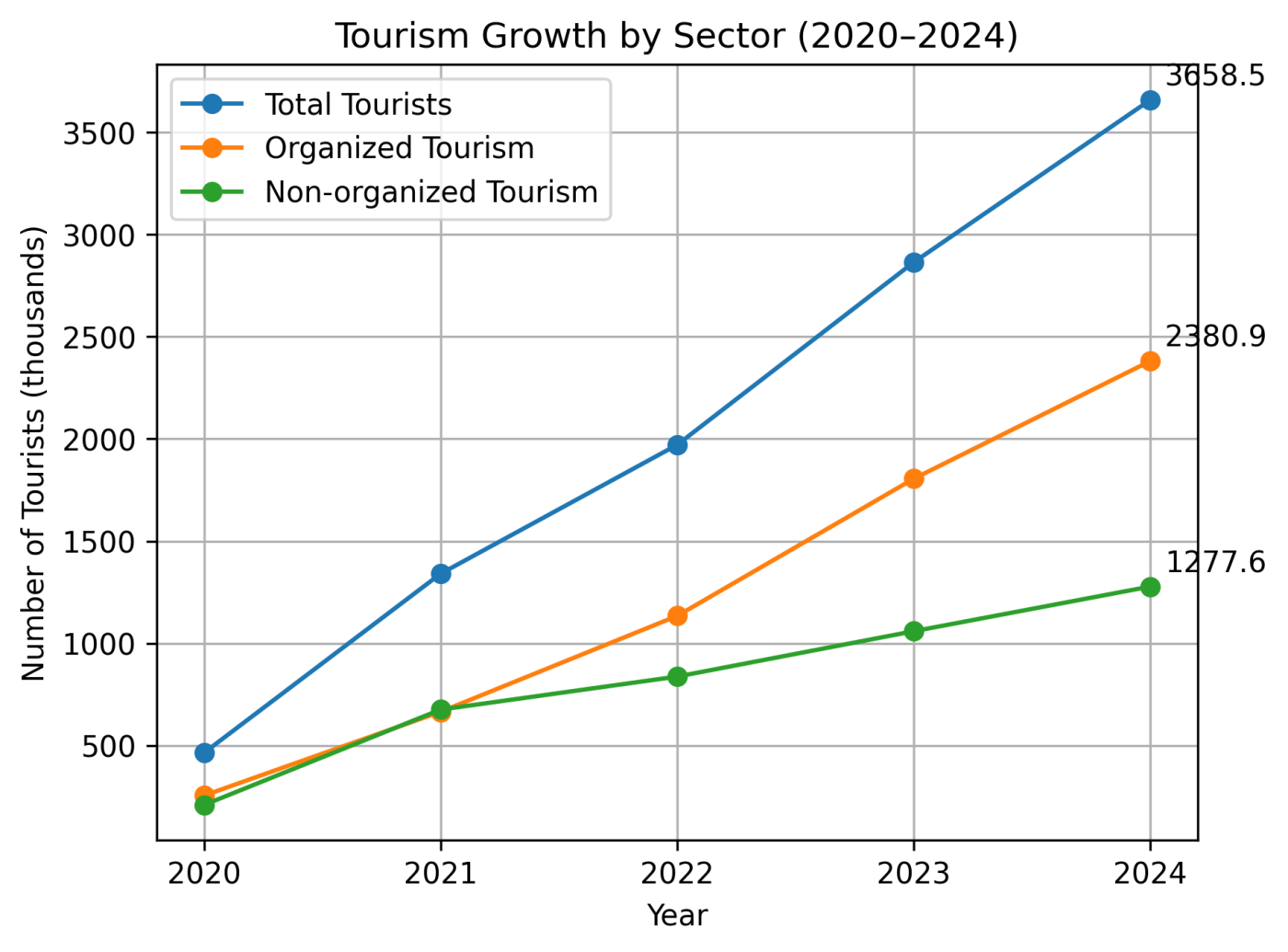
According to the National Statistical Committee of the Kyrgyz Republic, the number of officially recorded tourists has grown steadily since the post-pandemic rebound.
| Year | Official Tourists | Change vs Previous Year |
|---|---|---|
| 2020 | 463,900 | Post-pandemic low period |
| 2021 | 1,340,200 | Recovery begins |
| 2022 | 1,970,900 | Continued rebound |
| 2023 | 2,864,200 | Strong growth |
| 2024 | 3,658,500 | +27.7% |
| 2025 | Approximately 5.31 million | +45.2% |
The 2025 total represents another sharp increase in recorded tourism activity. Approximately 3.57 million visitors were recorded in the organized sector, including hotels, boarding houses, sanatoriums and other formal tourism facilities, while about 1.73 million were recorded in the unorganized sector.
Data note: The National Statistical Committee’s online dynamic table still displays the 2020–2024 series, while newer 2025 figures were released separately in 2026. The figures above therefore combine the historical open-data series with the latest published 2025 update.
These figures cover visitors recorded in both the organized and unorganized tourism sectors. In 2024, approximately 2.38 million were attributed to the organized sector and 1.28 million to the unorganized sector.
The series includes domestic tourism activity and therefore should not be used as a direct measure of international leisure arrivals.
Foreign-Citizen Border Crossings into Kyrgyzstan
If the question is interpreted more broadly as “how many foreign visitors enter Kyrgyzstan each year,” the number is considerably higher than the tourism-sector total.
| Metric | 2024 | 2025 |
|---|---|---|
| Recorded tourism-sector visitors | 3.66 million | Approximately 5.31 million |
| Foreign-citizen border entries | 8.86 million | Approximately 10.51 million |
Foreign-citizen border entries increased by about 18.7% in 2025. Uzbekistan accounted for the largest share, followed by Kazakhstan and Russia, while arrivals from China also increased sharply.
The distinction matters. 5.31 million represents recorded activity across Kyrgyzstan’s organized and unorganized tourism sectors and includes domestic tourism. 10.51 million represents entries by foreign citizens at the border. A traveler crossing the border several times may therefore appear several times in the border statistic.
Why Tourist Numbers and Arrivals Are Not the Same
The gap between official tourist counts and total arrivals exists for several practical reasons.
None of them are surprising if you’ve spent time in the region.
- Many visitors enter the country for short private or family visits.
- Cross-border travel from neighboring states often lasts less than one night.
- A large share of visitors never stays in registered accommodation.
It is not valid to divide the 3.66 million tourism-sector total by the border-crossing figure to estimate what percentage of foreign arrivals were tourists. The two datasets cover different populations and use different methods.
Tourism Growth Trend
Despite differences in methodology, all major sources point in the same direction.
Tourism volumes recovered strongly after the slowdown and pushed into record or near-record territory.
Most of that growth comes from summer travel, mountain routes, eco-tourism, and increased regional mobility within Central Asia. For trip-planning context rather than national statistics, see the Kyrgyzstan travel guide and the guide to when to visit Kyrgyzstan.
Different labels, same momentum.
Economic Contribution of Tourism in Kyrgyzstan
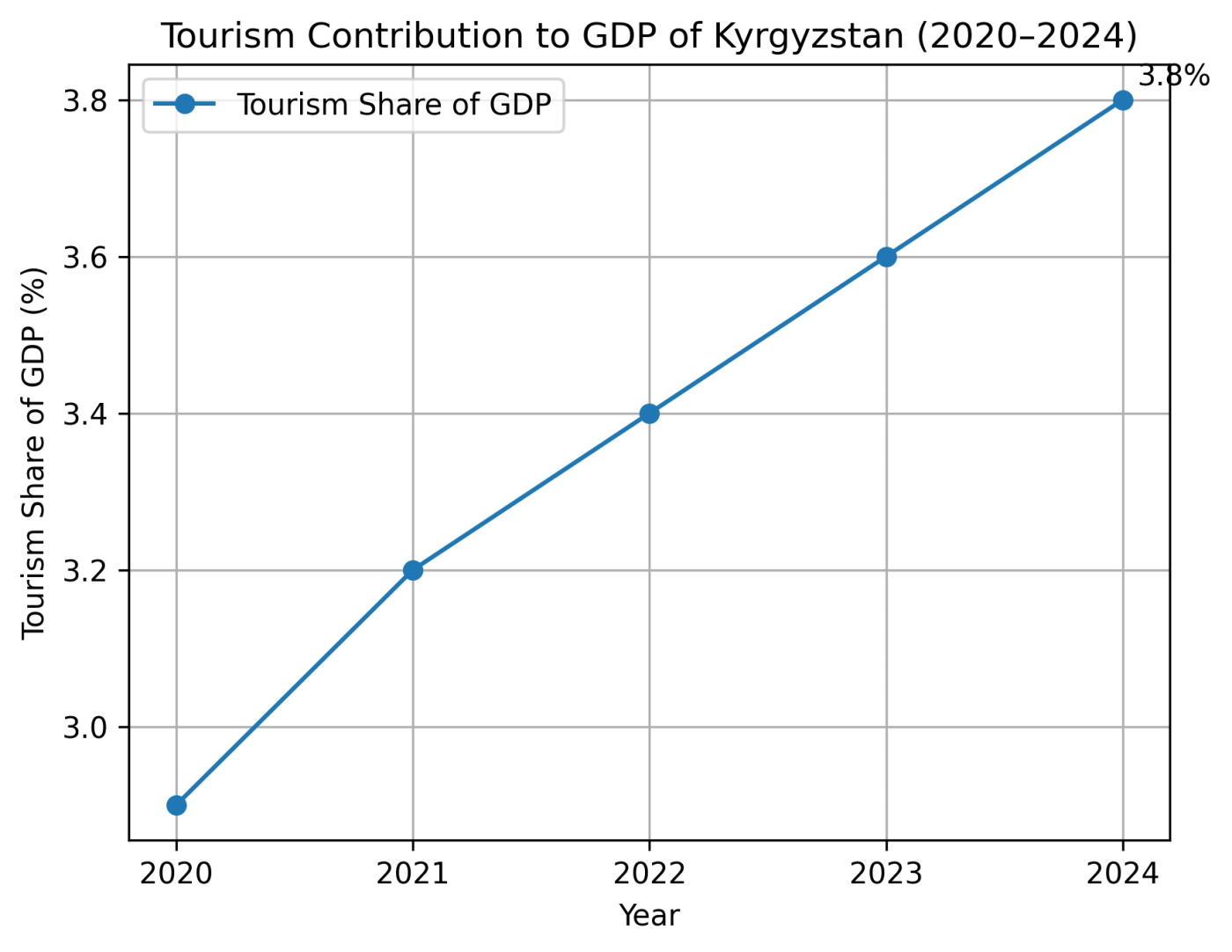
Tourism’s economic footprint has continued to expand alongside the growth in recorded visitor activity. The latest figures from the National Statistical Committee show a substantial increase in tourism-related value added in 2025.
| Year | Tourism Value Added (million soms) | Tourism Share of GDP | Capital Investment in Tourism (million soms) |
|---|---|---|---|
| 2020 | 18,506 | 2.9% | 13,654 |
| 2021 | 24,971 | 3.2% | 12,915 |
| 2022 | 35,158 | 3.4% | 19,392 |
| 2023 | 47,855 | 3.6% | 16,875 |
| 2024 | 57,616 | 3.64% | 23,313 |
| 2025 | 74,372 | 3.76% | 19,505 |
Data note: The 2024 value-added and GDP-share figures above use the comparative figures published by the National Statistical Committee in its 2025 tourism update. They differ slightly from earlier preliminary 2024 releases.
Tourism-related gross value added increased from approximately 57.6 billion soms in 2024 to 74.4 billion soms in 2025. Tourism accounted for about 3.76% of GDP in 2025, compared with 3.64% in the revised 2024 comparison.
The picture was less uniform for investment. Fixed-capital investment associated with tourism declined from approximately 23.3 billion soms in 2024 to 19.5 billion soms in 2025, even as the sector’s economic output continued to grow.
Another useful measure is tourism-service exports, which represent revenue associated with receiving foreign visitors. These reached approximately $1.10 billion in 2025, up from $1.02 billion in 2024.
Early 2026 update: Preliminary figures for January–March 2026 show tourism gross value added of approximately 10.96 billion soms, compared with 8.20 billion soms in the same period of 2025. Tourism-service exports reached $250.3 million, up 8.5% year over year. These are first-quarter figures and should not be compared directly with the full-year totals above.
Sources: National Statistical Committee — 2025 tourism indicators; National Statistical Committee — January–March 2026 tourism indicators.
Tourism Infrastructure: Sanatoriums and Holiday Facilities
Tourism growth in Kyrgyzstan has also been accompanied by an expansion of tourism infrastructure.
Sanatoriums, holiday homes, and recreational facilities play a particularly important role, especially around Issyk-Kul and other mountain resort areas.
According to data from the National Statistical Committee, the number of organized recreation facilities increased significantly between 2020 and 2024.
Tourism infrastructure often grows more slowly than visitor numbers. In Kyrgyzstan, however, the expansion of sanatoriums and holiday facilities has followed tourism demand closely.
| Type of Facility | 2020 | 2021 | 2022 | 2023 | 2024 |
|---|---|---|---|---|---|
| Total Facilities | 97 | 155 | 182 | 190 | 186 |
| Tourist Bases | 9 | 11 | 11 | 11 | 12 |
| Sanatoriums | 9 | 10 | 11 | 13 | 13 |
| Children’s Sanatoriums | 4 | 4 | 5 | 7 | 4 |
| Preventive Health Resorts | 11 | 12 | 12 | 13 | 10 |
| Holiday Homes | 4 | 6 | 5 | 5 | 4 |
| Resort Boarding Houses | 52 | 70 | 93 | 91 | 97 |
| Medical Boarding Houses | 1 | 1 | 1 | 2 | 2 |
| Other Recreation Facilities | 6 | 20 | 20 | 20 | 21 |
| Sports and Health Camps | 1 | 4 | 10 | 15 | 12 |
| Children’s Health Complexes | — | 17 | 14 | 13 | 11 |
Several trends are visible in the data.
- The total number of recreation facilities almost doubled between 2020 and 2023.
- Resort boarding houses represent the largest segment of tourism accommodation.
- Sports and wellness camps expanded rapidly during the tourism recovery period.
- Infrastructure development has been particularly visible around major resort areas such as Issyk-Kul.
Source: National Statistical Committee of the Kyrgyz Republic.
Major Tourist Regions of Kyrgyzstan
Tourism in Kyrgyzstan is not evenly distributed across the country.
Most visitor activity concentrates in a small number of regions where natural landscapes, transport accessibility, and existing resort infrastructure overlap.
While exact visitor counts by region are not always published in a standardized format, tourism reports and regional statistics consistently identify several core tourism zones.
| Region | Main Attractions | Tourism Profile |
|---|---|---|
| Issyk-Kul Region | Lake Issyk-Kul, Cholpon-Ata resorts, beaches, alpine landscapes | The main tourism hub of Kyrgyzstan. Summer lake tourism dominates. |
| Bishkek and Chuy Region | Ala-Archa National Park, city tourism, cultural sites | Gateway region for international visitors and domestic tourism. |
| Naryn Region | Song-Kul Lake, nomadic culture, high mountain pastures | Adventure tourism, trekking, yurt camps, horse trekking. |
| Sulaiman-Too Mountain (UNESCO), Silk Road heritage | Historical tourism and regional cultural travel. | |
| Batken Region | Alay Mountains, remote trekking routes | Emerging destination for mountaineering and adventure tourism. |
Several structural patterns define tourism geography in Kyrgyzstan.
- Lake tourism around Issyk-Kul remains the dominant driver of visitor numbers.
- Mountain regions such as Naryn attract smaller but longer-staying adventure travelers.
- Bishkek functions primarily as the entry gateway and logistical hub for international tourism.
- Southern regions like Osh combine cultural heritage tourism with regional mobility from neighboring countries.
Because Kyrgyzstan’s tourism economy is strongly nature-based, travel flows tend to concentrate around lakes, mountain valleys, and national parks rather than large cities.
Sources and Methodology
This page distinguishes between two official statistical concepts that are often presented under the general label of tourism.
- Tourism-sector visitors: The National Statistical Committee’s open-data series records visitors in organized and unorganized tourism sectors. It includes both domestic and international activity.
- Foreign-citizen border crossings: The Border Service records crossings into Kyrgyzstan by citizenship. These figures measure entries rather than unique leisure tourists.
The two datasets should be used for different purposes. The tourism-sector series is useful for tracking recorded tourism activity over time. Border data is useful for understanding the scale and geographic origin of international movement, but it does not identify the purpose of every trip.
Primary sources:
- National Statistical Committee: Number of Visitors in Organized and Unorganized Tourism Sectors — historical visitor series.
- National Statistical Committee: Main Indicators of Tourism Development in 2025 — latest full-year economic indicators.
- National Statistical Committee: Main Indicators of Tourism Development, January–March 2026 — latest short-term tourism indicators.
- Kabar: 2025 tourism-sector visitor totals, reporting National Statistical Committee figures.
- Kabar: 2025 foreign-citizen border crossings, based on State Border Service data.
Which Countries Account for the Most Border Crossings?
In 2024, most recorded entries by foreign citizens were made by citizens of neighboring Central Asian states. According to the official border-crossing distribution:
- Uzbekistan: 61.3%
- Kazakhstan: 27.9%
- Russia: 5.6%
- China: 1.4%
- Other countries: 3.8%
These percentages describe border crossings by citizenship. They do not show the purpose of travel, the number of unique visitors or how long each person stayed.
Which Countries Account for the Most Border Crossings?
Most foreign-citizen border crossings into Kyrgyzstan continue to come from neighboring Central Asian countries. In 2025, citizens of CIS countries accounted for approximately 9.87 million crossings, while citizens of other countries accounted for about 641,000.
| Country | Border Crossings in 2025 |
|---|---|
| Uzbekistan | 6.57 million |
| Kazakhstan | 2.63 million |
| Russia | 557,500 |
| China | 281,900 |
| Turkey | 69,500 |
Uzbekistan alone accounted for the majority of regional cross-border movement, while Uzbekistan and Kazakhstan together represented by far the largest share of foreign entries.
China remains much smaller in absolute terms but recorded one of the strongest increases: crossings by Chinese citizens rose from about 128,000 in 2024 to nearly 282,000 in 2025.
These figures count border crossings by citizenship, not unique tourists. They do not show the purpose of travel or the length of stay, and the same person may be counted more than once.
FAQ: Kyrgyzstan Tourism Statistics
How many tourists visit Kyrgyzstan annually?
The latest published tourism-sector figures indicate that approximately 5.31 million visitors were recorded in Kyrgyzstan in 2025, up 45.2% from about 3.66 million in 2024. The total includes both domestic and international tourism activity recorded across organized and unorganized sectors.
How many international arrivals does Kyrgyzstan receive?
Foreign citizens made approximately 10.5 million border crossings into Kyrgyzstan in 2025. This is a border-entry statistic, not a count of unique international tourists. Repeat crossings and travel for business, private visits and other purposes may all be included.
Why do some sources show much higher tourism numbers?
The figures measure different things. The 5.31 million tourism-sector total includes domestic tourism, while the 10.5 million border figure counts entries by foreign citizens. Neither figure represents a precise count of unique foreign leisure tourists.
What is the best number to cite for Kyrgyzstan tourism?
Use approximately 5.31 million when referring to visitors recorded in Kyrgyzstan’s tourism sectors in 2025. Use approximately 10.5 million when referring specifically to foreign-citizen border crossings. The two figures should not be used interchangeably.
What are the main tourist regions in Kyrgyzstan?
The main tourist regions are Issyk-Kul, Bishkek and Chuy, Naryn, Osh and mountain areas connected with trekking, lakes, yurt stays and adventure travel.
What is the best number to cite for Kyrgyzstan tourism?
Use about 3.66 million for official tourists in 2024. Use about 8.6–8.9 million if you are discussing broader international visitor arrivals.
What are the main tourist regions in Kyrgyzstan?
The main tourist regions are Issyk-Kul, Bishkek and Chuy, Naryn, Osh and mountain areas connected with trekking, lakes, yurt stays and adventure travel.
Summary
Kyrgyzstan recorded approximately 5.31 million visitors across its organized and unorganized tourism sectors in 2025, up from 3.66 million in 2024. This figure includes domestic as well as international tourism activity.
A separate border dataset recorded approximately 10.5 million crossings by foreign citizens in 2025. That figure measures entries rather than unique tourists and includes travel for purposes other than leisure.
For statistical comparisons, the distinction matters: 5.31 million is the latest tourism-sector visitor total, while 10.5 million describes the much broader scale of foreign-citizen border movement.