Burana Tower and Konorchek Canyons Day Trip: How the Experience Actually Works
You don’t really “go to” Burana Tower and Konorchek Canyons. That’s how it’s usually framed — two stops, one day, simple plan. But the actual experience doesn’t behave like that.
You leave Bishkek and nothing dramatic happens at first. Wide roads, low buildings, trees, that strange openness the city has… it just stretches. Then gradually — almost without noticing — the space starts shifting. Fewer buildings. More sky. The horizon pulls away from you.
By the time you reach Burana, you’re already out of the city mindset. And Burana itself… it doesn’t overwhelm you. It’s quiet. Compact. You walk around, climb the tower, look out — and it feels like a pause more than a destination.
Then the road continues. This part matters more than people expect. The landscape tightens, the terrain roughens, and somewhere along that drive the day flips from “light sightseeing” into something else entirely.
Because the moment you step into Konorchek Canyon, the scale changes. The openness collapses into walls. The path isn’t obvious anymore. You’re not just stopping at a place — you’re moving through it.
That’s the structure of this trip, even if no one explains it like that: not two locations, but a transition — city → steppe → canyon.
From Bishkek, this usually works as a full-day trip with one short historical stop and one moderate canyon walk. Most travelers spend far more active time in Konorchek than at Burana Tower itself.
Quick Overview of the Day Trip
| Feature | What to Expect |
|---|---|
| Duration | 7–9 hours (up to 12 with extended routes) |
| Distance from Bishkek | ~80–125 km |
| Main Stops | Burana Tower + Konorchek Canyons |
| Hiking Time | 1.5–3 hours inside the canyon |
| Difficulty | Easy to moderate (uneven terrain, not a simple walk) |
| Best For | First-time visitors, short nature exposure, light hiking |
In reality, most of your time is spent in between — in the movement, in the shift of terrain, in that slow build toward the canyon. That’s where the day actually forms.
Some tour links on this page are affiliate links. If you book through them, we may earn a commission at no extra cost to you.
The strongest all-round choice: private hotel pickup, a guided Burana stop, lunch and a longer Konorchek segment without being tied to a larger group.
A strong lower-cost match to this itinerary: Burana Tower, around three hours at Konorchek, guide, transport, entry costs and food, with departure from Bishkek Railway Station.
What You Should Know Before Choosing This Trip
| Question | Short Answer |
|---|---|
| Is this mostly a historical tour? | No. Burana is brief; the canyon is the more active part of the day. |
| Is Konorchek a real hike? | Yes, but moderate rather than difficult. Uneven ground matters more than elevation. |
| Do you spend a lot of time in the car? | Yes. Driving takes a large part of the day. |
| Is this good for first-time visitors? | Usually yes, especially for travelers who want one structured day outside Bishkek. |
How the Day Trip Actually Unfolds
Leaving Bishkek: When the City Drops Away
Mornings usually start early. Not painfully early, but enough that the city still feels half-asleep. Traffic is light, the air is cooler, and for a while it feels like you’re not really going anywhere specific — just out.
Bishkek doesn’t have a dramatic edge. You don’t pass a gate or a viewpoint where everything suddenly changes. It just thins out. Blocks get longer. Buildings lower. Then fields start appearing between things, then instead of things.
If you’re not paying attention, you miss the transition completely.
But it’s there — and it matters. Because by the time you reach the first stop, you’re already mentally outside the city.
Burana Tower: A Short Historical Stop
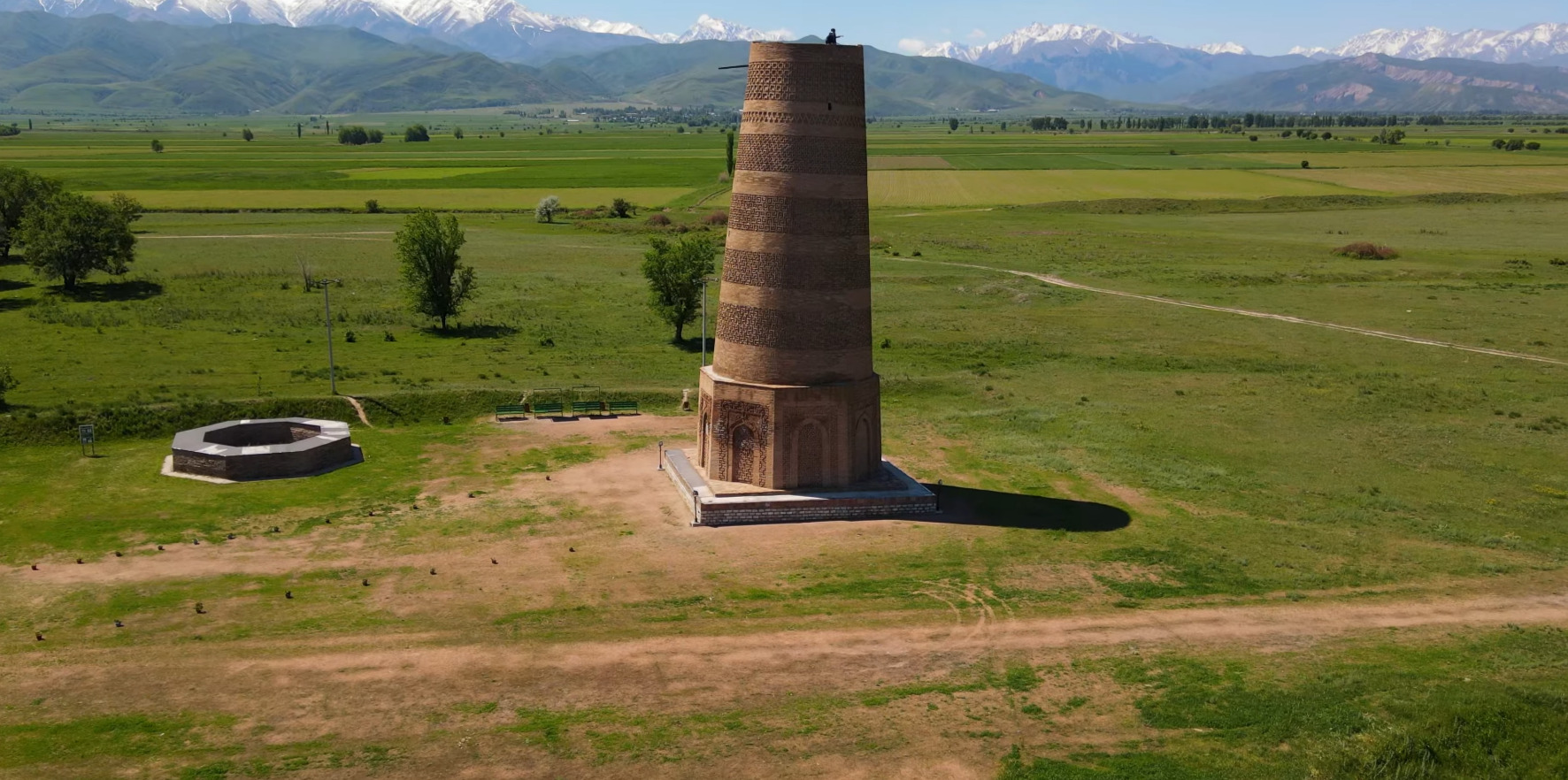
Burana doesn’t try to impress you from a distance. It just stands there — slightly off-center, surrounded by open land that feels bigger than the site itself.
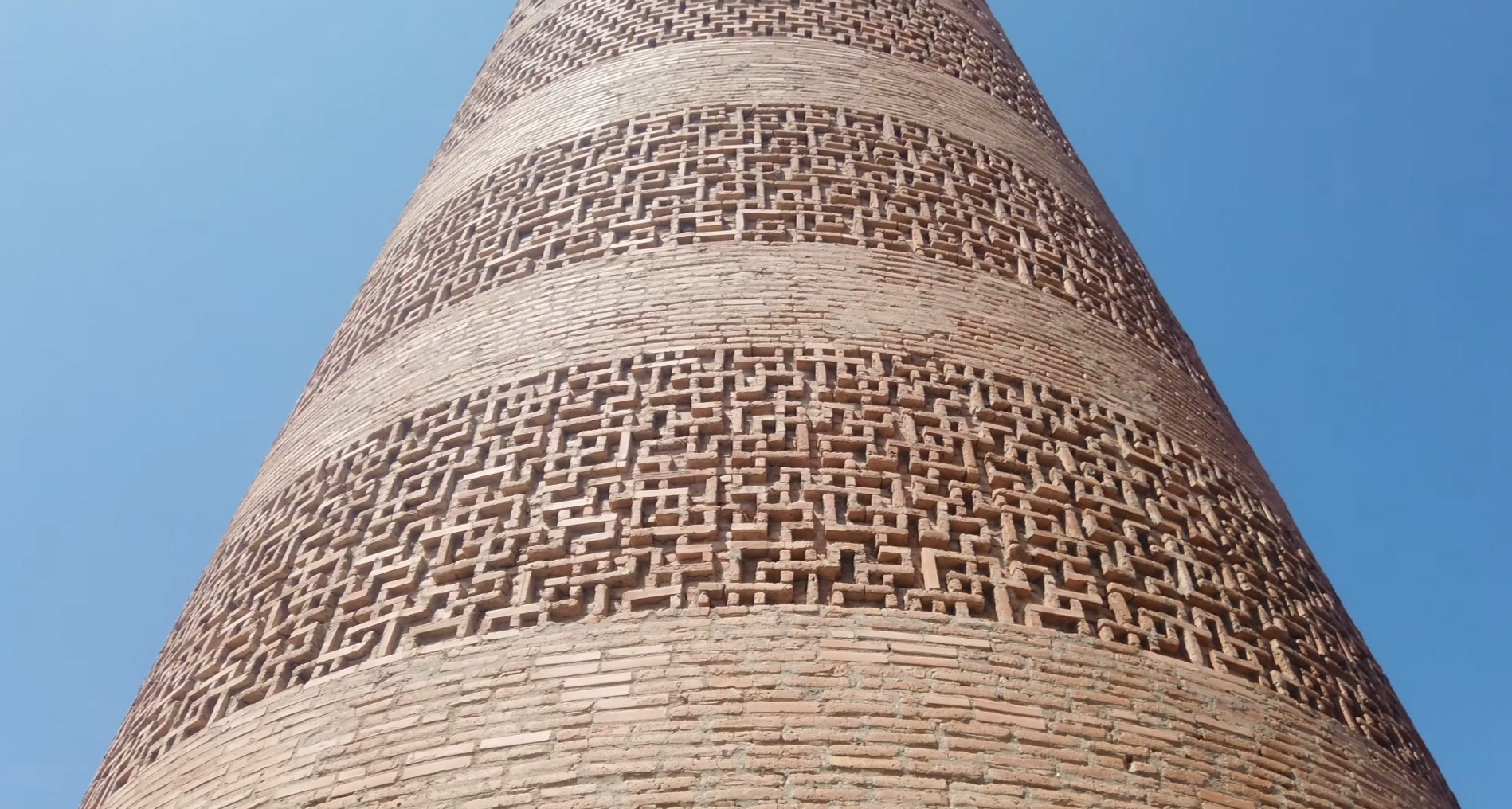
You walk in, and within minutes you’ve seen most of it. The tower, the scattered stone figures, the small museum. You climb the narrow staircase, step out at the top, and suddenly the scale flips — not because the tower is huge, but because everything around it is so flat, so open.
It’s a quick stop. Thirty minutes, maybe an hour if you take it slow.
The Drive That Changes the Day
After Burana, the route settles into something quieter. Less structured. Longer stretches without stopping.
The land starts shifting again. Flat turns uneven. Colors dull, then sharpen. The road cuts through rock, then opens, then narrows again. You pass through spaces that don’t feel like destinations, but they’re doing something — adjusting your sense of scale without announcing it.
And by the time you reach the parking area near the canyon, the day already feels different from how it started.
Entering Konorchek Canyon
The entrance doesn’t look like much.
A wide, dry riverbed. Stones. Dust. No dramatic viewpoint, no immediate payoff. If anything, it feels underwhelming for the first few minutes.
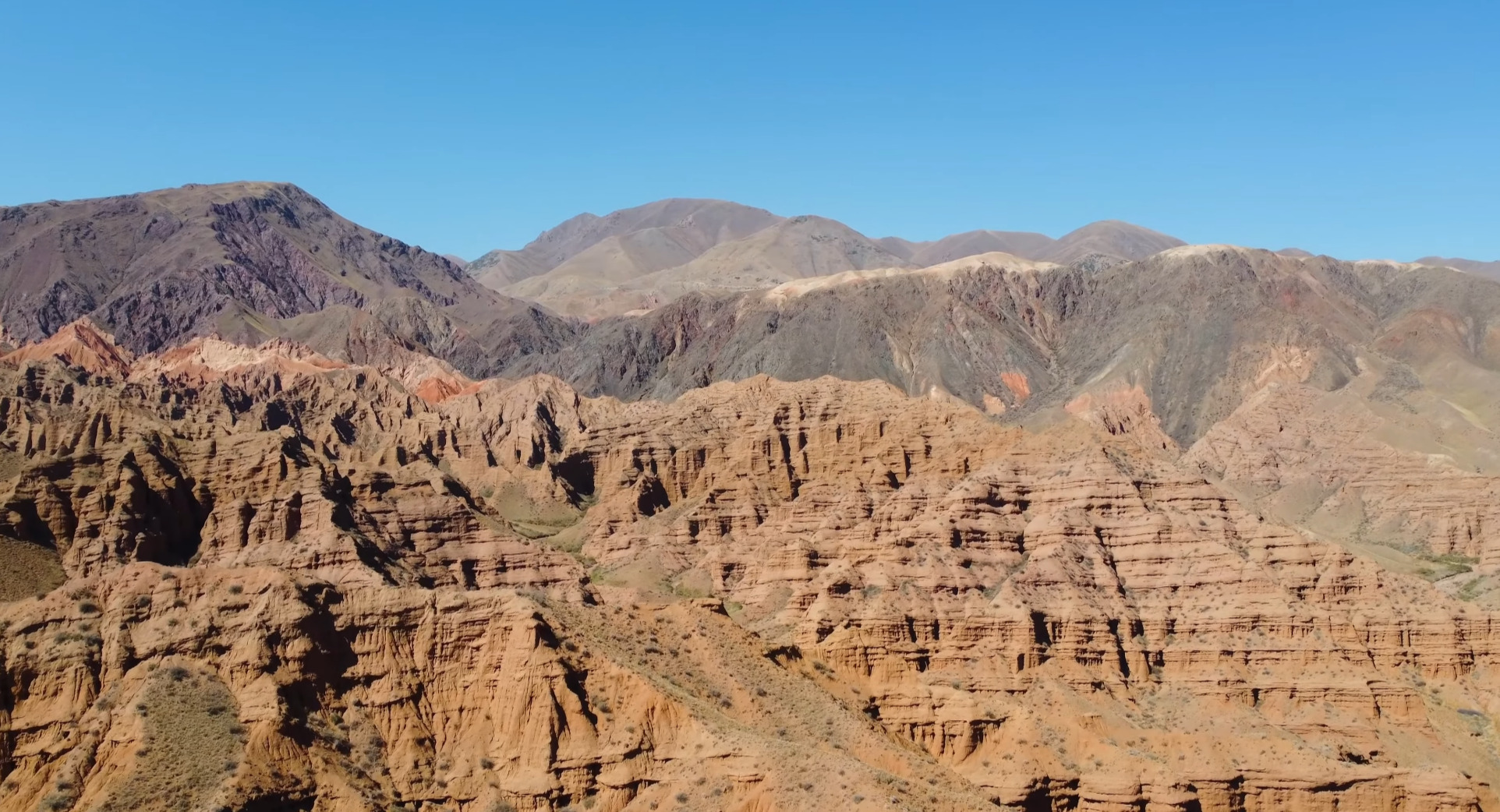
Then you keep walking.
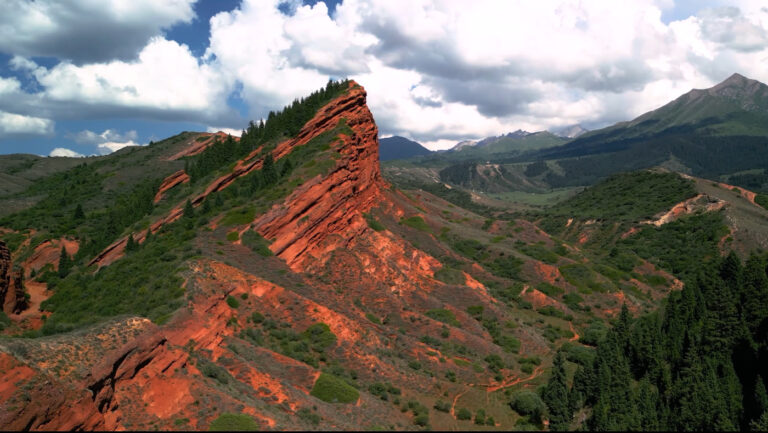
The walls start to rise slowly, almost casually at first. The path narrows without forcing you to notice. The colors shift — reds, browns, sharper contrasts against the sky.
And somewhere along that path, without a clear marker, you realize you’re inside it now.
Not looking at it. Inside.
Konorchek Canyons: What the Hike Is Really Like
Once you’re inside Konorchek, the day finally stops feeling like a transfer between points and turns into something physical. You’re not standing and looking anymore — you’re moving, adjusting your footing, choosing where to step next.
Distance and Route
Most routes into Konorchek follow a dry riverbed — wide at first, almost flat, scattered with stones and sand. It doesn’t look like a trail in the classic sense. No clear markings, no built path. Just direction.
Typical distance:
- ~2–3 km one way for standard tours
- up to ~4–5 km if the group goes deeper
The first stretch feels easy. Open space, minimal elevation, nothing technical. You could mistake it for a casual walk at that point.
That impression doesn’t last.
As you move further in, the terrain shifts. The ground becomes uneven, stones get larger, and the canyon walls begin to guide your path whether you want them to or not.
Difficulty (What It Actually Feels Like)
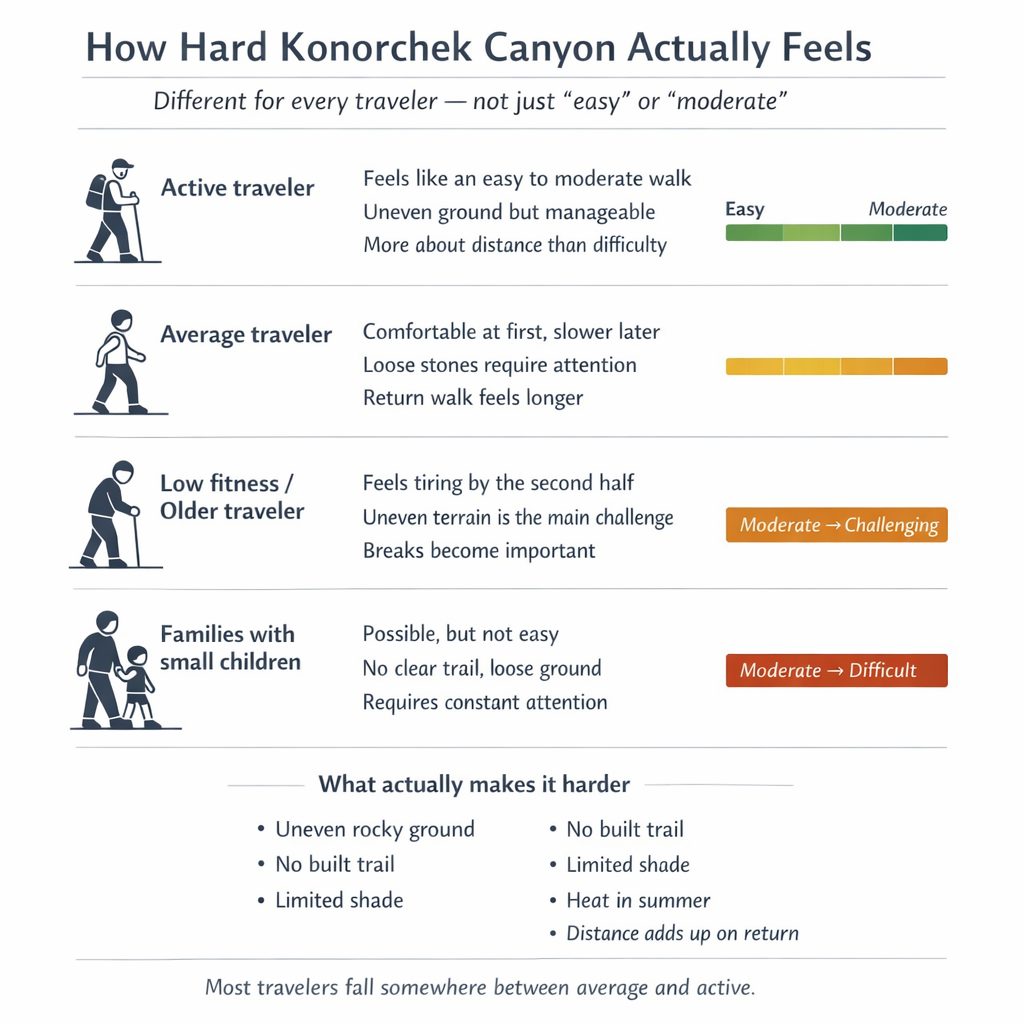
This is where expectations usually break a bit.
A lot of descriptions call it “easy” — and technically, it’s not a mountain hike. No ropes, no exposure, no steep climbs. But it’s also not a flat walk you can forget about.
You’re constantly adjusting:
- stepping over loose rocks
- crossing uneven ground
- occasionally using your hands for balance
There are sections where you climb small rock steps — nothing dramatic, maybe one or two meters at most — but enough to slow the pace and make you think about movement again.
Add the heat, the dryness, the lack of shade… and it builds. Not exhausting, but noticeable.
By the time you turn back, most people feel it in their legs. Not in a bad way — more like you’ve actually done something, not just observed it.
How Hard It Feels for Different Travelers
| Traveler Type | How Konorchek Usually Feels |
|---|---|
| Active traveler | Easy to moderate |
| Average traveler | Manageable, but uneven underfoot |
| Older traveler | Possible, but the return walk may feel tiring |
| Families with small children | Only if everyone is comfortable with loose stones and no built trail |
What the Landscape Feels Like
Konorchek doesn’t hit you all at once.
It’s not like arriving at a viewpoint and getting a postcard shot. The scale is hidden at first, then slowly revealed as the walls rise higher and the space narrows around you.
Colors shift depending on the light — deep reds, dusty browns, sometimes almost orange. The textures are sharp, layered, almost carved. You start noticing patterns in the rock, then shapes, then entire formations that look like something intentional even though they’re not.
And then there’s the silence.
Wind, footsteps, maybe distant voices from another group — but mostly it’s just… contained. The canyon absorbs sound differently. It feels enclosed, even when the sky above is completely open.
Where the Experience Peaks
There isn’t a sign telling you “this is the best part.”
Usually it’s a wider section deeper inside, where the formations open up and the space finally breathes again. After walking through narrower passages, that expansion hits differently. You feel it.
People slow down here. Sit on rocks. Take longer breaks than planned.
Not because they’re tired — though they might be — but because this is the moment where the canyon makes sense as a place, not just a path.
And then, eventually, you turn back.
The way out is faster. Familiar ground, less uncertainty. But it doesn’t feel like repetition. The light has shifted, the angles are different, and you notice things you missed on the way in.
Burana Tower: What It Adds to the Day (and What It Doesn’t)
By the time you reach Burana, you’ve already left the city behind — but the day hasn’t fully started yet. That’s the strange role this place plays. It feels like the beginning, even though it’s technically the first stop.
You arrive, step out, and there’s no buildup. No crowds pulling you in, no layered streets to explore. Just a tower standing in open space, slightly isolated, almost too simple at first glance.
And that simplicity is the point.
What Burana Tower Actually Is
- the brick minaret itself
- stone balbals displayed around the site
- small archaeological remains
- a compact museum visit in some tour formats
Burana is what remains of the ancient city of Balasagun, once a key stop along the Silk Road. What you see today is a fragment — not a preserved city, not a reconstructed complex. A fragment that stayed.
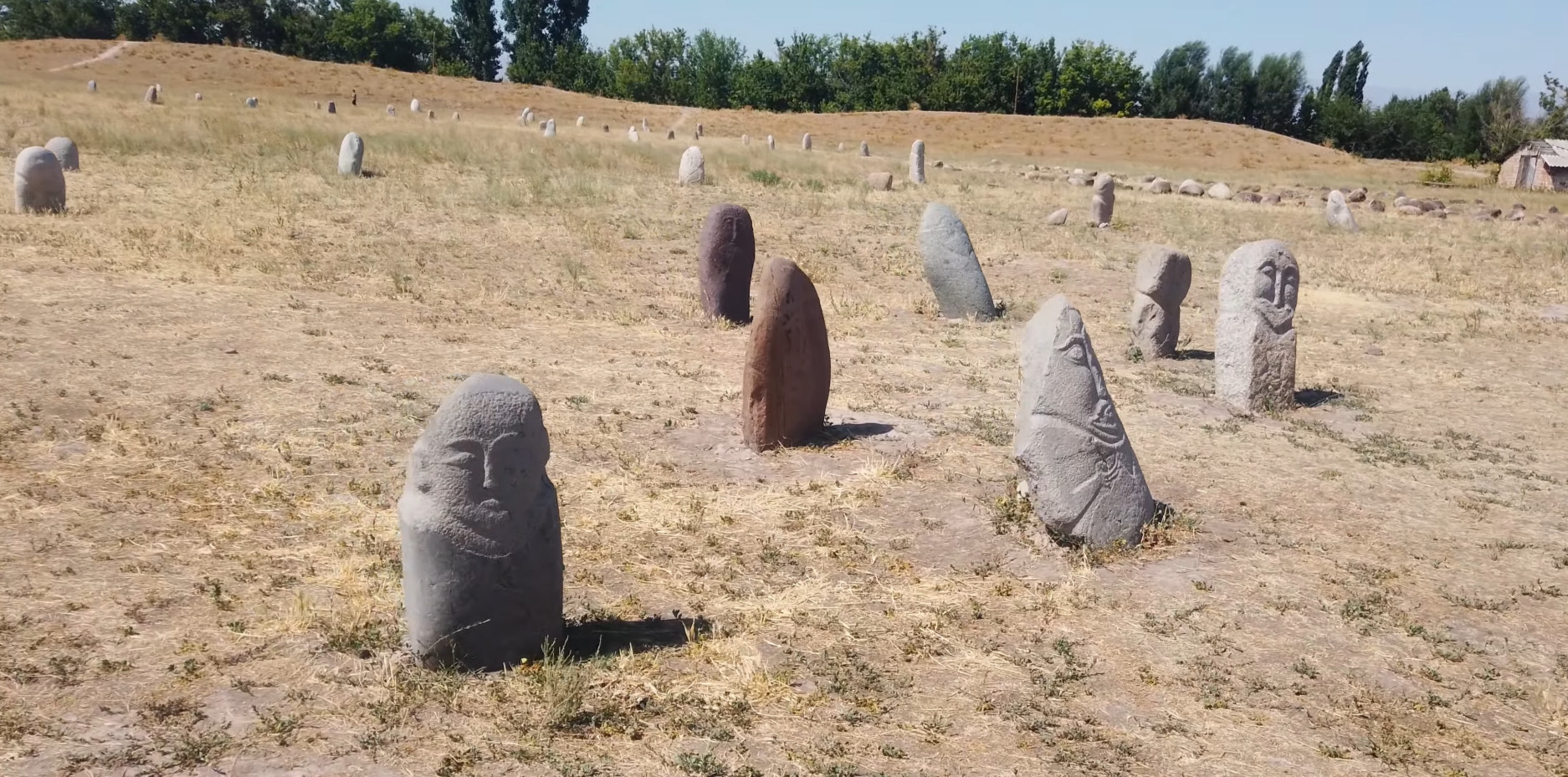
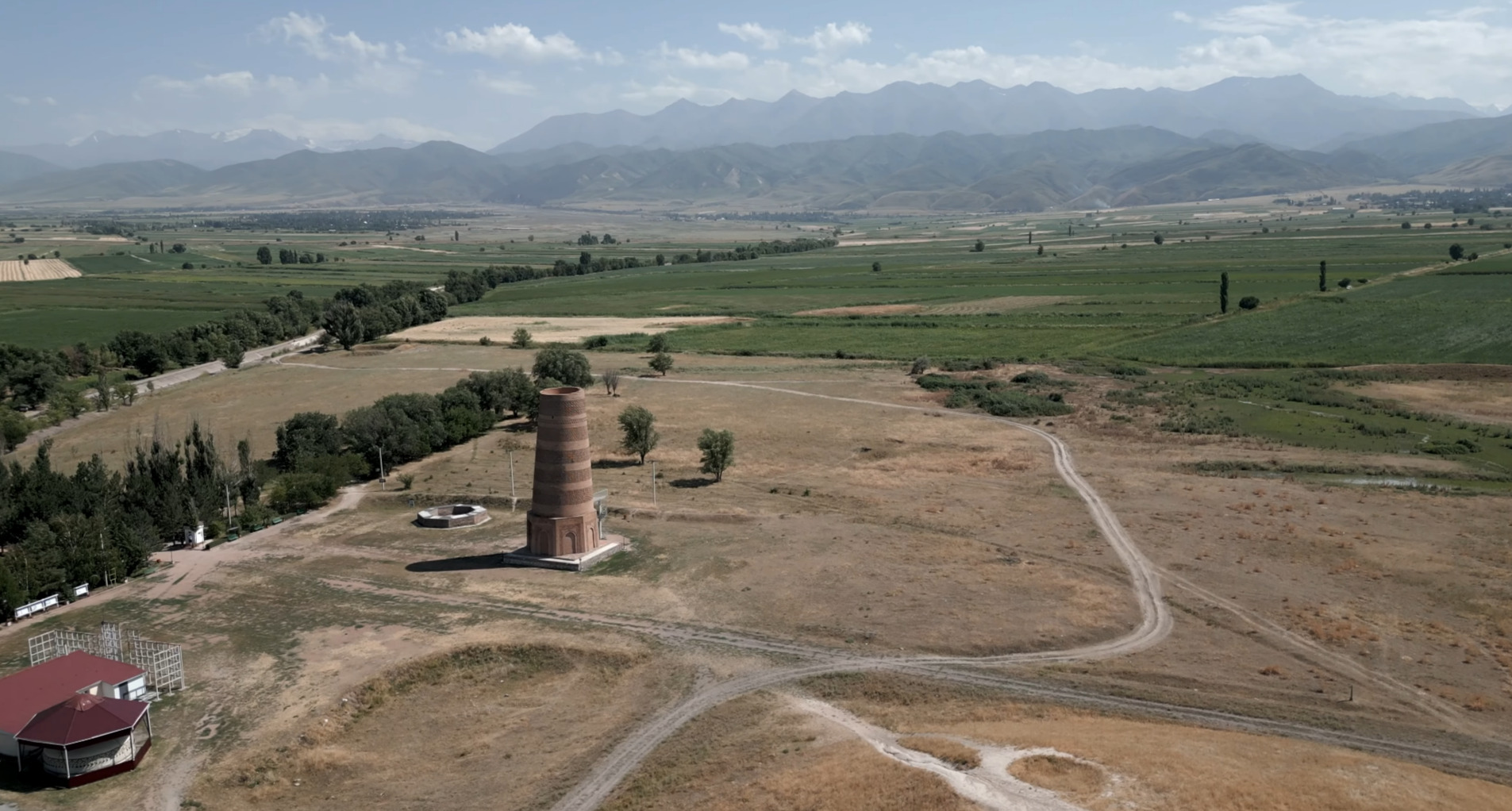
The tower itself rises out of flat land, surrounded by scattered stone figures (balbals), low ruins, and a small museum nearby. Everything is spread out, not dense. You don’t move from building to building — you move across space.
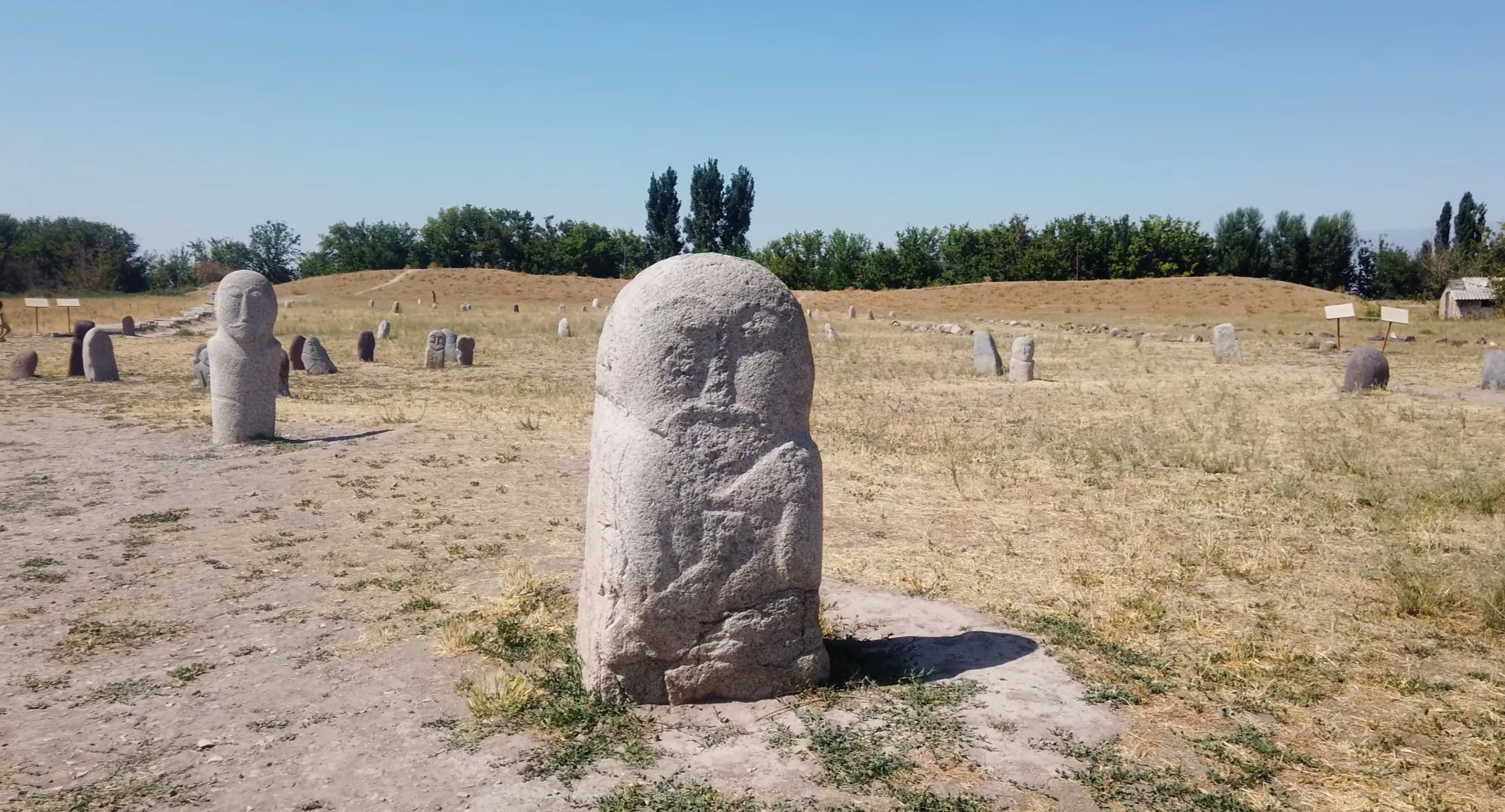
The layout is simple: the tower, a small museum area, scattered balbals, and open ground around them. Most visitors understand the site within minutes and then head up the tower.
Climbing the Tower
The staircase is narrow. Steep. Dim in places. You don’t linger inside — you just move upward.
Then you step out at the top, and suddenly the perspective flips.
It’s not the height that makes it interesting. It’s what surrounds it. Flat land stretching in every direction, mountains faint in the distance, no obvious center. You get a sense of how exposed this place is — how small the structure feels against the landscape.
How Much Time You Actually Spend Here
This is where expectations need to be reset.
- Typical stop: 30–60 minutes
- Fast visits: ~20 minutes
- Longer visits (with museum): up to 1 hour
There isn’t a full “exploration loop” like in larger historical sites. Once you’ve seen the tower, walked past the balbals, and maybe stepped into the museum — you’ve covered it.
No hidden sections. No second layer waiting behind the first impression.
Why It’s Included in Almost Every Tour
Because it works — structurally.
Not as a highlight, but as a transition.
It gives the day a starting point. A reason to leave early. A place that feels different from the city, but not overwhelming yet. You ease into the trip here, rather than being thrown straight into the canyon.
It also breaks the drive. Without it, the route would feel like a long transfer straight into hiking. With it, the day has layers.
What Most People Expect (and Why That Doesn’t Match Reality)
The name “Burana Tower” sounds bigger than the experience itself.
People expect:
- a large historical complex
- multiple structures
- a longer, deeper visit
What they get instead:
- one main structure
- open surroundings
- a short, self-contained stop
That gap can feel disappointing — if you think this is the main event.
It isn’t.
Once you understand that Burana is just the first layer of the day, the experience clicks into place.
What Burana Actually Contributes to the Trip
It slows the start down.
You don’t rush straight into physical activity. You walk, observe, adjust to the environment. The openness, the quiet, the lack of density — it resets your pace before the canyon does the opposite.
It also anchors the day in something human. History, movement, trade routes, the idea that this space used to connect things rather than isolate them.
Then you leave — and the landscape gradually takes over.
By the time you reach Konorchek, Burana already feels distant. Almost like it belongs to a different trip.
But without it, the day would feel flatter.
Distance, Travel Time, and What the Day Actually Feels Like Logistically
On paper, this is a short day trip. The distances don’t look intimidating, the map doesn’t suggest anything extreme, and everything fits comfortably into a single day.
But the way that time is distributed — that’s where the reality shifts a bit.
How Far Everything Actually Is
From Bishkek, the route looks roughly like this:
- Bishkek → Burana Tower: ~80 km (1.5–2 hours)
- Burana → Konorchek parking area: ~60–90 km (1.5–2 hours)
- Return to Bishkek: ~2–3 hours depending on pace and stops
Total driving distance:
- ~160–250 km round trip
Nothing extreme. But it adds up.
By the end of the day, you’ve spent a significant amount of time in the car — not constantly, but in long enough stretches that you feel the transitions between stops.
That also affects how the day feels physically. Even if the hike itself is manageable, the combination of road time, dry air, sun exposure, and an afternoon return drive can make the trip feel fuller than the map suggests.
The Road Itself
Leaving Bishkek, the road is smooth and predictable. Straight sections, open views, very little that demands attention.
After Burana, it changes.
The route starts cutting through more rugged terrain. You enter sections of Boom Gorge — rock walls closer to the road, tighter passages, less of that wide-open feeling.
It’s not a difficult drive, but it becomes more visually engaging. You stop looking at your phone. You start watching the road again.
That shift matters. It prepares you for what’s coming next without announcing it directly.
Where Time Actually Goes
Most people assume the day is evenly split between stops.
It isn’t.
| Part of the Day | Time Spent |
|---|---|
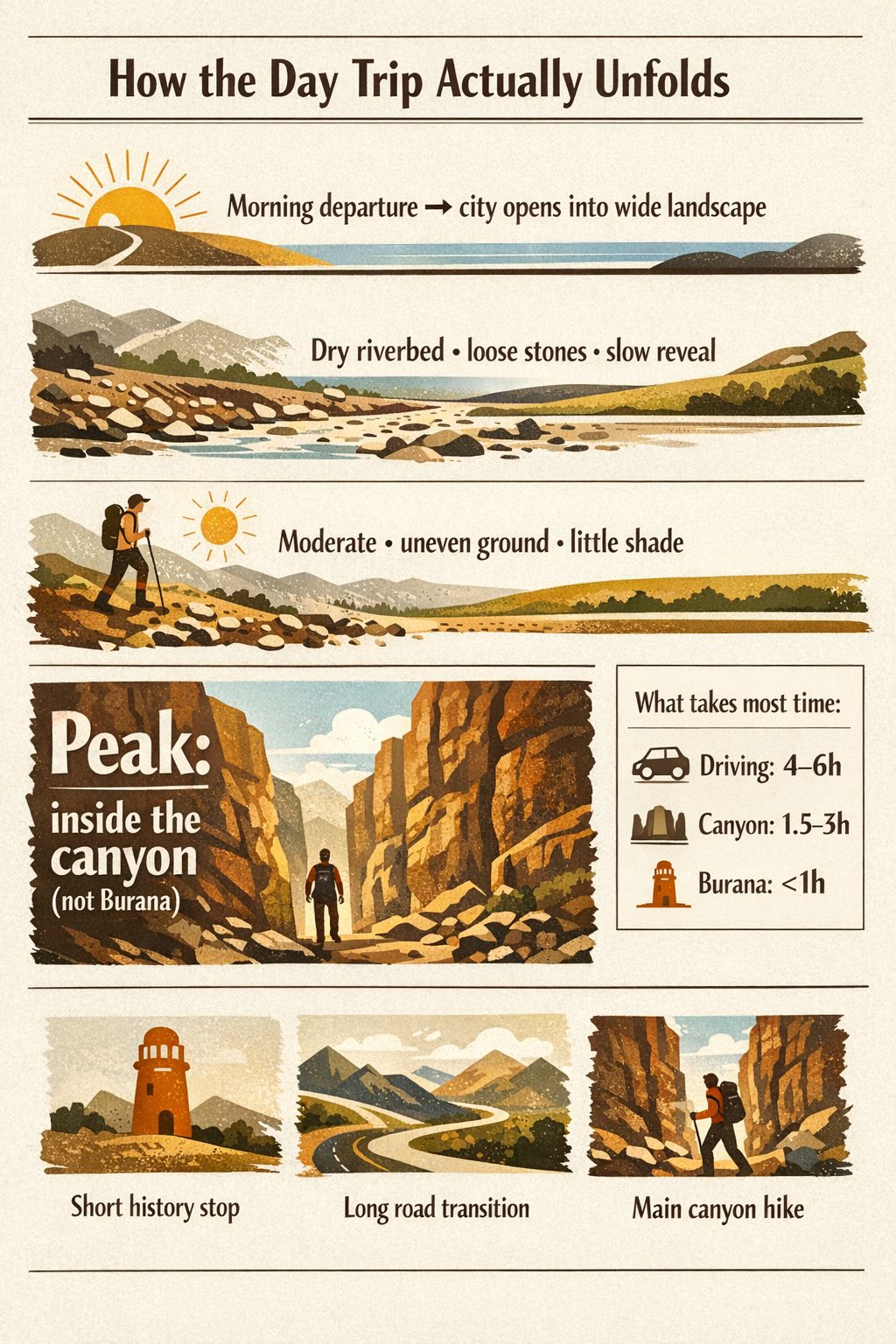
| Driving | 4–6 hours total |
| Burana Tower | 30–60 minutes |
| Konorchek Canyon hike | 1.5–3 hours |
So even though the canyon is the highlight, the day is built around movement — not just the destination.
That’s why pacing matters more than distance.
Typical Timeline of the Day
Most tours follow a similar rhythm, even if the exact timing shifts slightly.
- 08:00–09:00 — Departure from Bishkek
- 10:00–11:00 — Arrival at Burana Tower
- 11:00–13:00 — Drive toward Konorchek area
- 13:00–16:00 — Hiking inside the canyon
- 16:00–18:00+ — Return to Bishkek
That middle block — the hike — is where the day peaks.
Everything before it builds up to it. Everything after it winds down from it.
When You Start Feeling It
There’s a point in the afternoon, usually on the way back, where the day catches up with you.
Not dramatically. Just a shift.
You’ve walked for a couple of hours, the terrain wasn’t completely easy, the sun has been there the whole time… and now you’re back in the car, sitting still again.
That contrast makes the fatigue more noticeable.
It’s not exhaustion. More like a slow drop in energy.
Conversations get quieter. People look out the window more. Some fall asleep without planning to.
And that’s normal. It’s part of the structure of the day.
Why the Logistics Matter More Than Expected
Because this isn’t a “walk around and leave” type of trip.
You’re committing to:
- a few hours of driving
- a real (if moderate) hike
- a full day outside the city
If you understand that going in, the day feels balanced.
If you don’t, it can feel longer than expected.
Practical Things to Know Before You Go
What to Wear
Closed shoes with decent grip are a much better choice than sandals or smooth-soled sneakers. The canyon floor is uneven, dusty, and scattered with loose stones.
Water, Sun, and Shade
The canyon can feel hotter than expected because shade is limited for much of the walk. Bring enough water for a few hours outside the vehicle, especially in warmer months.
Food and Comfort
This is not always a food-focused day trip. Some itineraries include a simple stop for lunch, while others leave meals flexible or separate. It is better to assume a practical road-day setup rather than a relaxed restaurant experience.
Who Should Think Twice
Travelers who dislike uneven footing, prolonged car time, or sun exposure may find this day more tiring than expected, even though it is not a difficult trekking route.
Best Time of Year for This Day Trip
Spring
Spring usually gives the most comfortable balance for this route: milder temperatures, clearer walking conditions, and a softer feel to the drive out of Bishkek.
Summer
Summer works, but the canyon can feel much hotter than travelers expect. Shade is limited, and the return walk can feel harder in the afternoon heat.
Autumn
Autumn is often one of the best seasons for this trip. Temperatures are usually more stable, and the canyon walk feels less draining than in peak summer.
Winter
Winter trips are possible, but comfort depends much more on road conditions, wind, and how much time the group actually spends outside at each stop.
Not All Day Trips Are the Same
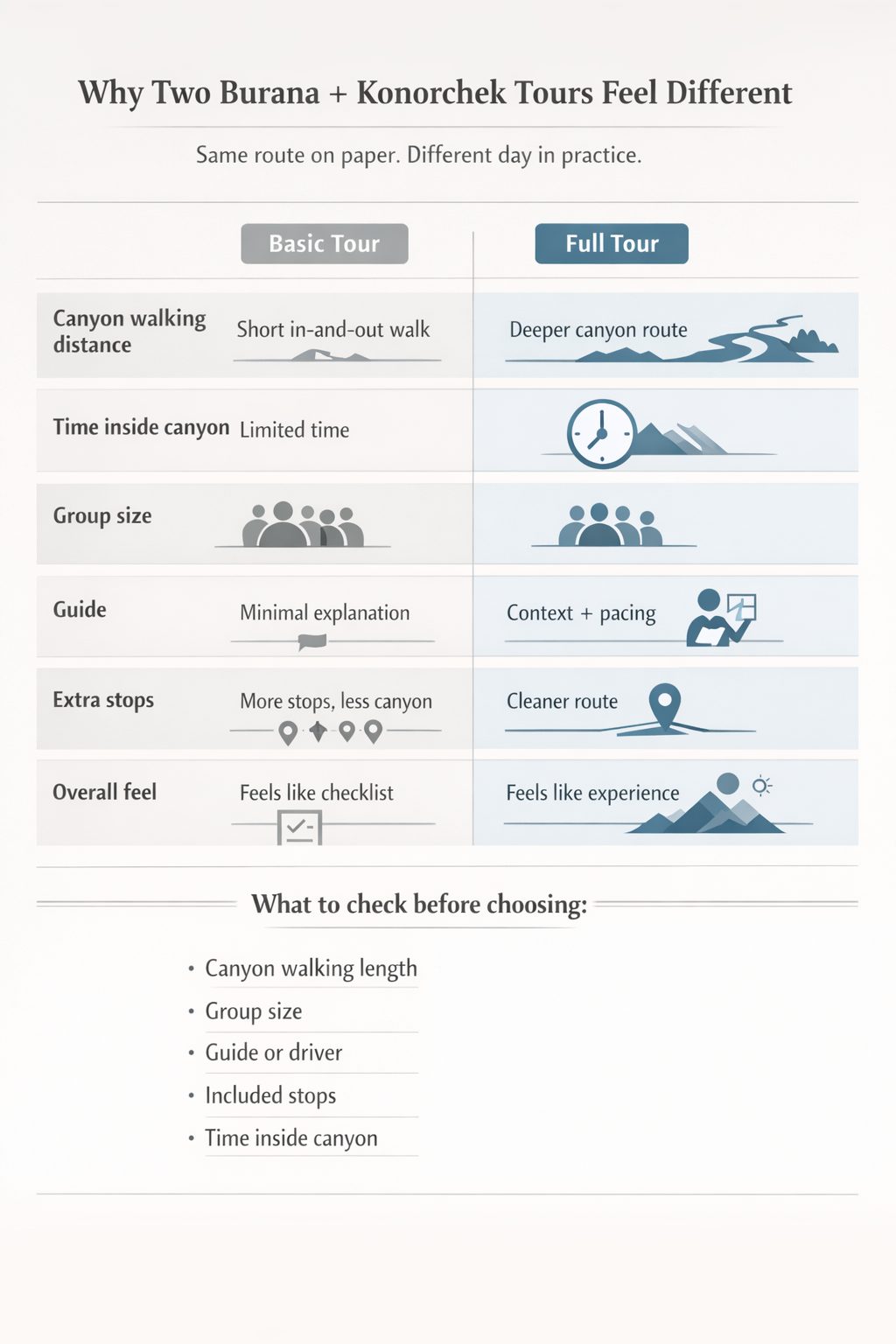
At a glance, most day trips to Burana Tower and Konorchek Canyon look identical.
Same two locations. Same duration. Same general route.
But once you look closer — or actually experience one — the differences start to show. Not in the obvious places, but in the details that shape how the day feels.
And those details matter more than the headline itinerary.
The Factors That Actually Change the Experience
| Factor | What Changes | Why It Matters |
|---|---|---|
| Hiking length | 1–2 km vs 4–5 km | Defines how deep you go into the canyon |
| Group size | 4–6 vs 10–15 people | Affects pace, waiting time, flexibility |
| Guide vs driver | Explanation vs basic transport | Changes how Burana is experienced |
| Route variation | Direct vs extended stops | Impacts overall energy and timing |
Most listings don’t highlight these differences clearly. They focus on what you’ll see — not how you’ll experience it.
But the “how” is where the real variation is.
Hiking Length: The Hidden Variable
This is the biggest one — and the least obvious.
Some groups barely go into the canyon. They walk in far enough to see the formations, spend some time there, then turn back.
Others go deeper. Not dramatically further in distance, but enough to change the experience completely.
The deeper routes:
- feel more immersive
- have fewer people
- include more varied terrain
Shorter routes:
- are easier physically
- feel more like a stop than a journey
- can feel rushed if the group is large
And here’s the key part — this difference is rarely stated clearly in advance.
Group Size and Pace
Group size doesn’t sound like a big deal at first. But inside the canyon, it changes everything.
In smaller groups:
- movement is smoother
- less waiting at narrow sections
- easier to adjust pace naturally
In larger groups:
- the pace becomes uneven
- frequent stops to regroup
- less flexibility to go further or explore side paths
You feel this most in tighter sections of the canyon, where movement naturally slows down.
It’s not a deal-breaker — but it changes the rhythm of the hike.
Prefer to control the pace?
A private trip makes more sense if you are traveling as a couple, family or small group and do not want your canyon pace determined by other travelers. This route includes hotel pickup, Burana Tower, Boom Gorge, around three hours at Konorchek and a traditional lunch.
The trade-off: It costs more than joining a small group, and private transport does not make the canyon itself easier. You still need to be comfortable with uneven ground and several short climbing sections.
The private format is most useful inside Konorchek, where a flexible pace and fewer regrouping stops matter more than they do at Burana.
Guide vs Driver: Why It Matters More at Burana
Inside the canyon, you don’t need much explanation. The experience is physical, visual, immediate.
At Burana, it’s different.
Without context, it’s just a tower in an open field. You walk around, take a look, and leave without really understanding what you saw.
With a guide:
- the Silk Road context becomes clearer
- the purpose of the site makes sense
- the stop feels intentional, not random
So while the canyon carries itself, Burana depends heavily on how it’s explained — or not explained.
Route Variations and “Extra Stops”
Some tours add more to the itinerary:
- roadside viewpoints
- local food stops
- extensions toward Issyk-Kul
These can go two ways.
In some cases, they enrich the day — breaking up the drive, adding variety, giving you a bit more context.
In others, they dilute it.
More stops mean:
- less time inside the canyon
- more time getting in and out of the vehicle
- a more fragmented experience
There’s a balance here, and it’s not always obvious from the outside which side a tour falls on.
What Looks the Same — But Isn’t
From the outside, most tours follow the same formula:
- Burana Tower
- Konorchek Canyon
- full-day duration
But the actual experience depends on how those elements are handled:
- how deep you go into the canyon
- how fast or slow the group moves
- how much context you get at the historical stop
That’s where the real differences are.
And that’s why two people can do “the same tour” and come back with completely different impressions.
What to Check Before Choosing a Day Trip
- how long the canyon walk actually is
- whether entrance fees are included
- if lunch is included or just a roadside stop
- whether the trip includes a guide or mainly transport
- if extra stops reduce time inside the canyon
- how large the group usually is
Who This Day Trip Works Best For
This is one of those trips that works really well — if you come in with the right expectations.
Not because it’s complicated, but because it’s structured in a very specific way: part driving, part walking, part observing. It’s not intense in any one direction, but it touches a bit of everything.
For some people, that balance is exactly the point.
Good Fit If You:
- want to get out of Bishkek without overplanning
- prefer light hiking over full-day trekking
- like variety — history, landscape, movement in one day
- have limited time but still want a “real” experience outside the city
It’s especially strong as a first step into Kyrgyzstan beyond the capital. You don’t go too far, but you go far enough to feel the shift.
Also Works Well If You’re Not Sure Yet
Some trips require commitment — long hikes, remote locations, early starts that don’t leave room for hesitation.
This one doesn’t.
It gives you a controlled version of that experience. You step into nature, but not too deep. You walk, but you’re never completely out of reach of the road. You get a sense of scale without having to fully commit to it.
For a lot of travelers, that’s exactly what they’re looking for without realizing it.
Who Might Want Something Different
At the same time, this trip doesn’t try to be everything.
And if you’re expecting something more specific, it can feel slightly off.
Not Ideal If You:
- want a deep historical experience (Burana is too short for that)
- expect dramatic viewpoints without walking
- prefer minimal time in the car
- are looking for a more challenging hike
None of these are problems with the trip itself — they’re just mismatches in expectation.
If you’re after something more focused, there are better options.
Burana and Konorchek vs Other Day Trips from Bishkek
This trip sits somewhere in the middle — not the easiest, not the most demanding, not the most remote.
And that’s what makes it interesting to compare.
| Day Trip | Main Experience | Best For |
|---|---|---|
| Ala-Archa National Park | Mountain scenery and more continuous hiking | Travelers who want a more outdoor-focused day |
| Burana + Konorchek | Short history stop plus moderate canyon walking | Travelers who want variety in one day |
| Issyk-Kul Lake | Longer driving day with scenic stops and lakeside views | Travelers who prefer scenery over hiking |
If Ala-Archa is about going into the mountains, and Issyk-Kul is about distance and scenery, this one is about transition — moving through different environments in a single day.
Have two days instead of one?
A two-day route expands the idea of this trip rather than simply stretching the same canyon walk. It combines Burana Tower and Konorchek with Kok-Moinok Canyon, Issyk-Kul and an overnight stay in a lakeside yurt.
- Private two-day route from Bishkek
- Burana Tower, Konorchek and Kok-Moinok
- Issyk-Kul and one night in a yurt camp
- Hotel pickup and the meals listed in the itinerary
Choose it for variety, not depth: The second day adds another canyon and the lake, but it does not mean spending two full days inside Konorchek. A focused one-day tour is still the better fit if Konorchek itself is your main priority.
A strong extension of the one-day route: Burana and about three hours in Konorchek on day one, followed by Issyk-Kul, a yurt stay and more south-shore scenery. Choose it for variety, not for extra time inside Konorchek itself.
What Most People Misunderstand About This Trip
They think it’s about the locations.
Two names, two points on a map, one day connecting them.
But the locations themselves are only part of it.
Burana is brief. The canyon has no single defining viewpoint. Neither one, on its own, would justify the whole day for most people.
What makes it work is everything in between.
The gradual shift out of the city. The way the land opens, then tightens. The moment the canyon closes around you after hours of open space.
That sequence — that’s the actual experience.