Bishkek to Song-Kul Lake: Real Transport Options, Routes and Costs
Getting from Bishkek to Song-Kul Lake is one of the Kyrgyzstan routes that looks simple on a map and becomes confusing as soon as you start planning the transport. Song-Kul is one of the country’s most memorable high-altitude lake and yurt experiences, but it is not a place where you simply take a normal public bus from Bishkek and step out beside the water.
Song-Kul sits at about 3,016 meters above sea level. That altitude explains why transport, weather, warm clothing, yurt-camp season and mountain-pass conditions matter much more here than they do around lower destinations in Kyrgyzstan.
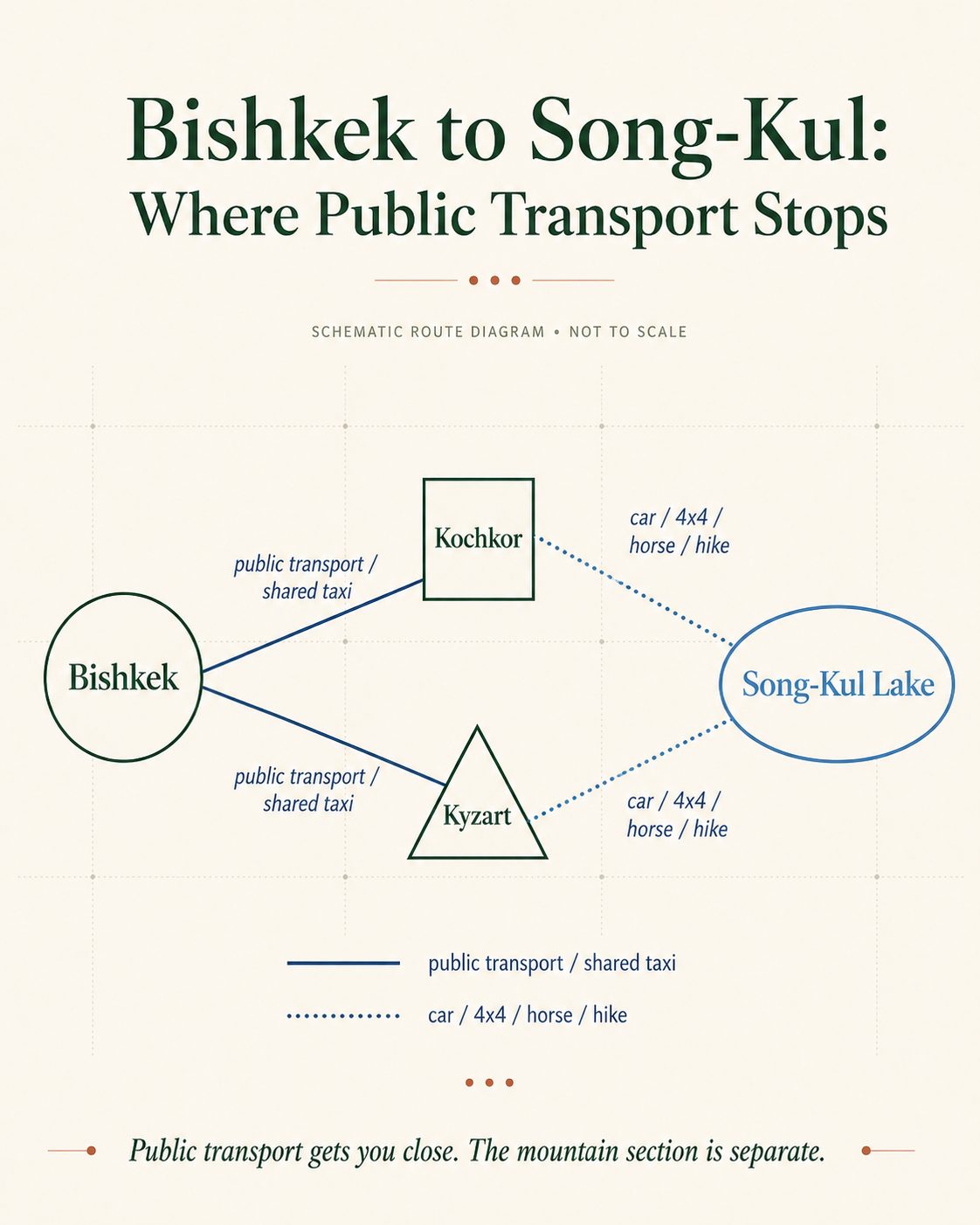
The real route is a chain of choices. You first travel from Bishkek to a gateway town, usually Kochkor or Kyzart. From there, you arrange the mountain section separately by private car, 4×4, local transfer, horse trek, hike or arranged trip.
This guide explains the real transport options from Bishkek to Song-Kul Lake, including routes via Kochkor, Kyzart and Naryn, how much time you need, rough cost expectations, when the road is open, and what to ask before booking transport or a yurt camp.
Route reality: Think of Bishkek to Song-Kul as two trips: Bishkek to a gateway town, then gateway town to the lake. Public transport can help with the first part, but not usually with the final mountain section.
Current route on Google Maps.
Can You Travel Directly from Bishkek to Song-Kul?
You can travel directly from Bishkek to Song-Kul only with a private driver, arranged trip, rental car or pre-arranged transfer. You should not plan on taking a regular public bus directly from Bishkek to a Song-Kul yurt camp.
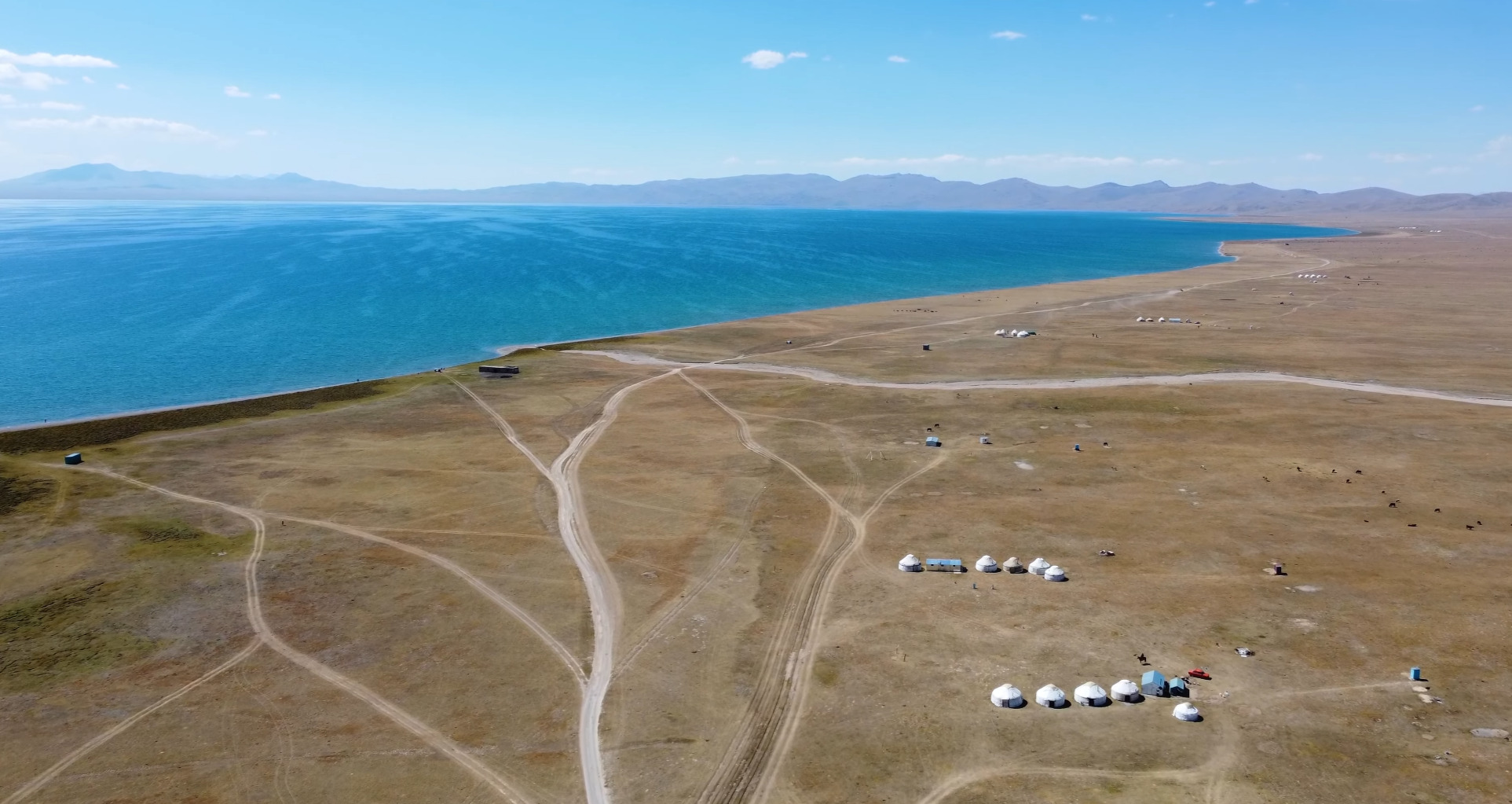
This is the first point to understand. Song-Kul is not like Issyk-Kul, where towns and villages sit around the lake with regular transport links. Song-Kul is a high mountain lake in Naryn Region, surrounded by open jailoo pastures, seasonal yurt camps, livestock and mountain roads. Public transport serves towns and villages. It does not reliably serve the lakeshore camps.
For independent travelers, the usual pattern is:
- Bishkek to Kochkor by bus, marshrutka or shared taxi;
- Kochkor to Song-Kul by local car, 4×4, horse trek, hike or arranged transfer;
- overnight in a yurt camp;
- return to Kochkor, continue to Naryn or follow another onward route.
Another option is Bishkek to Kyzart, then horse trek or hike to Song-Kul. This is better for travelers who want the journey itself to be part of the experience.
A one-day trip from Bishkek to Song-Kul is technically possible with a long private drive, but it is not a good plan for most travelers. You will spend most of the day in the car and very little time at the lake. Song-Kul is best when you sleep there, see the evening or morning light, and spend at least a little time walking, riding or simply sitting outside the yurt.
Best minimum: 2 days / 1 night.
Better for most travelers: 3 days / 2 nights.
Quick Answer: Best Ways to Get from Bishkek to Song-Kul
There is no single best route for every traveler. The right option depends on your time, budget, comfort level and whether you want a simple lake visit or a more active journey.
| Best For | Route | Summary |
|---|---|---|
| Easiest route | Bishkek → private driver or arranged trip → Song-Kul | Most convenient, more expensive, simplest for a short itinerary |
| Best value | Bishkek → Kochkor → local transfer | Cheaper and flexible, but requires local arranging |
| Best adventure | Bishkek → Kyzart → horse trek or hike | Best if you want the journey to feel active |
| Onward Naryn route | Bishkek → Song-Kul → Naryn | Useful for Tash Rabat, Kel-Suu or a wider Naryn Region itinerary |
| Self-drive | Bishkek → Kochkor → mountain pass → Song-Kul | Only for confident drivers in the right season |
The easiest route is not the cheapest. The cheapest route is not the smoothest. The most memorable route may involve horses or hiking, but it needs more time and preparation.
The strongest value option for a short Song-Kul trip: shared transport from Bishkek, a yurt night and the main lake route are arranged without the cost of a fully private tour.
The Three Main Gateways: Kochkor, Kyzart and Naryn
The most useful way to plan Song-Kul transport is to stop thinking only about Bishkek and start thinking about the gateway towns. For most travelers, that means Kochkor, Kyzart or Naryn.
| Gateway | Best For | Why Use It | Main Drawback |
|---|---|---|---|
| Kochkor | Most first-time travelers | Easiest logistics, guesthouses, local drivers, yurt contacts, horse trek arranging | You still need onward transport to the lake |
| Kyzart | Horse treks and hikes | Good starting point for active routes to Song-Kul | Less convenient than Kochkor if you arrive without a plan |
| Naryn | Onward regional routes | Useful if continuing to Tash Rabat, Kel-Suu or deeper Naryn Region | Not the simplest route if Song-Kul is your only goal |
Kochkor: The Easiest Gateway
Kochkor is the most practical gateway for independent travelers going from Bishkek to Song-Kul. It is a small town, but it has guesthouses, local travel organizers, drivers, horse trek contacts and yurt camp connections. If you want a simple independent route without paying for a full Bishkek-based trip, Kochkor is usually the best place to start.
You can reach Kochkor from Bishkek by public transport or shared taxi. Once there, you arrange the mountain section separately. This can mean a car to a yurt camp, a 4×4 transfer, a horse trek or a hiking route with transport to a trailhead.
Kochkor is also a good place to spend the night before Song-Kul. Arriving late and trying to continue straight to the lake can create unnecessary stress.
Kyzart: The Best Gateway for Horse Treks and Hikes
Kyzart is better if you want an active route to Song-Kul rather than just a car transfer. Many horse treks and hiking routes begin from Kyzart village or nearby Kyzart Pass.
Some recent traveler reports mention marshrutka 534 from Bishkek’s New Bus Station to Kyzart, with daytime departures and fares around 500-600 KGS. Treat this as a useful lead, not a guaranteed schedule. Ask at the station or your guesthouse before building your plan around it.
If the direct Bishkek to Kyzart option does not work, go Bishkek to Kochkor first, then arrange a transfer onward to Kyzart or Kyzart Pass.
Kyzart is ideal for travelers who want Song-Kul to feel like a journey: horses, open passes, yurt stays, slow movement and a stronger sense of the landscape.
Naryn: The Gateway for Onward Routes
Naryn is not usually the easiest first gateway if your only plan is Bishkek to Song-Kul and back. It becomes useful when Song-Kul is part of a wider route through Naryn Region.
Choose a Naryn-side route if you want to continue to Tash Rabat, Kel-Suu Lake or other remote parts of central Kyrgyzstan. For this style of trip, a private driver or 4×4 is much more practical than trying to stitch everything together with public transport.
Scenario 1: Private Driver or 2-Day Trip from Bishkek
The simplest way to get from Bishkek to Song-Kul is to book a private driver or arranged 2-day trip. This is the easiest option for travelers who are short on time, carrying luggage, traveling as a couple or family, or simply do not want to manage local transfers.
A typical 2-day route looks like this:
- Day 1: Leave Bishkek in the morning.
- Optional stop at Burana Tower, Boom Gorge or Orto-Tokoy Reservoir.
- Drive to Kochkor.
- Continue over the mountain road toward Song-Kul.
- Arrive at a yurt camp.
- Dinner and overnight at the lake.
- Day 2: Breakfast, short walk or horse ride, then return to Bishkek.
This route is comfortable because someone else handles the vehicle, yurt booking, meals, timing and road decisions. It is not necessarily easy in terms of driving hours. Bishkek to Song-Kul is still a long mountain journey.
This option is best if:
- you have only 2 days;
- you want to sleep at Song-Kul without planning all the logistics;
- you are traveling with family or luggage;
- you want pickup in Bishkek;
- you prefer one clear price with transport, yurt and meals included;
- you want to combine Song-Kul with other stops on the way.
The main downside is cost. A private-style 2-day Song-Kul trip from Bishkek often costs in the low hundreds of dollars per person, depending on group size, vehicle, accommodation, meals, guide or driver language, and what is included. The price usually drops if more people share the vehicle.
The second downside is pace. Two days is the minimum realistic version, not the slow version. You will get the lake, the yurt night, the road experience and some time outside. You will not get a relaxed horse trek or much buffer for bad weather.
For travelers who dislike long driving days, 3 days is a better plan.
Scenario 2: Bishkek to Kochkor, Then Local Transfer to Song-Kul
This is the best value route for many independent travelers. You use public transport or shared transport from Bishkek to Kochkor, then arrange the Song-Kul section locally.
Step 1: Bishkek to Kochkor
Start from Bishkek’s New Bus Station rather than relying on old blog advice that mentions the former Western Bus Station. Recent traveler reports place the New Bus Station around Alma-Atinskaya 1/1, but you should still confirm the current departure point before you go.
From Bishkek, you can usually reach Kochkor by marshrutka, bus or shared taxi. Allow several hours for the journey, plus waiting time. Shared taxis can be faster but cost more and usually leave when full. Marshrutkas are cheaper but less flexible.
When you arrive in Kochkor, do not assume you can instantly continue to the lake, especially late in the day. Song-Kul is not just “one more local bus.” This is where the mountain logistics start.
Step 2: Arrange the Lake Section in Kochkor
Kochkor is where you can arrange:
- local car transfer to Song-Kul;
- 4×4 or high-clearance vehicle;
- yurt camp accommodation;
- meals at the yurt camp;
- horse trek from Kyzart or nearby areas;
- return transport;
- onward route to Naryn if needed.
Guesthouses can often help. Local agencies and community tourism contacts may also arrange drivers, horses, guides and yurt stays. Ask what is included before you agree: transport, meals, yurt, guide, horses, return transfer and pickup or drop-off points.
Practical tip: If you arrive in Kochkor late in the day, do not expect a smooth same-day Song-Kul transfer. Sleep in Kochkor, arrange the lake section properly, and leave early the next morning.
Step 3: Kochkor to Song-Kul
The usual car route from Kochkor goes toward the mountain passes that lead onto the Song-Kul plateau. One of the common access routes from the Kochkor side is Kalmak-Ashuu Pass, a high mountain pass at about 3,446 meters. It is usually opened after snow clearing near the end of May and closes when serious snow arrives in autumn, but tourist camps and nomadic families may leave the lake earlier than the road’s theoretical closure.
Exact routing depends on road conditions, season, driver preference and where your yurt camp is located.
Before leaving Kochkor, confirm:
- which yurt camp you are going to;
- whether the driver waits or returns later;
- whether return transport is included;
- what time you leave the lake;
- whether meals are included;
- whether horse riding is extra;
- whether you can continue onward to Naryn instead of returning to Kochkor.
This route is cheaper and more flexible than a full private trip from Bishkek. It also requires more patience. Choose this route when you have time, flexibility and comfort with local arranging.
Scenario 3: Bishkek to Kyzart, Then Horse Trek or Hike
Kyzart is the best gateway if you want to reach Song-Kul by horse or on foot. This changes the trip completely. Instead of treating Song-Kul as a place you drive to, you make the journey across the landscape part of the experience.
Some recent traveler reports mention marshrutka 534 from Bishkek’s New Bus Station to Kyzart, with daytime departures and fares around 500-600 KGS. This is useful information, but it should not be treated as a permanent timetable. Schedules in Kyrgyzstan can change, and you should confirm locally before building your whole plan around one marshrutka.
If the direct Bishkek to Kyzart option does not work, go Bishkek to Kochkor first, then arrange a transfer to Kyzart or Kyzart Pass.
From Kyzart, common options include:
- 2-day horse trek to Song-Kul;
- 3-day horse trek with a slower pace;
- hike from Kyzart Pass to the lake;
- horse trek one way and vehicle return;
- yurt overnight at or near the lake.
If you want the longer journey arranged as one trip from Bishkek, this three-day option combines the road transfer with the horse trek to Song-Kul.
The stronger choice for a real Song-Kul adventure, with transport from Bishkek, two nights on the route and several hours of horseback riding through the Kyzart and Kilemche landscapes.
If you are comfortable reaching Kyzart independently, the local-start option avoids paying for a complete Bishkek-based package.
A more local and potentially cheaper way to do the classic Song-Kul horse route, starting directly in Kyzart with horses, a horse guide and meals arranged.
This is the best option if you want open pastures, riding, slow views and a more traditional-feeling journey. It is not the best option if you only want quick transport to the lake.
Before booking a horse trek, ask:
- how many hours per day you will ride;
- whether the route is suitable for beginners;
- whether a guide is included;
- whether helmets are available;
- where you sleep;
- what meals are included;
- how luggage is carried;
- where the trek starts and ends;
- whether your travel insurance covers horse riding.
Horse trekking is one of the most memorable ways to visit Song-Kul, but it is still a physical activity at altitude. Even in summer, the lake area can be windy and cold. Bring warm layers and waterproof protection.
For more planning context, see this guide to horse riding tours in Kyrgyzstan.
Scenario 4: Via Naryn or Continue from Song-Kul to Naryn
A Naryn-side route is not the simplest way to visit Song-Kul from Bishkek if the lake is your only goal. It becomes useful when Song-Kul is part of a larger central Kyrgyzstan itinerary.
This route makes sense if you want to travel:
- Bishkek → Song-Kul → Naryn;
- Bishkek → Song-Kul → Tash Rabat;
- Bishkek → Song-Kul → Kel-Suu;
- Bishkek → Kochkor → Song-Kul → Naryn → onward route.
This is a good structure if you want to see more than one remote place in Naryn Region. It can save backtracking compared with returning to Bishkek or Kochkor after Song-Kul.
The downside is logistics. You will probably need a private driver, 4×4 or carefully arranged local transport. Do not rely on random public transport between the lake and every onward destination. The roads, passes and schedules are too seasonal and too sparse for a casual plan.
If you are combining Song-Kul with Tash Rabat or Kel-Suu, build in buffer time. Mountain roads, weather, permits and long distances can make the route slower than it looks on a map.
Scenario 5: Self-Driving from Bishkek to Song-Kul
Self-driving to Song-Kul is possible in season, but it is not the right choice for everyone. The roads to the lake cross high mountain passes and include unpaved sections. Weather can change quickly, and the area is remote.
A high-clearance vehicle or 4×4 is strongly preferred. Some travelers may attempt the route in a normal car in good conditions, but that does not make it a good general recommendation. The issue is not only whether the road is technically open. It is whether you want to be responsible for a remote high-altitude gravel road if weather changes.
Kalmak-Ashuu Pass, one of the common Kochkor-side access routes, reaches about 3,446 meters. Even if the pass is open, rain, snow, mud or poor visibility can change the road experience quickly.
If you self-drive, prepare carefully:
- check pass and road conditions before leaving;
- do not drive to or from the lake at night;
- download offline maps;
- carry enough fuel before mountain sections;
- bring warm clothing and water;
- confirm your yurt camp location in advance;
- tell someone your route;
- avoid the route in bad weather unless you are experienced.
Self-driving is best for experienced travelers who are comfortable with mountain roads, remote areas and changing conditions. If that does not sound like you, hire a driver.
Which Route Should You Choose?
The best route depends on your time, budget, confidence and travel style.
| Traveler Type | Best Route | Why |
|---|---|---|
| First-timer with little time | Private 2-day trip from Bishkek | Simplest route, no local transport stress |
| Budget traveler | Bishkek → Kochkor → local transfer | Cheapest realistic route with flexibility |
| Horse riding traveler | Kochkor or Kyzart → horse trek | Best way to experience the landscape slowly |
| Trekker | Kyzart Pass route | More active and more rewarding than a car-only visit |
| Family | Private driver | Less uncertainty, easier with luggage and timing |
| Overland route | Song-Kul → Naryn | Better for Tash Rabat, Kel-Suu or wider Naryn Region |
| Self-driver | Kochkor side in season | Possible if confident with mountain roads |
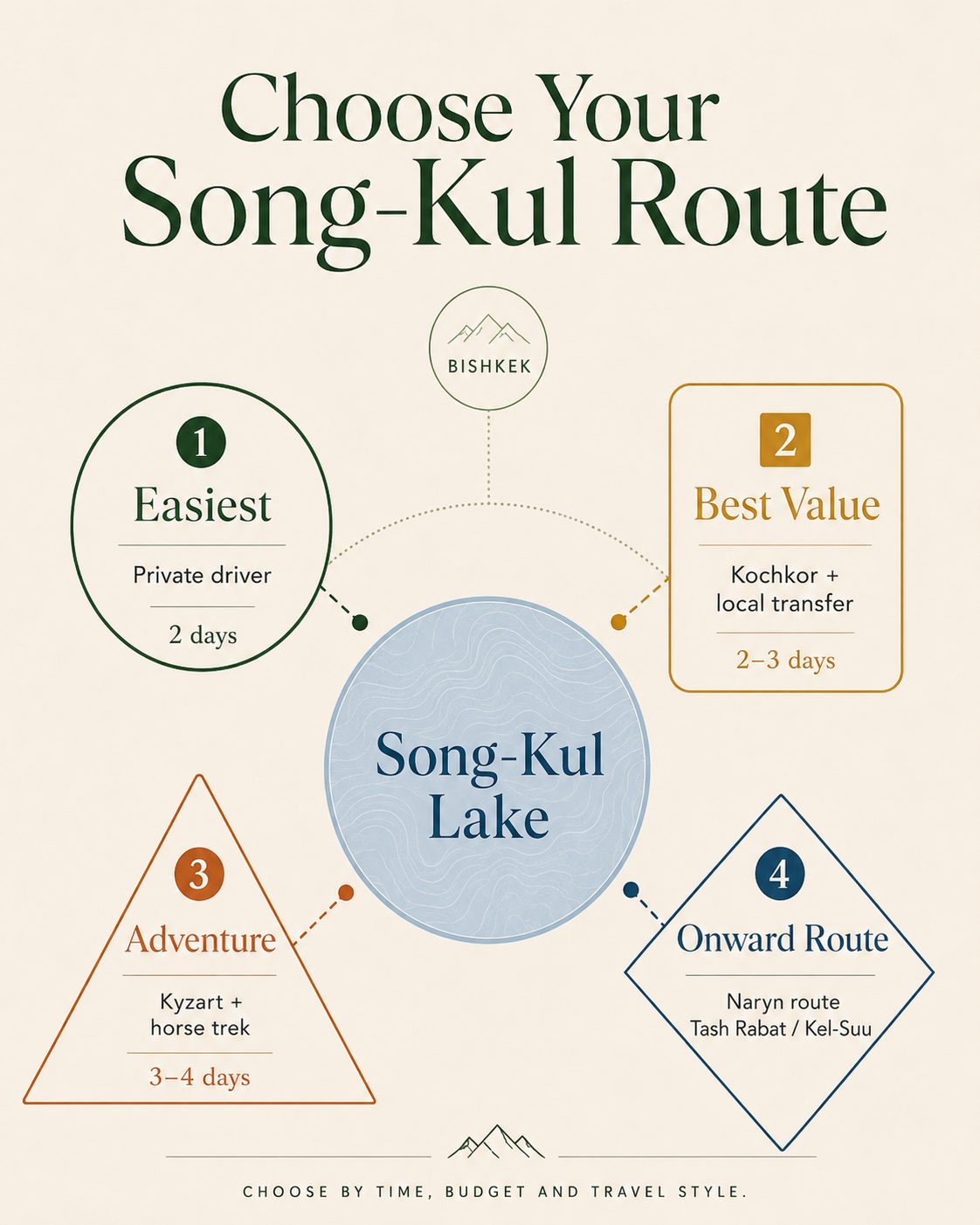
For most first-time visitors, the best overall choices are either a 2-day private-style trip from Bishkek or a self-organized route through Kochkor. For travelers who want the best experience rather than the fastest transport, a 3-day Kyzart horse trek is often more memorable.
How Much Time Do You Need?
Song-Kul is not a good place to rush. The lake sits high in the mountains, and much of the magic comes from slowing down: sunset, sunrise, horses, yurt life, silence, wind, stars and the feeling of open space.
| Time | Verdict | What It Feels Like |
|---|---|---|
| 1 day | Not recommended | Long drive, very little lake time, no real yurt experience |
| 2 days / 1 night | Minimum realistic trip | See the lake, sleep in a yurt, return the next day |
| 3 days / 2 nights | Best for most travelers | Better pace, horse ride or walk, sunset and sunrise, less stress |
| 4+ days | Best for active travel | Horse trek, hiking, slow route, more weather buffer |
Two days gets you to Song-Kul. Three days lets you feel Song-Kul.
If you do not sleep at Song-Kul, you are mostly paying for a long mountain drive, not the Song-Kul experience. The yurt night is not just accommodation. It is part of the reason to go.
How Much Does Bishkek to Song-Kul Cost?
The cost depends on how you break the route apart. A budget traveler using public transport to Kochkor and arranging locally will pay much less than a traveler booking a private vehicle from Bishkek. A horse trek costs more than a basic transfer but gives a very different experience.
Public Transport to a Gateway Town
Bishkek to Kochkor by public transport is the cheapest first step. Prices can change, but this is usually a low-cost route compared with private transfers. Bishkek to Kyzart may also be possible by marshrutka according to current local schedules, with recent traveler reports mentioning roughly 500-600 KGS. Confirm before relying on it.
Local Transfer to Song-Kul
From Kochkor, the next cost is the local transfer to Song-Kul. This depends on the vehicle, number of passengers, waiting time, exact yurt camp, return route, and whether you continue to Naryn or return to Kochkor.
Sharing a vehicle with other travelers can reduce the price. Guesthouses and local agencies may help connect people going the same way.
Yurt Stay
Yurt stays are usually seasonal. A yurt camp price may include dinner and breakfast, or meals may be charged separately depending on the arrangement. Ask before you go.
Do not expect hotel-style comfort at most Song-Kul yurt camps. Electricity, charging, showers, toilets and heating vary by camp, and some places are deliberately basic. Ask about bedding, stove or heating, toilet setup, and whether you need to bring a sleeping bag. Song-Kul nights can be cold even in summer.
Horse Trek
A simple 2- or 3-day horse trek is often quoted somewhere in the $150-250 per person range in recent traveler reports, depending on group size, route, guide, horses, yurt nights, meals and transfers. Cheaper or more expensive offers exist, so compare inclusions rather than only the headline price.
Private Trip from Bishkek
A 2-day private-style trip from Bishkek often costs in the low hundreds of dollars per person. The final price depends on group size, vehicle, driver or guide, meals, accommodation, pickup point, route, and whether extra stops are included.
For a wider sense of travel costs in the country, see this guide to Kyrgyzstan travel costs and budget.
Best Season for Bishkek to Song-Kul
Song-Kul is highly seasonal. Do not plan it the same way you would plan a city visit or a lower lake route.
The best general season is from mid-June to September. July and August are the safest months for most travelers because roads, yurt camps, horse services and local logistics are more likely to be operating.
Late May and early June can work only if the passes are open and camps are ready. Late September and October become riskier because weather changes, nights get colder, and camps may close. Winter, early spring and late autumn are not suitable for normal Song-Kul travel unless you are arranging a specialist trip.
Kalmak-Ashuu and other passes can be affected by snow. Even if a road is technically open, conditions can change. The practical question is not only “Is Song-Kul open?” It is “Are the passes open, are yurt camps operating, and do I have confirmed transport back?”
Bring warm clothes even in summer. Song-Kul is high, open and windy. Nights can feel cold, and weather can shift quickly.
For country-wide seasonal planning, use this guide to the best time to visit Kyrgyzstan.
What to Ask Before You Book Transport or a Yurt Camp
Before you pay or confirm anything, ask practical questions. This is more useful than only asking for a nice itinerary.
- Where exactly is the yurt camp?
- Is pickup from Bishkek, Kochkor, Kyzart or Naryn?
- Which route or pass will you use?
- Is the vehicle 4×4 or high-clearance?
- Is return transport included?
- Can I continue to Naryn instead of returning to Kochkor?
- Are dinner and breakfast included?
- Is lunch included?
- Is horse riding included or extra?
- Is bedding included?
- Do I need a sleeping bag?
- What happens if the pass is closed or weather changes?
- Do I need to pay in cash?
- What time do we leave the lake?
A good operator, driver or guesthouse should answer these questions calmly. Song-Kul is remote enough that vague answers can create real problems later.
What to Pack for Song-Kul
Even if you visit in summer, pack for mountain weather. Song-Kul is exposed, high and often windy.
- Warm jacket or fleece.
- Rain layer.
- Hat or beanie for evening.
- Comfortable shoes.
- Sun protection.
- Cash in small notes.
- Power bank.
- Offline maps.
- Water bottle.
- Snacks.
- Personal medicine.
- Toilet paper or tissues.
- Headlamp or small flashlight.
- Travel insurance details.
If you are horse riding, wear comfortable trousers and closed shoes. If you are trekking, check whether your route crosses high or exposed sections and pack accordingly.
For broader terrain context, read this guide to the mountains of Kyrgyzstan.
Common Mistakes to Avoid
Song-Kul is not difficult to enjoy if you plan honestly. Most problems come from treating it like an easy lake transfer.
- Thinking there is a normal bus directly to Song-Kul. Public transport gets you to gateway towns, not usually to the lakeshore.
- Using outdated Bishkek bus station advice. Check current departure points before going.
- Arriving in Kochkor too late. You may lose the chance to arrange a smooth same-day transfer.
- Trying Song-Kul as a one-day trip from Bishkek. It is too much driving for too little lake time.
- Booking 2 days when you really want horse trekking. Add a third day if the journey matters to you.
- Not confirming return transport. Getting to the lake is only half the plan.
- Not bringing warm clothes. Song-Kul can be cold even in summer.
- Assuming yurt camps operate all year. Most tourism services are seasonal.
- Self-driving without checking road and pass conditions. The mountain roads are not casual city roads.
- Not carrying cash. Do not rely on card payments at the lake.
- Confusing Kochkor and Kyzart routes. Kochkor is easier for logistics; Kyzart is better for horse treks and hikes.
FAQ: Bishkek to Song-Kul Lake
Can you get from Bishkek to Song-Kul by bus?
You can use public transport for part of the journey, usually from Bishkek to Kochkor or sometimes Kyzart, but there is no normal direct public bus from Bishkek to Song-Kul lakeshore yurt camps. The final mountain section usually requires a local car, 4×4, horse trek, hike or arranged transfer.
What is the easiest way to get to Song-Kul from Bishkek?
The easiest way is a private driver or arranged 2-day trip from Bishkek with transport, yurt stay and meals included. It costs more than independent travel but removes most of the logistics.
Is Kochkor or Kyzart better for Song-Kul?
Kochkor is better for most first-time independent travelers because it has more guesthouses, drivers, local agencies and yurt camp contacts. Kyzart is better if you want a horse trek or hiking route to Song-Kul.
How long does Bishkek to Song-Kul take?
It depends on the route and vehicle. Bishkek to Kochkor takes several hours by road, then the mountain section to Song-Kul takes additional time depending on pass, road conditions and yurt camp location. Treat it as a full travel day, not a quick transfer.
Can you do Song-Kul in one day from Bishkek?
It is technically possible with a private driver, but it is not recommended. You would spend most of the day driving and get very little time at the lake. Song-Kul is much better with at least one overnight in a yurt.
Do you need a 4×4 for Song-Kul?
A 4×4 or high-clearance vehicle is strongly preferred, especially when road conditions are rough or weather changes. Some vehicles may reach the lake in good conditions, but it is safer to plan around mountain-road reality rather than best-case conditions.
How much does it cost to get to Song-Kul?
Costs vary widely. Public transport to Kochkor is the cheapest first step. Local transfers, yurt stays, horse treks and private drivers add more. A simple 2- or 3-day horse trek is often quoted around $150-250 per person in recent traveler reports, depending on route and inclusions. Private Bishkek-based trips often cost in the low hundreds of dollars per person depending on group size and inclusions.
Can you go to Song-Kul without a tour?
Yes, but you still need to arrange the final section. The usual independent route is Bishkek to Kochkor, then local transfer, horse trek, hike or yurt camp arrangement from Kochkor or Kyzart.
When is the road to Song-Kul open?
The normal travel season is roughly mid-June to September, with July and August being the safest months for most travelers. Passes can open earlier or close later depending on snow, but yurt camps and transport services are seasonal.
Is horse riding necessary at Song-Kul?
No. You can visit Song-Kul by car and stay in a yurt without horse riding. Horse riding is one of the best experiences at the lake, but it is optional. If you are a beginner, ask how long the ride is and whether it is suitable for your level.
Can I continue from Song-Kul to Naryn?
Yes, it can be arranged, especially with a private driver or local transfer. This is useful if you want to continue toward Tash Rabat, Kel-Suu or other parts of Naryn Region. Do not assume public transport will be available from the lake without planning.
What should I pack for Song-Kul?
Pack warm layers, rain protection, comfortable shoes, sun protection, cash, snacks, water, power bank, offline maps, personal medicine and a headlamp. Nights can be cold even in summer.